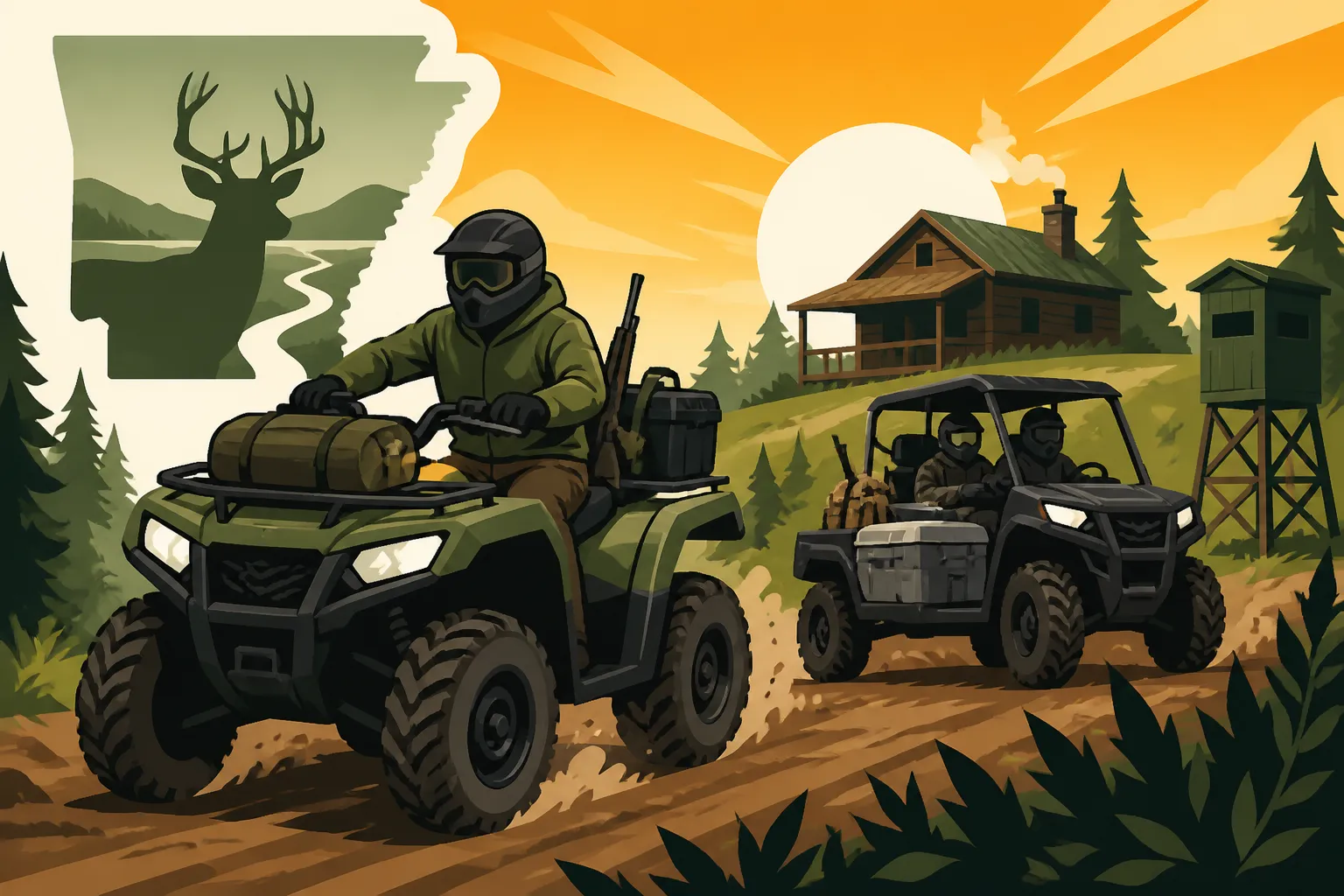
Travel To and From a Hunting Camp
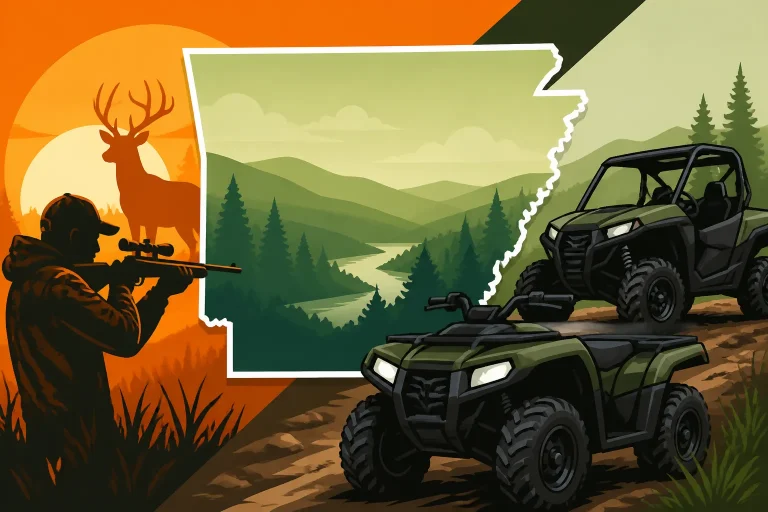
A hunting camp can make an Arkansas WMA trip easier, but it does not give an ATV or UTV blanket access to the area. The key question is whether the route is allowed for motor vehicles and whether a hunting-related exception applies to your situation. Here’s how to think through travel between camp and hunting ground without treating a narrow allowance as permission to ride anywhere.
What “travel to and from camp” means
On some Arkansas wildlife management areas, rules include a limited allowance for hunters to use a motor vehicle to travel to and from a hunting camp. The important point is that this is a specific, restricted purpose—not a general right to ride trails, explore the WMA, or drive directly to a hunting spot.
The route matters as much as the reason for the trip. A camp allowance does not automatically make a closed road, gated route, food plot, levee, or other restricted area open to vehicles. It also does not mean every WMA has the same rule. Check the regulations for the particular area and the dates of your trip before unloading a machine. Start with Arkansas AGFC WMA Rules for Riders and confirm whether the WMA is among Arkansas WMAs Named in the Exception List.
A useful way to interpret the allowance is to ask three questions:
- Are you traveling for the stated hunting-camp purpose? A ride for recreation or sightseeing is different from travel between camp and a hunting destination.
- Is the route open to motor vehicles? Use only roads or routes that the area allows for vehicle travel.
- Does the area’s rule apply to this WMA, season, and type of use? A rule that applies elsewhere should not be assumed to apply here.
If any answer is unclear, do not assume the machine is allowed. Contact the appropriate wildlife management area office or the Arkansas Game and Fish Commission before the trip. A short confirmation can help avoid a citation, a turned-around trip, or damage to a closed road.
Camp is not permission to ride off-road
“Travel to and from camp” describes a purpose for using an allowed route. It should not be read as permission to leave that route and cross fields, woods, or other ground to shorten the trip. Nor does it authorize riding around a gate because the camp is nearby.
The rule is especially easy to misread when a camp sits close to a hunting area. A rider may see a worn track leading toward a stand or food plot and assume it is part of the camp route. Unless the track is open to vehicle use, that assumption is risky. Check the posted signs and the WMA’s current vehicle rules rather than relying on tire marks or another visitor’s route.
Check the route before you ride
The safest plan is to identify your camp, destination, and legal route before leaving home. WMA road access can be limited by signs, gates, seasonal restrictions, management work, or conditions on the ground. A road that looks passable is not necessarily open to ATVs or UTVs.
Use the WMA’s official map and current regulations together. A map can show roads and boundaries, while the regulations explain whether vehicle use is allowed and under what conditions. Review Arkansas WMA Roads Open to Vehicles before planning the route. Pay particular attention to routes marked closed or restricted, and do not treat an unmarked trail as an open road without confirmation.
| Situation | Practical approach |
|---|---|
| A posted road is open to vehicle travel | Stay on the road and follow any posted limits or directions. |
| A gate or cable blocks the route | Do not go around, under, or through the barrier. Check for another authorized route. |
| A track is visible but not shown or posted as open | Do not assume it is legal for vehicle use; confirm with the area manager. |
| The route crosses a food plot, levee, or dam | Check the specific WMA rules. These areas may be closed even when nearby roads are open. |
| You need to leave the road to reach a stand | Do not rely on the camp allowance as permission to cross closed ground. |
| Your route enters a national forest or another managed area | Check that area’s separate access and permit rules as well. |
Gates and cables are clear signals to stop, not obstacles to work around. Review Arkansas WMA Gated and Cabled Barriers if you need to understand how barriers affect access. Also check Arkansas WMA Food Plots and Fire Lanes before planning a route near planted openings, fire lanes, or other managed areas. A vehicle route that appears convenient on a phone map may cross land where riding is not allowed.
Do not assume a road is open because it is gravel, maintained, or used by another vehicle. Roads may be closed to recreational riders, limited to specific users, or subject to temporary restrictions. If signs conflict with an older map or a route-planning app, follow the posted restriction and seek clarification.
Separate WMA access from permits and registration
A hunting-camp exception, a WMA access permit, an OHV permit, and ATV registration serve different purposes. Having one does not automatically satisfy the others.
A WMA rule determines where and when a machine may be used on that area. Some WMAs have additional permit requirements, including certain leased lands. Check whether the place you plan to hunt is one of the Arkansas Leased Lands Permit WMAs and verify what permit applies before traveling. A permit does not turn a closed road into an open one.
Forest OHV permits are another separate matter. If your route or riding plans involve a national forest OHV area, check the applicable forest requirements rather than assuming a WMA rule covers that travel. Arkansas OHV Permits: Two Forests, Two Prices explains why forest access can involve a different pass system. A forest permit does not replace WMA rules, and a WMA permit does not automatically authorize riding in a national forest area.
Vehicle registration is also distinct from land access. Arkansas registration or a decal does not, by itself, grant permission to ride on a WMA road or trail. Likewise, an out-of-state registration decal is not a substitute for checking the rules of the area you plan to visit. See Arkansas WMA Access for a Quad and Arkansas Hunting License and Quad Access for related questions about access and hunting status.
Before the trip, make a short checklist:
- Confirm the exact WMA and the dates you will be there.
- Read the current vehicle rules for that WMA, including any hunting-season limits.
- Confirm that the route from camp to your destination is open to your type of machine.
- Check whether the area requires a separate permit.
- If you will enter a national forest or private riding area, check that location’s requirements separately.
- Carry any required permit or proof of authorization, and keep your machine on the allowed route.
This separation is useful when planning a mixed trip. For example, a group may camp near a WMA, ride on a permitted forest trail, and hunt on a WMA during the same weekend. Those activities can involve different land managers and rules. Do not assume that the permission for one part of the trip follows you to another.
Plan for the return trip, too
Travel to camp is only half the route. The same restrictions apply when you leave camp, return from a hunting location, or retrieve equipment. A legal trip to a camp does not create an unrestricted route back. Keep the same boundaries in mind on every leg, including after dark or when weather makes the route harder to recognize.
Before departure, save or print the official map and regulations, and note the roads you are authorized to use. A phone map can help with navigation, but it may show informal tracks, omit closures, or fail to reflect a current restriction. If you lose signal, a paper copy or an offline map can be useful, but neither replaces posted signs.
If a road is blocked or conditions change, do not improvise by taking a shortcut through a field, food plot, or closed trail. Turn around and use a confirmed route. If no legal route remains, leave the machine where it is safe to do so and contact the area manager for guidance.
It also helps to keep the machine and gear ready for a slow, controlled trip. Use lights when visibility requires them, ride at a speed that lets you stop safely, and avoid widening ruts or damaging a road softened by rain. Keep hunting equipment secured so it cannot shift or fall onto the road. These are sensible precautions, but they do not override the WMA’s access rules.
If another rider tells you that “everyone uses that trail” or that the camp exception covers the whole area, verify the claim before following it. Informal habits can outlast a rule change, and one person’s permission may apply only to a particular route or activity. When in doubt, call the wildlife management area office or check the current official regulations.
The practical takeaway is simple: treat travel to and from a hunting camp as a limited purpose, not a general riding pass. Confirm that the exception applies to your WMA, use only authorized vehicle routes, and check separately for permits and restrictions. That approach keeps your trip focused on the hunt while reducing the chance of crossing into a closed area by mistake.
Disclaimer
This article is for general informational purposes only and does not constitute professional advice. Laws, prices and regulations vary by location and change over time. Consult a qualified professional for guidance on your specific situation.