Water Crossings on Arkansas Trails
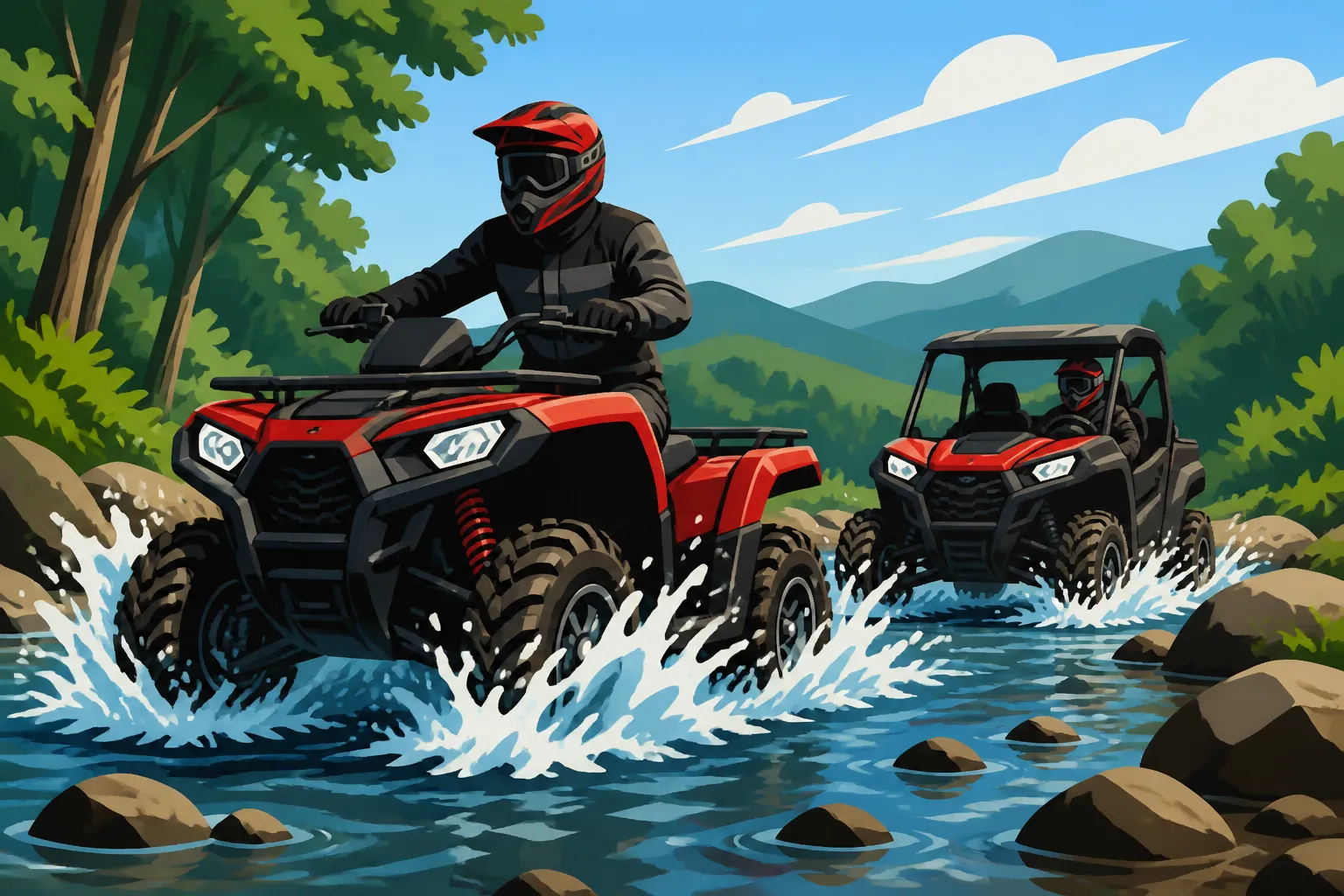
A creek crossing can look shallow from the trail and still hide a slippery rock shelf, a sudden drop, or a stronger current than you expected. Arkansas riders face changing water levels, slick Ozark stone, and muddy approaches after rain. This guide explains how to assess a crossing, when to turn around, and how to prepare your ATV or UTV for safer trail riding.
Why water crossings in Arkansas deserve extra caution
Arkansas trails pass through terrain where water conditions can change quickly. A creek that was easy to cross on a dry weekend may be higher, faster, and cloudier after a storm. Even familiar routes can feel different when leaves, gravel, or branches have shifted over the trail.
Water also hides the details that matter most to a rider: the depth, the bottom surface, the location of a rut, and how sharply the trail rises on the far bank. A cautious pause is not wasted riding time. It gives you a chance to decide whether the crossing is within your ability and whether conditions are safe enough to proceed.
What makes a crossing unpredictable
The water’s appearance is only one clue. Clear water can still cover a deep hole, while muddy water can conceal rocks or a washed-out edge. A smooth surface does not necessarily mean the current is gentle, and ripples may be caused by rocks rather than fast-moving water.
The approach and exit matter, too. A steep bank, loose gravel, exposed roots, or slick rock can make it difficult to keep a machine moving steadily. On the other side, the trail may be narrow or rutted, leaving little room to recover if your tires lose traction. If you cannot see where the route enters and leaves the water, treat that uncertainty as a reason to stop.
Recent weather can change the picture in a hurry. Rain upstream may raise a creek even when the sky above you is clear. After heavy rain, water can carry debris and make a familiar crossing less predictable. Check for closures and trail-condition updates before leaving, and be ready to change plans if conditions have shifted. [Arkansas Trail Closures After a Storm] and [Arkansas Riding After Heavy Rain] are useful reading before a wet-weather ride.
A familiar crossing is not automatically a safe crossing
It is tempting to assume that a crossing is safe because you or a friend have crossed it before. But water level, current, trail wear, and the condition of the banks can change between visits. A crossing that was manageable for a skilled rider on one machine may not be a good choice for a newer rider, a loaded side-by-side, or a group with children riding along.
Pause and look at the entire route rather than focusing on the water alone. Check the entry, the path across, and the exit. If one section is hidden, deep, fast, or difficult to approach, do not treat the rest of the crossing as proof that it is safe. You are allowed to turn around, wait for conditions to improve, or choose a different route.
How to assess a creek crossing before riding through
A careful assessment starts before the machine reaches the water’s edge. Stop well back from the bank so you have room to look without sliding toward the creek. If you are riding with others, make sure everyone knows you are evaluating the crossing and that no one moves ahead unexpectedly.
Maps can help you plan, but they cannot tell you exactly what the water looks like at the moment you arrive. Apps such as onX Offroad can help with route planning and orientation, but use them alongside current trail information and what you can safely observe on the ground. A digital route line is not a guarantee that the crossing is open, passable, or appropriate for your machine.
Look at the approach, water, and exit
First, check the trail leading into the creek. Is it firm enough to stop on? Is it steep, deeply rutted, or covered in slick mud? A difficult approach can leave you with little control before you even reach the water. Also look for a safe place to wait or turn around; narrow trail edges and soft banks may not support a heavy machine.
Next, assess the water without putting yourself at risk. Look for visible changes in speed, debris moving downstream, foam, or a surface that obscures the bottom. Do not wade into water to test it if the current, depth, footing, or bottom is uncertain. Getting off the machine does not make a questionable crossing safe, and a person can be swept or injured just as quickly as a vehicle can lose control.
Finally, inspect the exit. You want to know where the tires will climb out and whether there is enough room to continue without making a sharp turn on a slippery bank. If the far side is hidden by brush or the water is too cloudy to judge the route, do not guess. A crossing should be one you can evaluate, not one you have to hope will work.
| What to check | More reassuring signs | Reasons to stop or turn around |
|---|---|---|
| Water movement | Calm, clearly observable water | Fast current, moving debris, or uncertain flow |
| Depth and bottom | Route and bottom are visible | Cloudy water or hidden holes and obstacles |
| Entry and exit | Stable banks with a clear path | Steep, slick, undercut, or washed-out banks |
| Recent conditions | No known major rain or closure | Recent storms, rising water, or unclear status |
| Group and machine | Rider and vehicle are suited to the route | Inexperience, heavy load, or poor control margin |
These are observations, not a formula that makes a crossing safe. If you are unsure about even one important part of the route, the conservative choice is to avoid it. For additional route-planning context, see [Arkansas Trail Conditions Before You Tow] and [Arkansas ATV Trails With Creek Crossings].
Know when to turn around
Turn around if the water is rising, moving quickly, carrying debris, or too murky for you to judge the route. Do the same if you cannot identify a stable entry and exit, the trail is closed, or another rider’s attempt suggests the conditions are beyond your group’s ability. A crossing is not worth risking an injury, a damaged machine, or a rescue situation.
Avoid letting group pressure make the decision for you. Someone may say, “It’s only a little water,” or point to another machine that already crossed. Those details do not tell you whether your own vehicle, tires, passengers, or level of experience are suited to the same route. If the crossing does not feel manageable, explain your decision and turn back together.
Crossing safely when conditions and the route are suitable
There is no universal technique that makes every water crossing safe. The correct choice depends on the water, trail surface, machine, and rider. Follow the manufacturer’s guidance for your ATV or UTV and any rules for the riding area. If the crossing looks more demanding than your skills or equipment can handle, skip it.
Before entering, give your group a clear plan. Decide who will cross first, where others will wait, and how you will communicate if something goes wrong. Keep enough space between machines that one rider’s loss of traction does not put another rider immediately in harm’s way. Do not crowd the bank or block the trail while making a decision.
Keep the ride controlled and avoid risky shortcuts
When a crossing is within your ability and the route is open, use a controlled, steady approach suited to your machine and the trail. Avoid sudden acceleration, abrupt steering, or stopping in a spot where the tires may lose traction. Do not assume that speed will carry you through safely; a faster entry can reduce your ability to respond to hidden obstacles or changing footing.
Stay on the designated trail and use the intended crossing rather than creating a new route through the creek or along its banks. Riding outside the established track can damage vegetation and erode the shoreline, and it may violate the land manager’s rules. If the marked route is blocked or damaged, do not bypass the obstruction through the water. Check for official guidance or choose another route.
Good trail preparation includes knowing your machine’s limits and carrying gear appropriate for the ride. A snorkel or other modification does not make deep or fast-moving water safe, and it does not replace a careful assessment. For more on equipment considerations, see [Snorkels and Creek Crossings]. For broader riding preparation, [Arkansas Trail Etiquette Locals Expect] covers the kind of considerate habits that help protect shared routes.
Give the group room and a way to respond
On a group ride, one person should not enter the crossing until the far side is clear and there is space to continue. Riders waiting behind should stay on stable ground, leave the approach open, and avoid distractions that could lead someone to move forward unexpectedly. If children or inexperienced riders are in the group, use an especially cautious standard; they should not be pushed to cross beyond their ability.
Agree on a simple way to communicate before anyone starts, especially if engine noise or distance makes conversation difficult. If a rider gets stuck or a machine has a problem, do not rush into the water to help. First assess the conditions and keep other riders clear. A recovery attempt can turn a vehicle problem into a person-in-water emergency. Carry suitable recovery and first-aid supplies for your trip, and make sure someone in the group knows how to contact help if needed. [First Aid Worth Carrying on a Long Loop] offers a useful checklist for longer rides.
Prepare before you leave and after you cross
Water crossings are easier to manage when the whole ride is planned around changing conditions. Before heading out, check the riding area’s official notices, weather, trail status, and any permit or access requirements that apply. Do not rely on a social post or a saved route alone for a decision about whether a trail is open.
Planning also means having a backup. Save the route or map information you need before entering an area with weak cell service, and carry a paper map if you may lose signal. onX Offroad can be one part of that planning, but keep an offline or non-phone backup and confirm restrictions with the land manager. A map helps you understand where you are; it does not replace a closure notice or an on-the-ground safety decision. See [Carrying a Paper Map as Backup] and [Arkansas ATV Trails: Where to Ride] when planning a route.
Protect the machine after a wet ride
After a crossing, pause somewhere safe and check that the machine is behaving normally. Pay attention to unusual sounds, warning indicators, or a change in steering or braking. If the machine has been submerged or you suspect water reached areas that should stay dry, do not simply ride on and hope the problem goes away. Follow the owner’s manual and seek qualified service if needed.
When you get back, clean mud and grit from the machine and inspect vulnerable areas according to the manufacturer’s maintenance guidance. Water and trail debris can leave material packed around parts that are easy to overlook during a quick rinse. Check the air intake and other components only as directed by the manual; avoid starting or operating a machine if you believe water has entered the engine.
A short inspection can also catch damage to tires, skid plates, or other exposed parts before the next ride. Keep notes about any issue you noticed so it does not get forgotten once the machine is unloaded and the weekend routine takes over.
Make the conservative decision part of the plan
A good Arkansas ride is not measured by how many creeks you cross. It is measured by whether everyone returns safely, the machine is in good shape, and the trail has been treated with care. Make turning around an accepted option before you reach the first crossing, not a decision you have to defend once the group is already waiting.
Before every crossing, take a moment to reconsider the conditions in front of you. If the water is changing, the route is unclear, or your confidence depends on luck, do not enter. Find another trail, wait for safer conditions, or call the ride early. That can be frustrating when you have driven a long way to ride, but it is still better than letting one uncertain crossing decide how the whole day ends.
Disclaimer
This article is for general informational purposes only and does not constitute professional advice. Laws, prices and regulations vary by location and change over time. Consult a qualified professional for guidance on your specific situation.