Rock Sections at Arkansas Parks
Arkansas rock sections can turn a fun ride into a slow, tiring crawl, especially when loose stones, ledges, and wet patches appear around a blind bend. This guide explains what rocky terrain is like at Arkansas parks and trail systems, how to choose a route for your machine and experience, and what to check before you leave the trailhead.
What Arkansas rock sections are like
Expect different kinds of rock, not one uniform surface
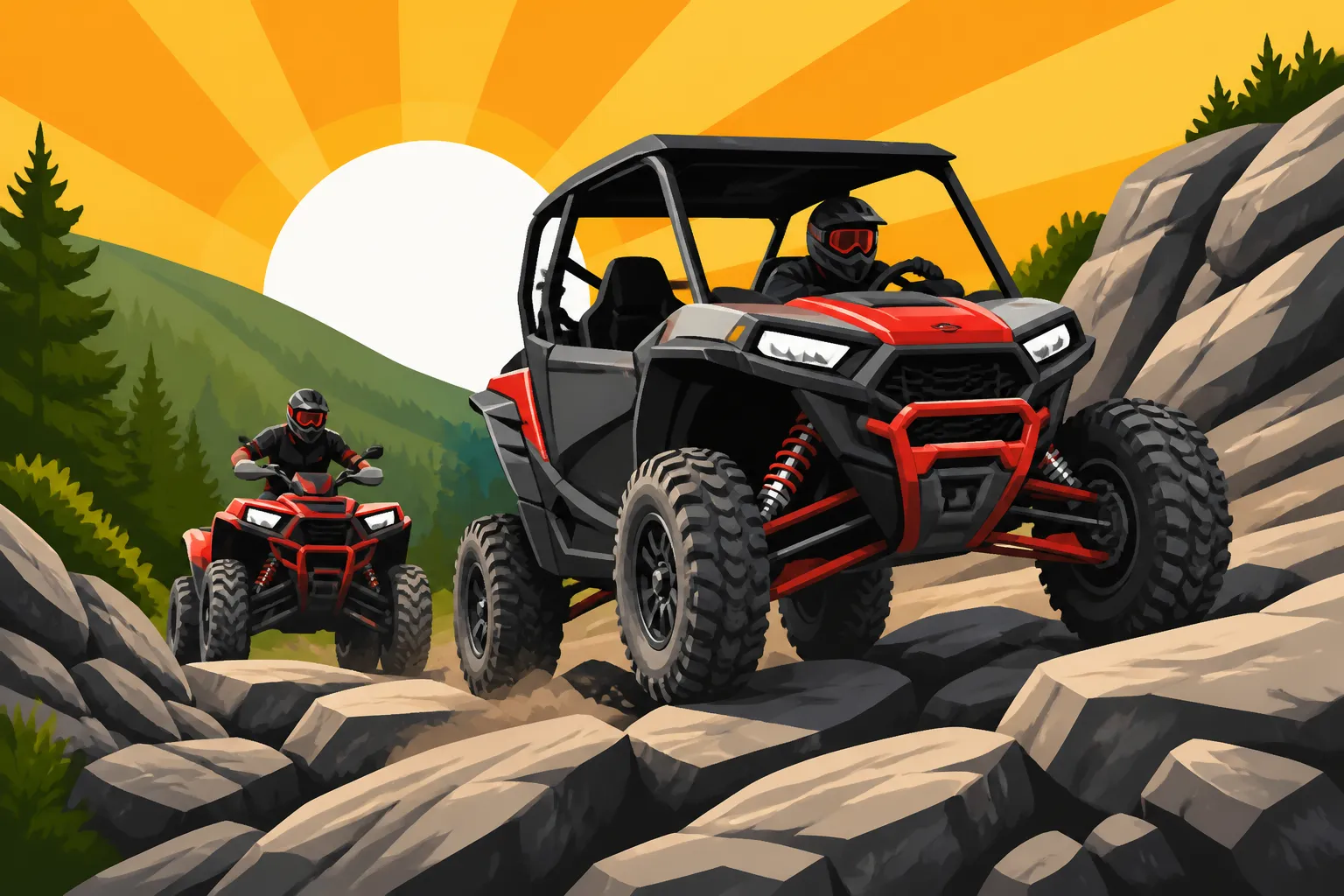
“Rocky trail” can mean anything from a firm gravel road with scattered stones to a steep, uneven climb where exposed rock forces you to pick a careful line. In Arkansas, riders may encounter loose rock that shifts under a tire, larger embedded stones, narrow ledges, and rough shelves with abrupt changes in height. A route can alternate between these surfaces within a short distance, so one easy-looking stretch does not guarantee the next section will feel the same.
The Ozarks and Ouachita Mountains also bring different terrain patterns. In the hills, slopes and drainage can send water across a trail, leaving a rock surface slick or eroded after rain. A rocky climb that feels manageable when dry may become a slow, slippery obstacle when wet. Do not assume that a route’s overall difficulty rating describes every rock feature on it.
Rock sections can also be challenging because of their shape, not just their steepness. A narrow line between stones may leave little room to turn, while a sharp step can lift one wheel and shift the machine’s weight. On a side-by-side, width and turning room matter as much as ground clearance. A full-size machine may have plenty of power but still be awkward in a tight, uneven passage.
Private parks and public trail systems are not interchangeable
Arkansas has private off-road parks as well as riding areas on public forest land. Those settings can differ in how routes are marked, what machines are allowed, and how riders should check closures or conditions. Private parks such as [Hot Springs Off-Road Park in Arkansas](Hot Springs Off-Road Park in Arkansas) and [Byrd's Adventure Center on the Mulberry River](Byrd's Adventure Center on the Mulberry River) have their own rules and trail networks. Check the park’s current information before making a trip, rather than relying on an old route description or a video from another rider.
Public trail systems, including [Wolf Pen Gap: Arkansas's Best Known OHV Complex](Wolf Pen Gap: Arkansas's Best Known OHV Complex) and [Mill Creek OHV Trail System in Arkansas](Mill Creek OHV Trail System in Arkansas), have their own access and management considerations. Trail conditions may change because of weather, maintenance, or seasonal restrictions. A rocky route shown on a map may not be open or suitable for your machine on the day you arrive.
Before choosing a destination, confirm whether you are looking at a private park or public land, whether your vehicle fits the area’s width limits, and whether the route is open. For public forest riding, also check what permit is required. The details vary by riding area, and a permit for one forest does not necessarily apply to another. The overview [Arkansas OHV Permits: Two Forests, Two Prices](Arkansas OHV Permits: Two Forests, Two Prices) can help clarify why permit planning matters.
| Riding setting | What to check before you go | Why it matters on rocky terrain |
|---|---|---|
| Private off-road park | Park rules, trail ratings, machine limits, and current conditions | The park may have designated routes or restrictions that affect which rock sections you can ride |
| Public forest trail system | Access status, permits, width limits, and closures | A route may be closed, restricted, or unsuitable for your machine |
| Unfamiliar route | Map coverage, intersections, and a backup navigation method | Rocky sections can slow progress and make it harder to retrace your route from memory |
| Wet-weather ride | Recent conditions and the park or trail system’s guidance | Wet rock, runoff, and erosion can change traction and difficulty |
Choosing a rock section that fits your ride
Match the trail to the least experienced rider
When a group includes a first-time rider, a younger rider, or someone on a new machine, pick the route around that person’s comfort level rather than the most experienced rider’s confidence. Rocky terrain can be intimidating even at low speed. A rider who feels rushed may accelerate at the wrong moment, turn sharply on uneven ground, or follow too closely behind another machine.
Look for a route where the group can stop safely and talk through a feature before attempting it. If the trail rating is unclear, ask park staff or the people responsible for the riding area what the rating means in practice. “Moderate” can still include an obstacle that feels demanding to a beginner, particularly after rain or when the machine is loaded with passengers and gear.
A sensible group plan includes an agreed turnaround point. If one rider reaches a section and decides it is beyond their comfort level, the group should be able to stop without pressure to continue. Turning around is not a failure; it is a practical way to keep a ride enjoyable and avoid converting a manageable outing into a recovery situation. For ideas on selecting routes by skill level, see [Best Arkansas ATV Trails for Beginners](Best Arkansas ATV Trails for Beginners).
Check width, clearance, tires, and load
Before heading for rocky trails, think about the machine’s dimensions and setup. A wider side-by-side may be difficult to position on a narrow route, even when its tires and suspension can handle the surface. Check the riding area’s rules for width limits and make sure you know the width of your own machine, including any accessories that extend beyond the body.
Ground clearance can help when crossing uneven rock, but it does not remove the need for careful line choice. A machine can still hang up if a rock catches underneath, and a high-clearance vehicle can feel unstable if a rider attacks an obstacle at speed. Tires, suspension, passenger weight, cargo, and the machine’s condition all affect how it behaves. A heavy load can change handling and make steep, uneven sections harder to control.
For Arkansas trails with width restrictions, read [Arkansas ATV Trails With Width Limits](Arkansas ATV Trails With Width Limits) before you tow. If you are riding a side-by-side, review [Arkansas ATV Trails That Allow Side-by-Sides](Arkansas ATV Trails That Allow Side-by-Sides) as well. Do not rely on a machine’s advertised capability alone; confirm that the specific riding area allows it and that the route is appropriate for its size.
Riding rocky terrain with more control
Slow down and choose a line before committing
Approach a rock feature slowly enough to look at the surface and decide where the tires should go. Avoid staring only at the nearest obstacle. Scan a little farther ahead for loose stones, a change in slope, or a safe place to stop. On a narrow climb, it can help to pause before the first difficult spot and consider whether there is enough room to complete the section without an abrupt turn.
Use steady, controlled movement rather than a sudden burst of throttle. Spinning tires can shift loose stones and reduce traction, while a hard stop on an uneven slope may make it harder to restart smoothly. Keep your body balanced and follow the machine manufacturer’s guidance for operating on hills and rough ground. If you are unsure how to clear a feature, stop in a safe place and reassess rather than trying to power through it.
Leave space between machines. If the rider ahead stops or needs to reposition, a close follower may have nowhere safe to go. On a steep or irregular section, one machine at a time can reduce crowding and give each rider room to choose a line. Agree on signals before the group enters a difficult stretch, especially if engine noise makes conversation difficult.
Adjust your plan for rain, erosion, and visibility
Rain changes more than the amount of mud on a trail. Water can run across exposed rock, wash loose material into a turn, and create slick patches in shaded areas. Even if the trailhead is dry, conditions deeper in the hills may be different. When storms have passed through, check the trail system’s notices and ask about conditions before committing to a long loop.
Avoid forcing a line that has become visibly eroded or damaged. Spinning through a wet section can deepen ruts and make the trail harder for everyone who follows. If a marked route is closed or a feature looks unsafe, respect the closure and use an open alternative. For broader guidance on riding after wet weather, read [Arkansas Trail Riding After Heavy Rain](Arkansas Trail Riding After Heavy Rain).
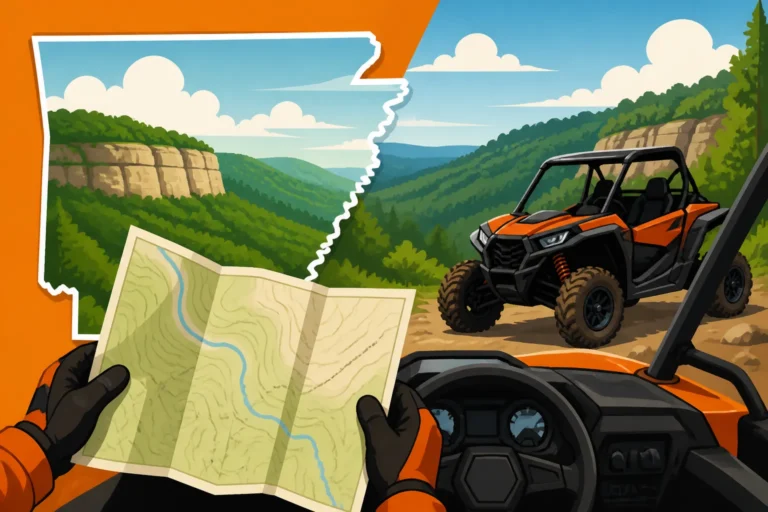
Navigation matters when a slow rocky section disrupts your timing or causes the group to miss a turn. A map app such as onX Offroad can help riders review mapped routes and keep track of their position, but it should not replace current trail-status information or posted signs. Download or prepare what you need before entering an area with limited cell service, and carry a paper map as a backup. [Carrying a Paper Map as Backup](Carrying a Paper Map as Backup) covers why a second navigation option is worth having.
Preparing for a safer, more enjoyable ride
Inspect the machine and pack for the terrain
Before leaving the staging area, check tires, wheels, steering, brakes, and visible undercarriage components. Rocky riding can put repeated impacts into tires and suspension, so it is helpful to notice a problem before it becomes a trail-side repair. Secure loose cargo and make sure passengers understand where to hold on and how to stay seated when the machine moves over uneven ground.
Pack basic recovery and repair gear that matches your machine and the length of your ride. A tow strap, suitable tools, a tire repair option, water, and a first-aid kit can make a delay easier to manage. For a longer or remote route, think through what you would do if a machine could not continue under its own power. Avoid assuming another group will be nearby or that a phone will have service.
Protective gear matters on rocky trails because small slips can throw up gravel or bring a rider into contact with hard surfaces. Wear a helmet and eye protection, gloves, sturdy footwear, and clothing suited to the weather. Keep passengers within the machine’s seating capacity and follow its safety instructions. For a wider packing list, [First Aid Worth Carrying on a Long Loop](First Aid Worth Carrying on a Long Loop) is a useful place to start.
Make a plan for the destination, not just the obstacle
A rocky climb may be the part you remember most, but a successful ride depends on the whole outing. Check where you can park or stage, whether there are facilities, and how much time the route may take at a careful pace. A slow technical section can turn a short loop into a longer day, especially when a group stops to assess obstacles or helps another rider.
If you are new to an area, ask about the trail’s character rather than asking only whether it is “hard.” Useful questions include whether the route has narrow ledges, loose rock, steep grades, exposed drop-offs, or limited turnaround space. Ask whether recent rain has affected traction and whether any closures or restrictions apply. Those details help you choose a route that fits your machine and your group.
Navigation tools can be useful for comparing routes and keeping the group oriented, and onX Offroad may help with that planning. Still, confirm access rules with the land manager or park and follow on-site signs. A digital route line is not permission to ride a closed road, and mapped terrain cannot guarantee that a particular rock feature will feel comfortable for every rider. Combine a map, local guidance, preparation, and conservative decisions for the best chance of a smooth day.
Disclaimer
This article is for general informational purposes only and does not constitute professional advice. Laws, prices and regulations vary by location and change over time. Consult a qualified professional for guidance on your specific situation.