Hunting Operations and What Qualifies
It's incredibly frustrating when you've got a quad or side-by-side that's perfect for hauling gear or scouting deer, but you're worried about getting it from your camp to your hunting spot on a public road. Arkansas law can feel a bit like a maze when it comes to riding ATVs and UTVs on public roads. This guide is here to untangle the specifics of one of the most common and useful exceptions: what actually qualifies as a "hunting operation" in Arkansas, allowing you to legally use your off-road machine on certain public thoroughfares.
The General Rule: Why Roads Are Tricky for ATVs in Arkansas
Let's be real, the moment you roll your ATV or UTV onto a paved or gravel county road in Arkansas, you're entering a legal grey area that can quickly turn into a black-and-white citation. Arkansas, like many states, has a foundational stance that off-road vehicles belong off-road. This isn't just about safety; it's also about vehicle classifications, registration, and the wear and tear on public infrastructure. Many riders assume that if a road is rarely used or isn't a major highway, it's fair game. That's a common misconception that can lead to an expensive lesson.
Arkansas's Strict Stance on Public Road Use
Generally speaking, Arkansas Statute 27-21-106 makes it unlawful to operate an "all-terrain vehicle" on any public street or highway. This is the overarching rule that governs everything. It doesn't matter if it's a bustling state highway or a sleepy gravel lane in the middle of nowhere – the default position is "no." This can be a real headache for hunters, farmers, or anyone who needs to traverse a short distance on a public road to get to their destination. Imagine having to load your UTV onto a trailer just to go a quarter-mile down a county road to reach the next section of your hunting lease. It’s inconvenient, to say the least, and it’s why understanding the exceptions is so crucial. You might be surprised to learn that even riding your ATV down a ditch alongside a county road is often considered riding on the right-of-way, and thus, still unlawful under this statute.
The "Why" Behind the Restrictions
So, why such strict rules? A big part of it comes down to safety and vehicle design. ATVs and UTVs aren't built for road speeds. Their tires are often designed for grip in mud and dirt, not for smooth, high-speed asphalt. Their suspension, braking, and even their lighting systems aren't typically up to the standards required for highway-legal vehicles. There's also the matter of insurance, licensing, and road taxes – all things that traditional vehicles contribute to, but off-road machines often don't. The state wants to protect all road users and minimize accidents, and these restrictions are part of that effort. While it might feel like the law is directly targeting your hunting plans, it's really about maintaining public safety across the board. The goal isn't to stop you from enjoying the outdoors; it's to ensure everyone does so responsibly and safely.
Unpacking the Hunting Operations Exception
Now, for the good news! Arkansas's strict road-riding rules do come with a few statutory exceptions, and one of the most vital for many of us is the "hunting operation" exception. This particular allowance recognizes that these machines are invaluable tools for outdoor pursuits, especially when it comes to managing wildlife and accessing remote areas during hunting season. However, simply having a rifle in the scabbard doesn't automatically mean you're covered. You need to understand what constitutes a legitimate hunting operation.
Defining "Hunting Operation" Under Arkansas Law
The statute itself provides some clarity, though common sense and the intent behind the law are key to its interpretation. An "all-terrain vehicle may be operated on a public street or highway for the purpose of a hunting operation." This isn't a free pass for joyriding with hunting gear. The crucial part is that the use of the ATV or UTV must be directly and reasonably connected to the act of hunting. This includes activities essential to preparing for a hunt, conducting a hunt, or concluding a hunt. It's about legitimate utility, not casual recreation. Think of it as using your machine as a work vehicle for the specific task of hunting. This exception is designed to facilitate hunting, not to bypass the general prohibition on road use. For instance, if you're riding around aimlessly with a bow in the back of your UTV, you're likely not engaged in a "hunting operation." You must have a clear, immediate purpose related to hunting.
Examples of Qualifying Activities
To help clarify, let's look at some real-world scenarios where the hunting operation exception would generally apply:
- Traveling to and from a hunting stand or blind: This is perhaps the most common scenario. You're parked at the edge of a public road, and your stand is a quarter-mile down a logging trail. You can use your ATV to get from your parking spot, across or down the public road (if necessary and brief), and onto the trail leading to your stand. This is direct travel for the purpose of hunting. You might use a powerful UTV to carry your gear, like a SuperATV with a cargo bed, directly to your deer stand.
- Transporting harvested game: After a successful hunt, you might need to use your UTV or ATV to retrieve a deer, hog, or other game from the field and transport it back to your vehicle or camp. This often involves traveling short distances on public roads. The machine is being used to move the harvest, a clear part of a hunting operation.
- Hauling hunting equipment or supplies: Taking a tree stand, a bag of corn for bait (where legal), or other necessary hunting supplies to a specific spot that requires brief road travel would fall under this. This also includes bringing out camping gear that supports your hunting trip.
- Scouting for game, placing trail cameras, or clearing shooting lanes: In the days or weeks leading up to a hunt, you might need to access certain areas to scout for animal signs, set up trail cameras, or even trim branches to create a clear shot. If accessing these areas requires minimal use of a public road, it would generally be considered part of a hunting operation, as these are preparatory steps essential for a successful hunt.
- Checking traps: If you're a licensed trapper, using your ATV or UTV to check and service your trap lines, even if it involves short stints on public roads, typically falls under the umbrella of a hunting or trapping operation.
It's important to note that these activities should be conducted safely and with due regard for other traffic. When using an ATV or UTV for these purposes, you should always [Carry Proof on the Trail] of your hunting license and any other relevant permits.
Navigating the Nuances and Limitations
While the "hunting operation" exception provides crucial flexibility for hunters, it's not a carte blanche to ride anywhere, anytime. There are significant nuances and limitations you absolutely must understand to avoid potential legal trouble. Simply having a hunting license in your wallet isn't enough; your actions must genuinely align with the spirit and letter of the law. This is where many riders get into hot water, often unknowingly.
Direct Travel Versus Joyriding
This is perhaps the most critical distinction. The hunting operation exception is specifically for direct travel to facilitate hunting activities. It is not an excuse for recreational riding, even if you have a hunting license in your pocket or a hunting accessory on your machine.
Consider these scenarios:
- Direct Travel Example: You are at your deer camp, and your hunting lease is across a county road. You load your gear into your UTV, drive directly across the road, and turn onto the private land access road to your stand. This is direct travel for a hunting operation.
- Joyriding Example: You finish your morning hunt and decide to take your UTV for a spin around the county roads "just to see what's out there" before heading back to camp. Even if you're still wearing your camo and have your rifle, this is likely to be interpreted as recreational riding, not a direct part of your hunting operation. The purpose of your travel has shifted. You'd be in the same boat if you decided to run into town for a snack on your ATV; that's not a hunting operation.
Law enforcement officers are trained to look for signs that differentiate legitimate utility from recreational use. Excessive speed, multiple passes on the same road, or traveling routes that don't directly lead to or from a hunting area are red flags. The machine should be used as a tool to support your hunting efforts, not as a leisure vehicle on public ways. It's about fulfilling the legal requirement of [Arkansas Rules for Riding to a Deer Stand] in a way that respects the law.
The Role of Private Land Access
Another critical aspect is the interaction with private land. Often, the "hunting operation" exception is invoked when you need to briefly use a public road to get between parcels of private land, or from a public road to private land where hunting occurs.
- Accessing Private Land: If your hunting property is accessed directly from a public road, you can use your ATV/UTV to travel the short distance from the road's edge into your private property. This is a legitimate use. However, if you're riding your machine for miles down a public road to get to a different piece of land you have permission to hunt, that might stretch the definition too far.
- Riding on Public Land vs. Private Land: The hunting operation exception applies to public streets or highways. It does not necessarily grant you carte blanche to ride anywhere on public land (like National Forests or Wildlife Management Areas) outside of designated trails or roads open to vehicles. Rules for riding on these public lands are separate and often require specific permits, such as [Arkansas OHV Permits: Two Forests, Two Prices], or adhere to [Arkansas WMA Roads Open to Vehicles]. Always verify specific rules for the land you're hunting on. For instance, if you're on a Wildlife Management Area (WMA), there are often very specific rules regarding vehicle use, and the hunting operation exception for public roads might not override WMA-specific closures or restrictions.
Understanding [Arkansas Landowner Permission Forms] is also crucial. If you're hunting on land you don't own, having explicit written permission can help reinforce the legitimacy of your presence and activities, especially if a deputy questions your use of a public road to access that property. The context of your entire journey—where you started, where you're going, and what you're doing—will be considered.
Practical Advice for Hunters on the Road
Okay, so you understand the "hunting operation" exception, and you know the difference between direct travel and joyriding. Now, let's talk about how to minimize your chances of a misunderstanding with law enforcement and ensure you're as prepared as possible when you do need to briefly use an Arkansas public road for your hunting endeavors. Being proactive and demonstrating responsibility goes a long way.
What to Carry and What to Expect
When you're out using your ATV or UTV for a hunting operation, assume you might encounter law enforcement. Being prepared can save you a lot of hassle.
- Proof of Hunting: Always carry your valid Arkansas hunting license, your hunting tags, and a form of personal identification. This is fundamental. If you're harvesting game, be prepared to show those tags are properly filled out. This immediately establishes your legitimate purpose.
- Proof of Ownership: While not strictly required for every roadside stop, having proof of ownership for your ATV or UTV (like a bill of sale or registration document) can be helpful. This shows the machine is yours and not stolen, addressing another common concern for officers. You should also be ready to explain [What a Deputy Can Ask to See].
- Safety Gear: Even though Arkansas doesn't have a mandatory helmet law for ATVs, wearing a helmet and other safety gear like eye protection is just smart. It shows you're taking safety seriously, which can positively influence an officer's perception. Consider adding high-visibility flags or reflective tape, especially if you're near a road during low light conditions. Some riders even add aftermarket turn signals and mirrors from brands like SuperATV, even if not legally required, to improve visibility and communication with other road users.
- Limited Road Use: If you must use a public road, do so for the absolute minimum distance and time required. Stick to the shoulder if safe, or cross the road at a 90-degree angle after coming to a complete stop, as per [Crossing a Highway on an ATV in Arkansas]. Don't dawdle. The faster you're off the public road and onto private land or designated trails, the better.
- Expect Questions: If you're stopped, be polite, cooperative, and clear about your purpose. Explain that you are engaged in a hunting operation and are using the road to access your hunting area or transport game. Avoid being defensive or argumentative. An officer's primary concern is usually public safety and enforcing the law, not necessarily ruining your hunt.
- Understand Penalties: Be aware that [Arkansas Penalties for Illegal Road Riding] can range from a citation and fine to more serious consequences, especially if reckless operation is involved. It's far better to err on the side of caution and understand the rules.
Respecting Other Road Users and the Law
Even when you're legally operating your ATV or UTV as part of a hunting operation, you are sharing the road (briefly!) with other vehicles.
- Yield to Traffic: Always yield to cars and trucks. They have the right-of-way. Your ATV or UTV is small and less visible, so assume other drivers might not see you.
- Maintain Control: Operate your machine responsibly. Avoid sudden movements, excessive speed, or erratic driving. This isn't the time for stunts or testing the limits of your machine. Keep your speed appropriate for the conditions and the brief nature of your road travel.
- Avoid Busy Roads: If there's an alternative, avoid using busy highways or main roads, even for short distances. Stick to less traveled county roads or gravel paths where possible. The fewer cars you encounter, the lower the risk of an incident or an officer stopping you due to perceived unsafe operation.
- Know Your Local Ordinances: While the state law provides this exception, some local municipalities might have specific ordinances that could affect where and how you can operate. It's always a good idea to be aware of any local rules in the areas you frequent.
- Stay Informed: Laws and interpretations can change. Periodically review [Arkansas ATV Road Rules: What 27-21-106 Says] and other related statutes to ensure your understanding is current. Joining local ATV clubs or online forums can also be a good way to stay updated on local enforcement trends or rule changes.
Remember, the goal is to enjoy your hunting experience safely and legally. By understanding and respecting the hunting operation exception, you can use your ATV or UTV as the valuable tool it is without running afoul of Arkansas law.
| Activity Type | Generally Qualifies as Hunting Operation | Explanation |
|---|---|---|
| Traveling to/from hunting stand | Yes | Direct, purposeful travel for hunting. |
| Transporting harvested game | Yes | Moving game from field to vehicle/camp is an integral part of hunting. |
| Hauling hunting equipment | Yes | Transporting necessary gear (stands, feeders, cameras) directly to a hunting spot. |
| Scouting/Prepping hunt areas | Yes | Activities like setting trail cameras, clearing shooting lanes, done in preparation for a hunt. |
| Running errands in town | No | Not directly related to the act of hunting itself; recreational or personal use. |
| Joyriding for leisure | No | Recreational riding, even with hunting gear, is not considered a hunting operation for road use. |
| Traveling between distant hunting properties | Generally No | Brief crossing may be okay, but extensive road travel between properties stretches the definition. |
| Off-season recreational riding | No | The exception is specifically for hunting operations, not general off-season recreation. |
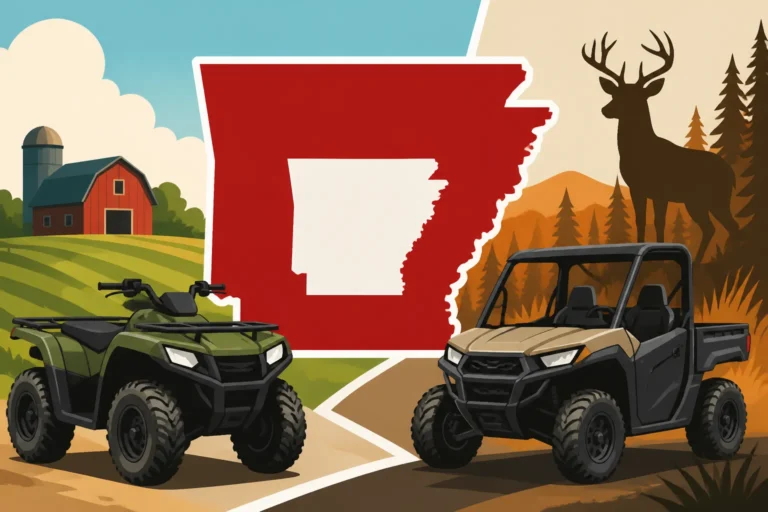
| [Arkansas Rules for Farm Road Riding] | Separate exception | Farming operations have their own specific exception, distinct from hunting operations. |
Disclaimer
This article is for general informational purposes only and does not constitute professional advice. Laws, prices and regulations vary by location and change over time. Consult a qualified professional for guidance on your specific situation.