Rutting After a Wet Weekend
Arkansas trails can look rideable after a rainy weekend while the soil underneath is still soft enough for tires to cut deep ruts. Those grooves can damage a route, make the next ride harder, and create a recovery headache for you. This guide explains how to judge wet conditions, avoid rutting, respond if you get stuck, and help protect Arkansas riding areas.
Why wet trails rut so easily
What happens beneath your tires
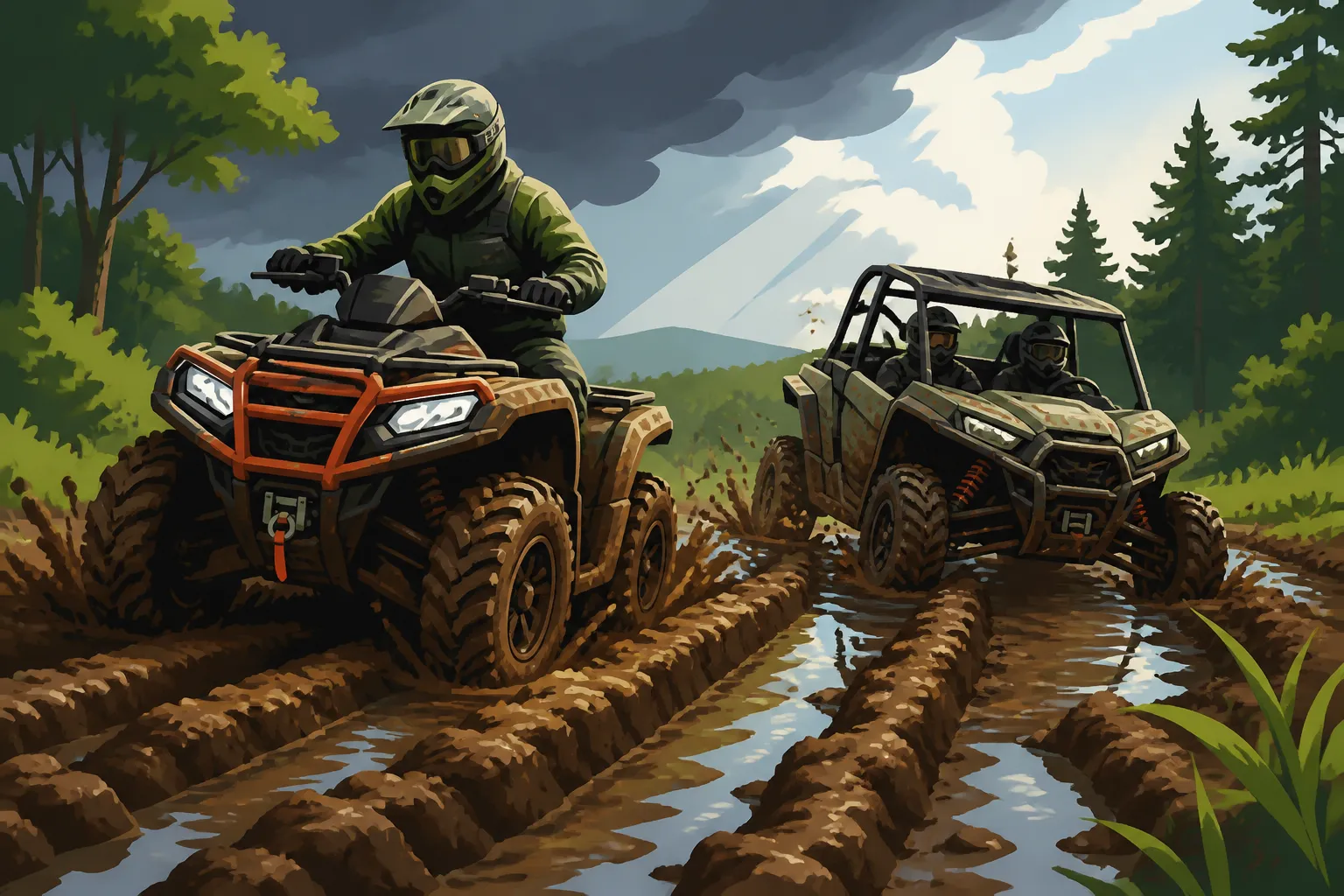
A trail’s surface can seem firm while the soil below it is saturated. Water fills the spaces between soil particles, reducing the ground’s ability to support the weight and torque of an ATV or UTV. Tires then press into the surface, push loose soil aside, and leave grooves that may deepen with every pass.
The risk depends on more than the amount of rain. Clay-heavy ground can stay slick and soft after the rain stops, while a rocky section may drain quickly but still have muddy pockets between stones. Shade, slope, leaf cover, and drainage all affect how long a route takes to dry. A sunny ridge and a shaded hollow on the same trail may be in very different shape.
Machine weight and tire choice matter too. A loaded side-by-side with passengers and gear can put more pressure on vulnerable ground than a lighter quad. Aggressive throttle can make things worse: when tires spin, they dig instead of carrying the machine forward. Even a short attempt to power through a muddy section can turn a shallow rut into a trench.
Why one rut can create a bigger problem
Ruts are not just cosmetic marks. A deep groove can collect water, which may widen it or carry soil downhill. On a slope, tire tracks can become channels that direct runoff along the trail instead of allowing it to spread naturally. That can speed up erosion and leave loose rock, exposed roots, or uneven ledges behind.
Ruts also make a trail harder for other riders to use. A groove that is manageable for one machine may catch a smaller ATV’s tires, pull a vehicle off its line, or leave a side-by-side leaning at an uncomfortable angle. In some situations, riders try to steer around the damage and widen the trail into the surrounding vegetation.
Repeated traffic magnifies the impact. One careful rider may leave modest impressions that recover as the trail dries. Many machines crossing the same saturated section can compact the ground, push soil to the edges, and make the damage much harder to repair. That is one reason to check conditions before towing out, not just when you reach the trailhead.
How Arkansas terrain changes the picture
Arkansas riding areas include rocky slopes, forest roads, creek crossings, clay-rich sections, and low spots that hold water. Conditions can change quickly between exposed ridges and shaded valleys, especially in the Ouachita and Ozark mountains. A route that was firm on the way out may be slicker on the return if rain begins or water runs across the trail.
A trail’s official status matters as much as how it looks. A route may be closed for seasonal protection, storm damage, maintenance, or another management reason. Do not treat a lack of standing water as permission to ride. Check the rules for the land and riding area you plan to visit, and consult Arkansas Trail Closures After a Storm for more on why routes may close after rough weather.
How to decide whether to ride after rain
Check conditions before you leave home
Before loading the machines, look for trail-specific information rather than relying on a general weather forecast. Recent rainfall in the nearest town does not always reflect conditions in the hills, and a dry morning does not mean the ground has recovered from rain the night before. Check the riding area’s official notices and trail-status information, then confirm any access rules that apply.
Mapping tools such as onX Offroad can help you understand where a planned route goes and what alternatives are nearby. Use mapping as a planning aid, not as proof that a trail is open or dry. Pair it with current information from the land manager or riding area. If a closure notice conflicts with what appears on a map, follow the closure.
Also think about the forecast for the entire ride. A route that is barely manageable when dry can become difficult if a shower moves through while you are far from the trailhead. If the plan includes low crossings, steep grades, or a long loop, the cost of getting caught in changing conditions is higher than it is on a short, familiar route.
For a practical pre-trip routine, use Arkansas Trail Conditions Before You Tow. It can help you build the habit of checking the route before you commit to the drive, fuel, and loading.
Read the ground, not just the calendar
There is no universal number of hours that makes a trail safe after rain. Soil type, temperature, shade, elevation, and drainage all play a part. Instead of deciding that a trail must be ready because a day has passed, look for evidence that the surface can support normal traffic without deforming.
At the trailhead, observe the ground around the parking area and the first section of trail. If tires leave deep impressions in soft soil, water is flowing along the route, or existing ruts are filled with mud, treat those as warnings. A route may also be slick even when it is not deeply muddy, especially where wet leaves or loose clay cover rocks.
If you encounter a soft patch, do not ride into it just to test how deep it is. Stop in a stable place and assess whether there is a legal, durable route around it. If the only option is to cross a fragile muddy section, turning back may be the least damaging choice. A short change of plans is better than widening the trail or needing a difficult recovery.
| Trail condition | What it may mean | A sensible response |
|---|---|---|
| Firm surface with shallow tire marks | The ground may support light, careful use, but conditions can vary nearby | Ride slowly and reassess at low spots and slopes |
| Soft soil that holds a boot print | The surface may deform under a machine | Avoid the section and consider turning around |
| Standing or flowing water in a rut | The trail may be carrying runoff or hiding soft ground | Do not use the rut as a test crossing |
| Tires spin with light throttle | The machine is losing traction and digging in | Stop rather than adding throttle |
| Trail closure or maintenance notice | Access is restricted regardless of how dry it looks | Follow the posted direction and choose an open route |
Choose a conservative plan for mixed conditions
When conditions are uncertain, shorten the ride and stay on routes that are permitted and likely to drain well. Avoid treating a narrow trail edge as an alternate route. Riding around a muddy patch can crush plants, loosen soil, and create a second track that later becomes a wider damaged corridor.
Leave room in the day for a turnaround. Groups often feel pressure to keep moving because everyone has driven a long distance or booked a weekend away. Agree in advance that any rider can call for a stop if the trail is becoming fragile or unsafe. That conversation is easier to have before the group reaches the mud.
If you are planning a ride in spring, expect conditions to vary from one section to the next. Arkansas Riding in Spring Rain offers related planning considerations for rides when showers and damp ground are part of the season.
How to ride without making ruts worse
Use smooth, controlled inputs
On a firm, open trail, a steady pace is usually easier on the ground than abrupt acceleration and braking. In a vulnerable section, keep your hands and throttle inputs calm. A spinning tire removes soil and creates heat and friction; it does not necessarily create useful forward movement.
Avoid sharp turns on soft ground. Turning tires scrub across the surface, and a tight pivot can break up the trail edge. If the route is too soft to turn around without digging in, stop in the safest available spot and consider whether reversing along the existing track is less damaging than making a new maneuver.
Do not assume that more throttle is the answer when traction fades. If you notice the machine sliding, sinking, or making a rut deeper, ease off and pause. If you are in a group, leave enough space for the rider ahead to clear the section without pressure to rush. Their line may be the only stable one, and tailgating can lead to unnecessary wheelspin.
Stay on the established trail
Keeping to the designated route is one of the simplest ways to reduce damage. Do not create a bypass through vegetation because the main trail is muddy. A detour can widen the disturbed area, damage roots, and tempt later riders to use the new track. Follow signs and barriers, and do not cross a closed section simply because you can see tracks beyond it.
On public forest land, approved routes and closures can be specific to a road, trail, or area. Confirm what kind of machine is allowed and where riding is permitted before setting out. Arkansas National Forest Riding Explained is a useful companion when you are planning a ride on national forest land.
Use extra care on rocky or uneven ground. It may look durable, but the soil between rocks can be easy to displace, and exposed roots can be damaged by repeated wheelspin. Tread Lightly on Rocky Ground covers ways to approach those surfaces with less impact.
Respect other riders and the trail crew
A wet trail can bring out frustration. One rider may want to push forward, while another is worried about getting stuck or damaging the route. Keep the conversation practical: identify what you are seeing, discuss whether there is a legal way around it, and make a group decision before anyone enters the soft section.
Do not block a trail while debating. If you can move to a firm, safe pull-off without leaving the established route, use it. Keep your group together, but leave enough space for machines to move without crowding or forcing abrupt stops.
Respect trail workers and volunteers who may be managing closures, repairing drainage, or assessing storm damage. Fresh work can look like an obstacle, but it may be protecting the route from further erosion. Arkansas Trail Etiquette Locals Expect includes other considerate habits that help keep shared riding areas usable.
What to do if a machine starts sinking
Stop before spinning turns a rut into a trench
The first sign of trouble may be a tire slipping, the machine losing momentum, or the frame settling into soft ground. Stop as soon as you can do so safely. Continued spinning can dig the tires down, pack mud into the tread, and leave the machine resting on its skid plate.
Do not repeatedly accelerate in the hope that the next attempt will work. Take a moment to look at the machine’s position, the trail surface, and the space around it. Ask passengers to dismount if it is safe and useful to reduce the load. Keep everyone away from tires and recovery equipment while the machine is being moved.
If a shallow rut is already forming, avoid making it worse by trying several different lines. When possible, reverse carefully along the existing track rather than cutting a new path through plants or soft soil. If the machine is badly stuck, use an appropriate recovery method and do not take risks with a strained tow point, damaged strap, or unstable anchor.
Prepare for recovery before the ride
A recovery plan is part of wet-weather trail planning. Bring gear suited to your machine and know how to use it before you need it. A tow strap, gloves, basic tools, and a charged phone or other communication option can help, but equipment alone does not make a recovery safe. Keep people clear of tensioned straps and follow the manufacturer’s guidance for approved recovery points.
Traveling with another capable machine can help, but do not assume that one vehicle can safely pull another from every angle. Pulling sideways on a slope, attaching to an unsuitable point, or using a damaged strap can cause injury or damage. If the machine is in a dangerous position, or your group is unsure how to recover it safely, stop and seek qualified help.
A recovery can also affect the trail. Use the existing route where possible, avoid dragging a machine across vegetation, and do not turn a recovery into an excuse to push through a closed or badly damaged section. Carrying a Tow Strap in the Hills has more on planning for this kind of problem in Arkansas terrain.
Leave the trail better than you found it
If you caused damage, do not attempt a large repair with a machine or tool that could make the site worse. Avoid pushing soil into a rut without understanding how water drains there. A poorly placed mound can redirect runoff and deepen erosion elsewhere. Report significant damage or a hazard to the relevant land manager or riding area.
If you see fresh damage, note the location as clearly as you can and share it through the appropriate official channel. A map pin or nearby trail marker can make a report more useful. Tools such as onX Offroad may help you describe where you were, but confirm the location against trail signs or official maps when possible.
Trail repairs often depend on volunteers and local stewardship. If you want to help, look for organized work opportunities rather than attempting repairs on your own. Arkansas Trail Volunteer Days is a related topic for riders interested in supporting the places they enjoy.
Disclaimer
This article is for general informational purposes only and does not constitute professional advice. Laws, prices and regulations vary by location and change over time. Consult a qualified professional for guidance on your specific situation.