Arkansas Subdivision Streets and Quads
It's incredibly frustrating when you just want to take your quad or side-by-side from your garage down to a neighbor's house or even just to grab the mail, but you're constantly worried about whether you're breaking the law right there in your own subdivision. For many folks in Arkansas, the rules around riding ATVs on local streets, especially within their own neighborhoods, feel like a confusing maze. This comprehensive guide is here to untangle the nuances of Arkansas law regarding ATVs on subdivision streets, helping you understand what's allowed, what's definitely not, and what your options are.
Understanding Arkansas's Default Stance on Public Roads and ATVs
Before we even dive into the specifics of subdivision streets, it’s crucial to grasp the foundational legal principle in Arkansas regarding ATVs and public thoroughfares. It's often the root of much of the confusion and frustration.
The General Prohibition: Why It Feels So Restrictive
The default position under Arkansas law is pretty straightforward: All-Terrain Vehicles (ATVs), including your typical four-wheeled quad, are generally prohibited from operating on public streets and highways. This isn't just a suggestion; it's a legal mandate designed with public safety in mind. The idea is that ATVs, with their open design, lack of traditional safety features like crumple zones, and specialized off-road tires, aren't built for sharing pavement with cars, trucks, and other conventional traffic.
This general ban can feel incredibly restrictive, especially if you live in a rural subdivision or one where the main roads are quiet. You might think, "I'm just going a few blocks, what's the big deal?" But the law doesn't make exceptions based on how much traffic is present or how short your ride is. It's an across-the-board rule that applies to virtually all public roads, which often include the very streets within your neighborhood. It's this blanket prohibition that leads to so many questions and concerns for riders who simply want to enjoy their machines close to home.
The frustration is completely understandable. Many ATV owners purchase their machines for utility purposes, like hauling firewood or checking fences, and using a subdivision street for a short jaunt feels like a natural extension of that. However, the state views ATVs as distinct from street-legal vehicles, prioritizing the safety of all road users. This is why even if you're riding a top-of-the-line quad with all the bells and whistles, perhaps even some custom SuperATV accessories, it doesn't automatically qualify for street use under state law.
What Defines a "Public Road" in Arkansas
So, what exactly counts as a "public road" in Arkansas? This is where a lot of the local confusion crops up, particularly concerning subdivision streets. Generally speaking, any road or street maintained by the state, county, or a municipality (city or town) and open to public use is considered a public road. This includes everything from interstate highways to quiet county roads and, yes, often the streets within your residential subdivision.
The key factor is typically whether the road has been "dedicated" to public use. When a developer builds a subdivision, they often dedicate the roads to the city or county. Once dedicated, these roads become part of the public infrastructure, meaning they fall under the same state laws as any other public road. Even if there are no signs indicating it's a public road, or if it feels like your private neighborhood, if it's been dedicated and is maintained with public funds, it's very likely a public road in the eyes of the law.
Contrast this with genuinely private roads, such as those found within a strictly private, gated community where the homeowners' association (HOA) maintains the roads, and they are not open to general public access. In such rare instances, the rules might be different, but for most residential subdivisions, the streets are public. Understanding this distinction is vital, as operating your ATV on a dedicated subdivision street can lead to a citation for illegal road use, regardless of how "private" it might feel.
Navigating Subdivision Streets: What the Law Says (and Doesn't Say)
The legal landscape for ATVs on subdivision streets in Arkansas is often more about what isn't explicitly permitted than what is. This creates a challenging situation for many residents.
The Lack of Specific ATV Subdivision Laws
One of the biggest sources of frustration for ATV owners is the absence of specific state laws that create a special category or exemption for riding ATVs on subdivision streets. Unlike some states that might have nuanced rules for residential zones or low-speed roads, Arkansas's general prohibition on ATVs on public roads typically extends to these neighborhood streets without exception. This means that if your subdivision streets are considered public, then riding your ATV on them is, by default, unlawful under state statute.
This lack of tailored legislation for ATVs in residential areas leaves a significant gap for riders who feel their neighborhood streets are safe enough for limited use. There's no specific carve-out for "neighborhood use" or "access to private property within a subdivision" that would permit regular ATV operation. Instead, you're left with the overarching state law that treats a subdivision street much like any other county road when it comes to ATV access. This can make simply getting to a friend's house a risky endeavor.
The legal framework simply hasn't evolved to address the specific desires of ATV owners in a residential context for quads. While riders might argue that their four-wheeler is no more dangerous than a golf cart in a quiet cul-de-sac, the law generally sees them as vehicles designed for off-road use, and thus inappropriate for public roadways, even low-traffic ones. This often leaves ATV enthusiasts feeling like they're in a legal limbo in their own neighborhoods.
Why Your Town's UTV Ordinance Might Not Apply to Your Quad
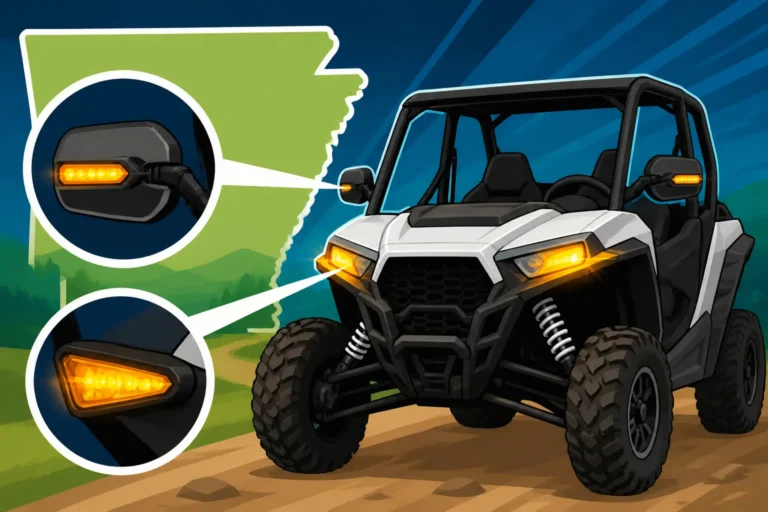
Here's where things get even more confusing, especially since Arkansas Act 922 of 2025 gave cities and towns the ability to open certain streets to side-by-sides (UTVs). Many communities across Arkansas are now considering or have already passed ordinances allowing UTVs to be street legal under specific conditions, like requiring insurance, turn signals, and a licensed driver. It's incredibly common for a quad owner to see their neighbor's side-by-side legally cruising down the street and think, "Why can't I do that with my ATV?"
The critical distinction lies in how Arkansas law defines and treats ATVs versus UTVs. While both are off-highway vehicles, UTVs (often called side-by-sides) typically have a more car-like configuration with steering wheels, bench seats, and roll cages, making them perceived as safer for street use by lawmakers. Many local ordinances explicitly state that they apply only to "UTVs" or "side-by-sides" and often include width restrictions that exclude many ATVs, which are generally narrower. This means that even if your city has a UTV ordinance, it's highly unlikely to extend to your ATV.
So, while a friend with a modified UTV, perhaps outfitted with a complete street-legal kit from a brand like SuperATV, might be able to get a city permit and legally drive on certain subdivision streets, your traditional quad is almost certainly excluded. This disparity causes significant frustration and a sense of unfairness among quad owners. It highlights the need for riders to meticulously check the specific language of any local ordinance, as [Arkansas UTV Street Legal Rules by Town] can vary wildly, and very few, if any, will encompass standard ATVs.
The Realities of Riding an ATV in Your Subdivision
Understanding the law is one thing, but living with its implications on a daily basis is another. For ATV owners in Arkansas subdivisions, the realities can be quite stark.
Potential Consequences of Ignoring the Rules
Let's be direct: riding your ATV on public subdivision streets when it's not legally permitted carries real risks. The most immediate consequence is a traffic citation. Law enforcement officers, whether city police or county deputies, are generally aware of the state's prohibition on ATVs on public roads. While some officers might offer a warning for a brief, infrequent trip, many will issue a ticket, and frankly, they're within their rights to do so. The penalties for such citations can range from significant fines to court costs, which can quickly add up. You can find more details on [Arkansas Penalties for Illegal Road Riding].
Beyond a simple ticket, repeated offenses or reckless driving could lead to more severe outcomes, such as your ATV being impounded. Imagine having your machine towed away right from your driveway because you used it to check the mailbox once too often. It's a costly and inconvenient process to retrieve an impounded vehicle, involving storage fees and proof of ownership. Furthermore, if you were to be involved in an accident while illegally operating your ATV on a public street, your insurance company might deny coverage, leaving you personally liable for damages and injuries. This could turn a minor fender-bender into a financial disaster.
The discretion of law enforcement is a factor, of course, but relying on it is a gamble. One officer might look the other way, while another might be strict. It's also worth noting that neighbor complaints can often trigger enforcement actions. If a neighbor reports you for riding your noisy ATV up and down the street, authorities are more likely to respond and issue a citation.
Navigating HOA Rules and Neighborly Relations
Even if you live in a subdivision that feels private, the Homeowners Association (HOA) rules play a crucial, yet often misunderstood, role. While an HOA cannot override state or local laws – meaning if the state bans ATVs on public roads, the HOA can't magically make them legal – they can implement additional, stricter rules for their community. Many HOAs have covenants that specifically address vehicle types, noise levels, and even where ATVs can be stored or operated within the common areas of the subdivision.
Ignoring HOA rules, even for a quick spin, can lead to fines from the association, loss of amenity privileges, or even legal action if the violations are persistent. Beyond the official consequences, riding your ATV frequently or loudly on subdivision streets can quickly sour neighborly relations. Noise complaints are a common issue. What sounds like a fun ride to you might be a disturbance to a neighbor trying to enjoy a quiet afternoon or put a baby down for a nap. Nobody wants to be "that neighbor" who constantly stirs up complaints.
Before riding, it’s always wise to review your subdivision's covenants and speak with your HOA board, if applicable. Even if there's no official "no ATV" rule, being considerate of your neighbors, especially regarding noise and dust, goes a long way. Understanding [Arkansas HOA Rules About Side-by-Sides] can offer some perspective, but remember that ATVs are often treated even more stringently than UTVs.
The Limited Exceptions That Apply (or Don't)
Arkansas law does provide a handful of specific exceptions where ATVs can legally operate on public roads. However, for most residents in a typical subdivision, these exceptions rarely, if ever, apply to their everyday riding needs. It’s important to understand these for clarity, but not to mistakenly believe they cover general neighborhood use.
The primary exceptions revolve around agricultural or hunting operations, utility work, law enforcement/EMS, and specific instances for individuals with certain disabilities. For example, if you're actively engaged in farming activities on land adjacent to a subdivision street, you might be able to use the ATV for that specific purpose. Similarly, a direct crossing of a public street at a ninety-degree angle after a complete stop is generally allowed, but this is for getting from one private property to another, not for traveling down the street. You can delve deeper into [Arkansas's Six Statutory Road Exceptions] for the full context.
What these exceptions don't cover is riding your ATV to a friend's house, taking it for a joyride around the block, or using it as casual transportation within your neighborhood. So, while it's good to know these exceptions exist, they offer little solace for the average ATV owner looking to use their machine on subdivision streets. The default remains: [Arkansas Makes Road Riding Unlawful by Default] for ATVs, and the exceptions are very narrowly defined.
What to Do If You Want to Ride Your ATV on Subdivision Streets
If you're determined to explore the possibility of legally riding your ATV on subdivision streets, there are specific steps you need to take and realities you need to face.
Research Your Local Ordinances Thoroughly
The very first and most crucial step is to connect with your local city or county clerk's office. Do not rely on hearsay from neighbors or what you've seen online. Local laws can be incredibly specific and vary dramatically from one municipality to another, even between neighboring towns. You need to ask about any ordinances related to "off-road vehicles," "all-terrain vehicles," or "UTVs/side-by-sides" on public streets.
When you do find an ordinance, read it meticulously. Pay close attention to the definitions. Does it explicitly mention ATVs (quads), or is it strictly limited to UTVs? Many ordinances passed since Act 922 specifically pertain to UTVs and exclude ATVs due to their differing safety profiles and legal classifications. Look for details on width restrictions, required safety equipment (like turn signals, mirrors, or headlights – which are often standard on UTVs but not ATVs, though SuperATV and similar companies offer conversion kits), age requirements for drivers, insurance mandates, and any permitting processes. If the ordinance is for UTVs, it simply won't apply to your quad.
Understanding the specific wording is key. For example, an ordinance might allow UTVs on streets with a speed limit of 35 mph or less, but explicitly prohibit them on state highways that pass through town, even if the speed limit is low. For ATVs, these allowances are exceedingly rare. This meticulous research will confirm if there's any legal avenue for your ATV in your specific subdivision, or if the general state prohibition is still the prevailing rule.
Advocating for Change (and Understanding the Hurdles)
If your local research confirms that ATVs are prohibited on subdivision streets, and you truly believe there's a need for change, you have the option to advocate for it. This typically involves approaching your city council or county quorum court. You'll need to gather support from other residents, present a well-researched case for why ATVs should be allowed, and propose a draft ordinance that addresses safety concerns.
However, be realistic about the significant hurdles involved. Getting local government to permit ATVs on public streets is often a much tougher sell than for UTVs. The perception of ATVs as less stable, more prone to rollovers, and generally less "street-friendly" than UTVs is deeply ingrained. Concerns about noise, dust, and potential accidents are common, and you'll need compelling arguments to address them. You might even find that some local officials aren't familiar with the difference between a UTV and an ATV, requiring you to educate them.
Joining or forming a local riding club or community group can significantly amplify your voice. A collective effort, with multiple residents presenting a unified front, is always more impactful than individual appeals. While it's great to customize your machine with robust aftermarket parts from a brand like SuperATV, it's crucial to remember that no amount of modification can bypass the legal framework without a change in local ordinance. This advocacy path can be long and challenging, but it's the only way to potentially shift the legal landscape for ATVs in your specific area.
Alternative Riding Options (The Safe and Legal Route)
Given the complexities and restrictions around riding ATVs on subdivision streets, many riders find peace of mind and more enjoyment by focusing on legal, designated riding areas. Arkansas boasts some fantastic options for off-road enthusiasts, providing a safe and permitted environment to unleash your machine.
Exploring dedicated trail systems in national forests, such as Wolf Pen Gap or Mill Creek, offers miles of varied terrain suitable for ATVs. These locations often require an OHV permit, but they guarantee a legal and often scenic riding experience. Private off-road parks, like Hot Springs Off-Road Park or Byrd's Adventure Center, are another excellent choice, offering controlled environments, amenities, and often more extreme challenges. These parks have their own rules and fees, but they remove the worry of breaking the law on public roads.
Consider also [Arkansas Rules for Riding on a Parent's Property] or [Arkansas Rules for Riding With Landowner's Permission] if you have access to private land. Always ensure you have explicit, preferably written, permission from the landowner. While it might not be as convenient as riding out of your driveway, embracing these alternative riding options ensures you're enjoying your ATV legally and safely, without the constant worry of fines or impoundment. For more ideas, check out [Arkansas ATV Trails: Where to Ride].
| Feature/Vehicle Type | ATV (Quad) | UTV (Side-by-Side) |
|---|---|---|
| Default State Law on Public Roads | Prohibited in most cases | Prohibited in most cases |
| Local Ordinance Potential for Subdivision Streets | Extremely rare; generally excluded | Yes, many towns allow with permit/requirements |
| Common Passenger Capacity | Typically 1-2 riders | Typically 2-6 riders |
| Steering Type | Handlebars | Steering wheel |
| Seat Type | Straddle seat | Bench/bucket seats |
| Street Legal Conversion Feasibility | Very difficult; state/local law typically bars | Possible in towns with UTV ordinances (e.g., [Arkansas UTV Street Legal Rules by Town]) |
| Primary Use Focus | Off-road recreation, utility | Off-road recreation, utility, potential street use |
Disclaimer
This article is for general informational purposes only and does not constitute professional advice. Laws, prices and regulations vary by location and change over time. Consult a qualified professional for guidance on your specific situation.