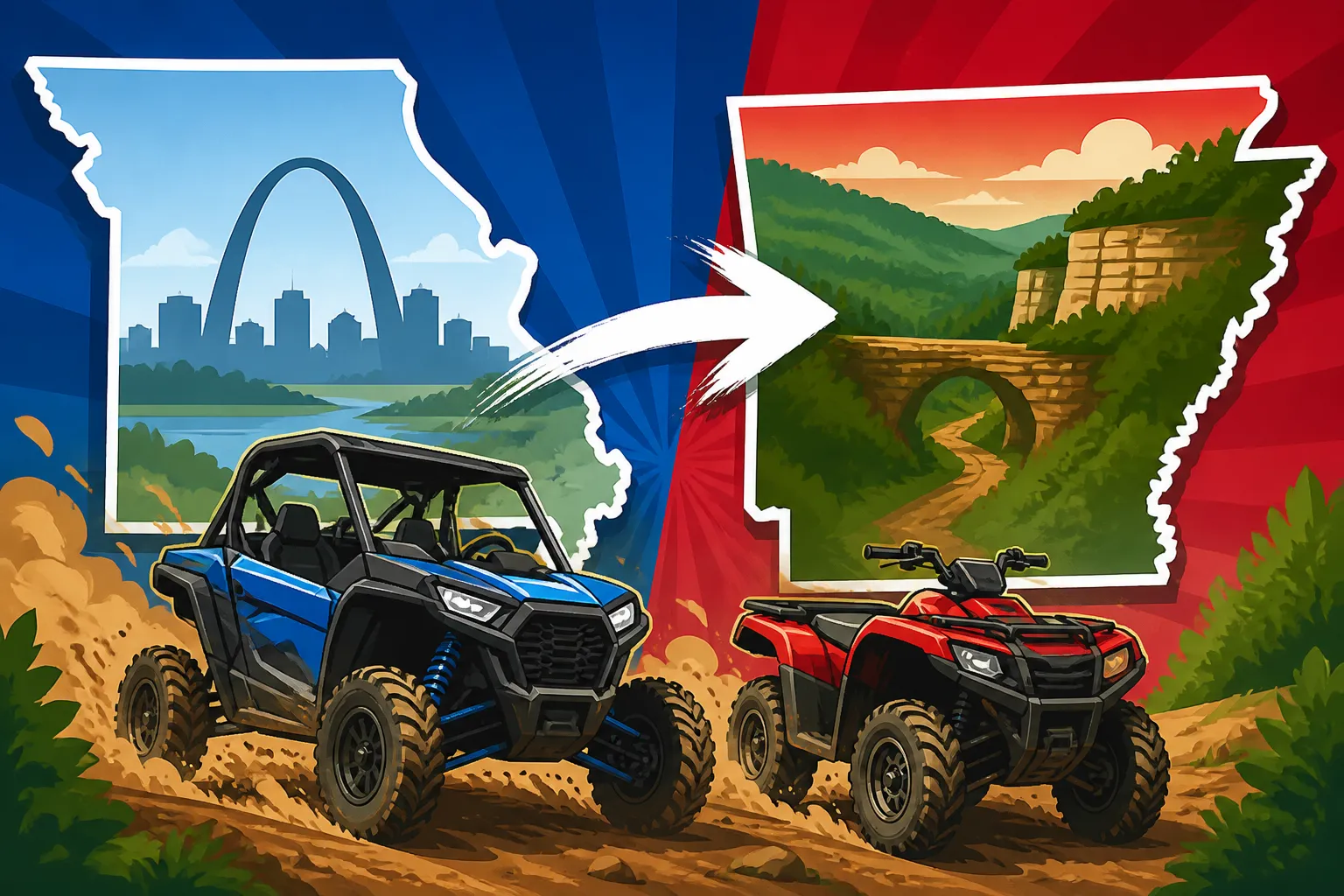
Arkansas Visitors From Missouri
Missouri riders planning an Arkansas ATV or side-by-side trip can run into a paperwork mix-up: a machine’s home-state documents are not the same thing as permission to ride a particular trail. The key is to check three separate things before leaving: machine requirements, riding-area permits and local access rules.
Separate Missouri paperwork from Arkansas riding permits
A Missouri registration, title or other ownership record may help show that a machine is properly documented at home. It does not automatically provide access to every Arkansas trail, forest road or wildlife management area. Nor should you assume that one permit covers all riding areas.
For a trip, think in three layers:
- Machine paperwork: Documents connected to the ATV or UTV, such as proof of ownership and any registration or decal that applies.
- Riding-area permit: A pass or permit required by the place where you plan to ride.
- Access rules: Limits on which trails or roads are open to your vehicle, and when you may use them.
These are separate checks. A rider could have valid Missouri paperwork but still need an Arkansas riding-area permit. A rider with a trail permit could still be turned away if the machine exceeds a gate’s width limit or is not allowed on a particular route.
Arkansas forest permits are not interchangeable across every riding area. The Ouachita and Ozark-St. Francis national forests have separate permit systems for designated OHV riding opportunities, so a pass for one forest should not be treated as permission to ride in the other. Check the specific area and route before setting out. The practical distinction is explained in Arkansas Riders Need Two Different Forest Passes.
Do not confuse a forest OHV permit with Arkansas vehicle registration. Registration concerns the machine and its legal status under applicable state rules; a forest permit concerns use of particular recreation land. If you are unsure whether your nonresident machine needs an Arkansas registration decal, check the current requirements with the appropriate state office before traveling. The issue is covered in Do Out-of-State Riders Need an Arkansas Registration Decal?.
| What you have or need | What it generally addresses | What it does not automatically provide |
|---|---|---|
| Missouri machine paperwork | Ownership or compliance matters under Missouri rules | A pass for Arkansas trails or public land |
| Arkansas forest OHV permit | Use of covered OHV riding areas under that permit’s terms | Permission to ride in every forest or on every road |
| Trail or site information | Route status, hours, vehicle limits and closures | Proof of ownership or required registration |
| Landowner or lease permission | Access to the specific private or leased land | Permission to cross other property or enter public trails |
For the permit and registration distinction in more detail, see Arkansas National Forest Riding Explained and [Arkansas Proof of Ownership on the Trail]. Treat any information from a prior trip as a starting point, not a guarantee that the same permit, route or operating condition applies now.
Check the riding area before you choose a permit
The most efficient approach is to plan around a named riding area, not simply “Arkansas.” Decide which trail system you intend to use, then check its current rules and status through the responsible land manager or operator. Arkansas riding opportunities include national forest systems and private off-road parks, and their permit, vehicle and access rules are not necessarily alike.
For forest riding, confirm which forest the trail is in and what permit that forest requires. Check whether your machine is allowed on the routes you want to ride, whether there are width restrictions, and whether seasonal closures or temporary conditions affect access. Trailheads and connecting roads may have different rules from the trails themselves. A forest permit is not a blanket pass to use every road or parcel of land in that forest.
If you plan to ride a private park, check directly with the park. Its admission or riding requirements may be separate from forest permits. Parks can also set their own operating rules, such as vehicle restrictions, age requirements, waiver procedures and required safety equipment. Do not buy a forest pass expecting it to cover a private park visit.
Before leaving Missouri, make a short list of each place you might ride and confirm:
- Which agency or operator manages it.
- Whether an OHV permit or admission pass is needed.
- Where and how the permit must be purchased or displayed.
- Whether the pass is tied to a particular vehicle or riding area.
- Whether your ATV or UTV fits the trail system’s vehicle limits.
- Whether the routes are open on the dates you plan to visit.
- Whether the trailhead has any special instructions or access restrictions.
The Arkansas ATV Trails: Where to Ride overview can help you identify the kind of area you are considering. For current permit steps, use How to Buy an Arkansas Forest OHV Permit as a planning reference, then confirm the details with the official permit provider. If you want to compare daily and longer-term options, Arkansas Day Permit vs Annual Permit Value may help you frame the question; verify current availability and terms before paying.
Wildlife management areas are a separate check
A forest trail permit does not mean an ATV or UTV can travel anywhere on a wildlife management area. These areas can have rules that distinguish open roads from gated roads, levees, food plots and other restricted ground. Some access may also depend on the season or the purpose of travel.
Check the rules for the specific area rather than relying on a map line, an old route description or another rider’s recollection. A road that appears passable is not necessarily open to recreational vehicle use. Start with Arkansas AGFC WMA Rules for Riders and verify any special rules for the property you plan to visit.
The same care applies to private land, timberland and hunting leases. Do not assume that a trail crossing or a gate left open means you have permission. If access depends on a landowner, club or leaseholder, get permission from the person or organization that controls it.
Prepare your documents and machine for the trip
Bring enough paperwork to explain who owns the machine and what riding permissions you have obtained. Keep digital copies as a backup, but do not rely on a phone alone: signal may be weak at a remote trailhead, and a battery can run down during a long day.
A practical travel folder can include:
- Your Missouri registration or other machine documents that apply.
- Proof of ownership, such as a purchase record or bill of sale if relevant.
- The confirmation or receipt for each required Arkansas riding permit.
- Any park reservation, waiver confirmation or access permission.
- Contact information for the riding area or permit office.
- A route map and notes about closures, gates and vehicle limits.
If you have questions about which documents demonstrate ownership or registration, resolve them before arriving at the trailhead. The paperwork a rider carries is different from the permit that grants access to a particular site. For an overview of what to keep available while riding, see [Arkansas Proof of Ownership on the Trail].
Check the machine itself against the riding area’s limits. Width can matter, especially where a trail system uses narrow gates. Measure the vehicle as it is equipped for the trip, including accessories that affect its overall width. Do not rely only on the model name or a brochure specification if the trail manager sets a maximum width. Tires, wheels, bumpers and other additions can affect whether the machine fits.
Carry the permit as directed by its issuer. Some permits may need to be displayed on the machine; others may have different proof requirements. Read the actual instructions rather than guessing where a sticker belongs. If the permit is electronic, save the confirmation where it can be opened offline and keep a screenshot or printed copy if allowed.
A downloaded map is useful, but a paper backup is sensible in areas with limited cell service. A waterproof map sleeve, available from outdoor retailers and marketplaces such as Amazon, can help protect a printed map from mud and rain. Check the map’s date and compare it with current closure information; a map is not a substitute for a current trail-status check.
Plan for the ride itself, too. Tell someone where you intend to ride, carry water and basic recovery or first-aid supplies, and avoid assuming that a remote area will have fuel, cell service or help nearby. These preparations do not replace permits, but they reduce the chance that a small problem turns into a difficult recovery.
A simple pre-trip process for Missouri visitors
Use this sequence before you load the trailer. It keeps machine paperwork, permits and trail access from getting tangled together.
- Choose the exact riding area. Identify the forest, park or management area rather than planning around a broad region. If your itinerary includes more than one riding area, check each one separately.
- Confirm the machine is eligible. Ask about vehicle type, width limits, route restrictions and any equipment requirements. If the machine is modified, use its actual equipped dimensions.
- Check the home-state documents. Bring the Missouri paperwork that applies to the machine and verify whether Arkansas has a separate registration or decal requirement for your circumstances. Do not infer reciprocity from a Missouri document alone.
- Get the right site permit. Confirm that the permit applies to the planned riding area, vehicle and dates. If the trip includes the Ouachita and Ozark-St. Francis forests, check each forest’s permit requirements independently.
- Review current access conditions. Look for seasonal closures, storm damage, maintenance closures, fire restrictions and route changes. Recheck shortly before departure because conditions can change.
- Pack proof and a backup map. Bring the permit confirmation and machine documents in an accessible place, plus an offline or paper map for areas without dependable service.
- Follow signs and posted directions at the site. A permit does not override a closure, gate, posted restriction or instruction from land managers.
A common mistake is to purchase a pass after hearing that “Arkansas requires a permit,” without checking which permit or where it applies. Another is to arrive with a Missouri registration and assume that settles every Arkansas requirement. The safer approach is to ask two distinct questions: “What paperwork must this machine have?” and “What permission does this riding area require?”
When contacting an office or park, describe the machine accurately. Give its type, whether it is an ATV or side-by-side, and its width if that could matter. Explain that you are visiting from Missouri and name the specific trail system. A precise question is more likely to produce a useful answer than asking whether “ATVs are allowed in Arkansas.”
For a closer look at the Missouri-specific visitor issue, see Arkansas Rules for a Visiting Missouri Rider. Use that information alongside the current instructions from the actual land manager or park. If the trip covers several locations, keep a separate note for each permit and access rule rather than treating the entire visit as one ride.
Disclaimer
This article is for general informational purposes only and does not constitute professional advice. Laws, prices and regulations vary by location and change over time. Consult a qualified professional for guidance on your specific situation.