Arkansas Visitors From Texas
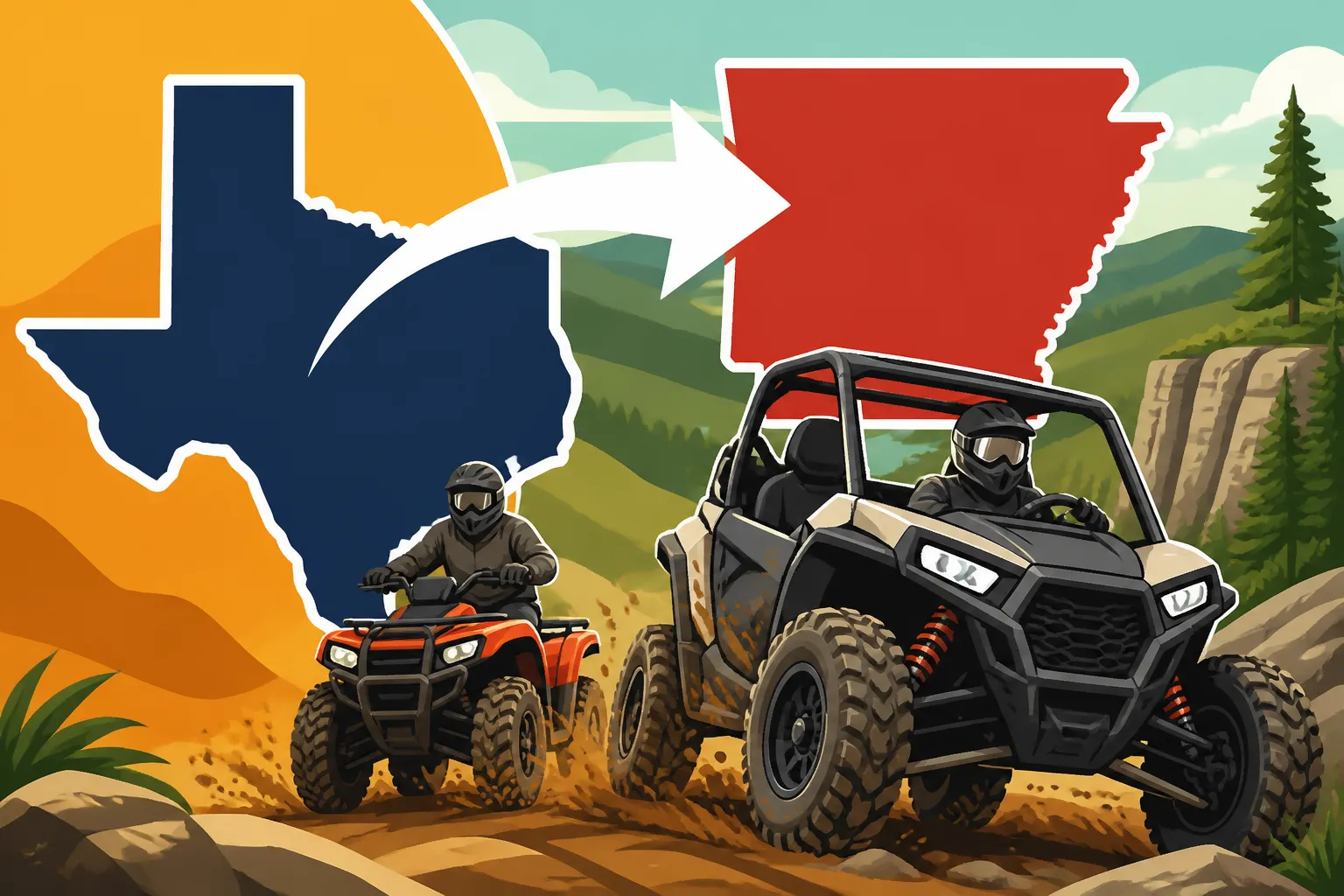
A Texas registration decal does not automatically give an ATV or UTV permission to ride everywhere in Arkansas. Visitors need to sort out what applies to their machine, who manages the land, and whether a particular trail requires a pass. The key distinction: federal forest access, special trail fees, state-managed areas, and public roads can each have different rules.
Does a Texas ATV Decal Work in Arkansas?
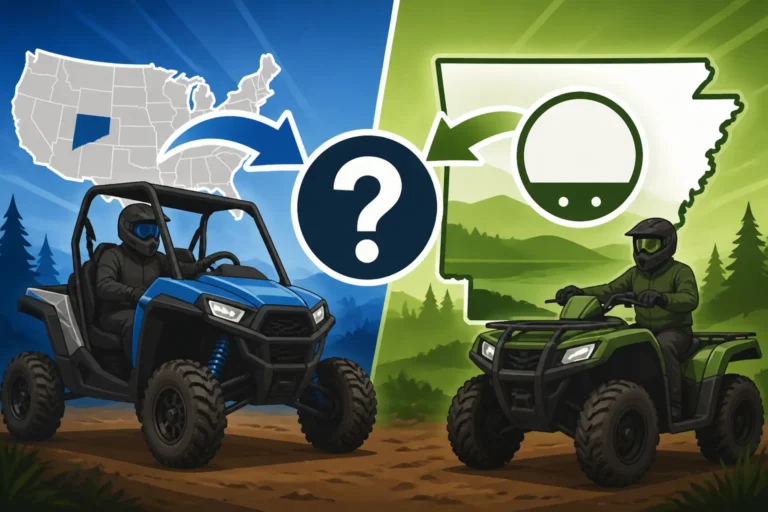
Arkansas and Texas have no off-highway vehicle registration or decal reciprocity agreement, according to Texas Parks & Wildlife Department. So don’t assume a Texas decal will satisfy an Arkansas registration requirement.
That does not mean a Texas visitor automatically needs Arkansas registration just to ride a designated route in a national forest. The USDA Forest Service says nonresidents generally do not need a separate Arkansas state OHV registration or trail permit to operate on federal public lands such as national forests, as long as they stay on designated routes. Some specific trails have their own fees or permits, though, and state-managed lands can follow different rules.
Think of registration and riding access as separate questions:
- Registration or decal: Does Arkansas require paperwork for your machine or use?
- Land access: Does the agency managing your destination allow OHV riding there, and does that location require a pass?
- Route access: Is the trail or road open to your vehicle type on the day you plan to ride?
A Texas decal does not answer all three. For a closer look at when visitors may need an Arkansas decal, see Do Out-of-State Riders Need an Arkansas Registration Decal?. If you are bringing a side-by-side, Arkansas Rules for an Out-of-State UTV covers the separate questions that can apply to UTVs.
If Arkansas registration does apply to your situation, the Arkansas Department of Finance and Administration lists an ATV registration fee of $5.00, as of November 2026. That fee is not a trail pass, and paying it does not by itself authorize riding on a particular property.
| Where you plan to ride | What a Texas visitor should check |
|---|---|
| General routes in an Arkansas national forest | The USDA Forest Service says a separate state OHV registration or trail permit is generally not required for nonresidents on federal public lands, provided they stay on designated routes. Check the forest’s route and vehicle rules. |
| Mill Creek or Moccasin Gap | The USDA Forest Service says these Ozark-St. Francis National Forest trail systems require a day-use fee or permit. |
| A state wildlife management area | Requirements depend on the land and its rules. The USDA Forest Service notes that state-managed wildlife areas can have their own access requirements. |
| A public street or highway | The Arkansas General Assembly says general ATV operation on public streets and highways is unlawful, subject to specific exceptions. |
| Buffalo National River | The National Park Service oversees regulations within the park boundary. Check its rules for the exact location and activity rather than assuming national forest rules apply. |
The practical point is to check the land manager, not just your home-state paperwork. A pass for one Arkansas riding area may not be valid at another. Arkansas ATV Trails: Where to Ride can help you identify a destination before you look up its specific access rules.
Forest Passes, Trail Fees, and Land Boundaries
Much of the confusion comes from treating “Arkansas forest riding” as one permit system. It is not. National forests, individual trail systems, wildlife management areas, and National Park Service land can have different managers and requirements.
On general designated routes in the national forests, the USDA Forest Service says nonresidents generally do not need a separate Arkansas OHV registration or trail permit. That is not a blanket pass for every trailhead or public property. The Forest Service identifies Mill Creek and Moccasin Gap in the Ozark-St. Francis National Forests as trail systems that require a day-use fee or permit. Confirm the current instructions for the exact system before heading out.
The Ouachita National Forest has designated motorized trails with operating seasons. According to the USDA Forest Service, trails such as the Wolf Pen Gap Trail Complex are typically open from the first Friday of March through October 31, plus specific holiday periods from three days before Thanksgiving through two days after, and December 22 through January 2. These are typical operating windows, not a guarantee that every route will be open: closures, conditions, or local notices can affect access. Check the forest’s current trail status before traveling.
The Arkansas OHV Permits: Two Forests, Two Prices article explains why a pass or fee associated with one forest should not be assumed to cover another. For a specific system, Mill Creek OHV Permits in Arkansas is a useful place to check the trail-level requirement.
State wildlife management areas are another separate category. A forest pass does not automatically provide access to a state-managed area, and a Texas decal does not replace any site-specific access rule. The USDA Forest Service notes that rules and entry permits can depend on the agency managing the land. Before unloading, check whether the area allows OHVs at all, which routes are open, and whether any permit or other access condition applies. See Arkansas WMA Access for a Quad for more on that distinction.
Buffalo National River also needs separate attention: it is overseen by the National Park Service, not treated as a national forest for regulation purposes. Do not assume that a route open to OHVs elsewhere in Arkansas is open within the river’s boundaries. Check the National Park Service’s rules for the location you intend to visit.
A reliable planning routine is:
- Identify the exact trail, forest, park, or managed area.
- Find the agency that manages it.
- Check whether OHVs are allowed on your intended route.
- Confirm any permit, day-use fee, seasonal closure, or vehicle-width rule.
- Recheck conditions before leaving, since access can change.
Equipment, Machine Type, and Rider Age
A machine that is properly registered in Texas may still need to meet Arkansas’s equipment and land-use rules. Pay particular attention to the spark arrester, exhaust, and the type of vehicle a trail allows.
The USDA Forest Service says internal combustion engines on off-highway vehicles operating in the National Forest System must have a properly installed and maintained spark arrester. In the Ozark-St. Francis National Forests, a spark arrester is legally required. A spark arrester that has been removed, altered, or is not maintained can create a compliance problem, even if the machine was acceptable for riding at home.
Arkansas law also prohibits operating an ATV with a modified exhaust or with a removed or modified spark arrester, according to the Arkansas State Legislature. Some public wildlife management areas enforce “Factory Exhaust Only” rules. Keep the exhaust system in its legal configuration, and check the rules for the exact area rather than relying on what is permitted at a Texas riding site.
For a UTV or side-by-side, width can affect whether the machine fits a route or trail system. The Arkansas Department of Finance and Administration defines a UTV or side-by-side as 80 inches or less in width. That definition does not mean every trail accepts every UTV within that width. Check the trail’s vehicle restrictions and gate measurements before making the trip. A registration decal cannot make an oversized machine fit a restricted route.
Rider age requirements also depend on where you are riding. Under Arkansas state law, a person must be at least 12 years old to operate an ATV without adult supervision, according to the Arkansas General Assembly. On federal public lands such as Arkansas national forests, the USDA Forest Service requires operators to be at least 16 years old to ride without constant adult supervision. A visitor should follow the rule that applies to the land being used, not assume the Texas rule carries over.
These rules are distinct from general protective advice. A properly fitted helmet, eye protection, and clothing suited to the terrain are sensible choices, but do not confuse personal safety gear with a forest permit or a valid route. For state-level helmet information, see Arkansas ATV Helmet Requirements.
Public Roads and a Simple Pre-Ride Checklist
Do not plan to use public roads as connectors between Arkansas riding areas. The Arkansas General Assembly says operating an ATV on public streets and highways is generally unlawful, with specific exceptions such as farming, hunting, or direct road crossings. State law does not authorize general ATV riding on paved state highways.
Those exceptions are limited; they are not a general permission to ride along a road because it is convenient. If your route involves a crossing, confirm the applicable conditions before you ride. The details are covered in Arkansas Rules for Crossing a State Highway. Keep the rest of your route on legal, designated trails or other land where you have permission to ride.
Before traveling from Texas, use this checklist:
- Confirm the destination and land manager. National forest, wildlife management area, and National Park Service land may have different rules.
- Check for a trail-specific pass. General forest access does not guarantee that a particular trail system is fee-free.
- Verify the route is open. Seasonal operating periods and temporary closures can affect your plans.
- Inspect the spark arrester and exhaust. Make sure the required equipment is installed, maintained, and unmodified.
- Check UTV width and trail limits. The state definition is not a promise that every route accepts your machine.
- Plan for the applicable age rule. State and federal public-land requirements are not identical.
- Avoid public-road shortcuts. Use designated routes and confirm any specific crossing exception that may apply.
- Carry useful machine and trip information. Keep your registration details and the trail or permit information available so you can answer questions about your vehicle and destination.
The safest assumption for a Texas visitor is that home-state paperwork does not settle Arkansas access. Check each destination’s current rules, obtain any required trail-specific permit, and keep the machine and route within the applicable limits. That approach avoids the common mistake of arriving with a valid Texas decal but the wrong expectations about where it allows you to ride.
Sources
- Department of Finance and Administration — Arkansas Code § 27-20-202 (2025) – Registration required (checked November 2, 2026)
- USDA Forest Service — Wolf Pen Gap – Ouachita National Forest (checked November 2, 2026)
- State of Arkansas Department of Finance and Administration — State of Arkansas Department of Finance and Administration Fiscal Impact Statement HB1606 (checked November 2, 2026)
Disclaimer
This article is for general informational purposes only and does not constitute professional advice. Laws, prices and regulations vary by location and change over time. Consult a qualified professional for guidance on your specific situation.