Arkansas Riding on a Guardian’s Land
Arkansas Riding on a Guardian’s Land
A child may have permission to ride an ATV on a parent or guardian’s property, but permission alone does not answer every legal and safety question. Arkansas rules can still apply to the rider, the machine, and the land. Here’s how to think through supervision, registration, forest permits, and the boundary between private property and public riding areas.
What Counts as Riding on a Guardian’s Land
For a young rider, “the guardian said it’s okay” and “the ride is on land the guardian owns or leases” are not necessarily the same thing. The property relationship can matter under Arkansas rules, especially for riders under 12. It is worth confirming who legally owns or leases the land, who is supervising, and whether the intended route stays within the property.
A parent or legal guardian’s land usually means property that person owns or leases. It does not automatically include a neighbor’s acreage, a relative’s farm, or a hunting lease held by someone else. Those places may still be available for riding with the owner or leaseholder’s permission, but that is a separate permission question. See Riding on Land You Lease and Arkansas Rules With a Landowner’s Permission for those situations.
Permission also has limits. A guardian cannot grant access to public land, a forest road, a wildlife management area, or another person’s property simply by agreeing to the ride. If a route leaves the guardian’s property, the rules for the next piece of land apply. A ride that begins in a backyard can quickly become a different legal situation if it continues onto a county road, crosses a public trail, or enters a neighbor’s field.
| Riding location | What permission covers | What to check separately |
|---|---|---|
| Land owned by the parent or guardian | The family’s permission to ride on that property | Rider supervision, machine registration, safety, and any local restrictions |
| Land leased by the parent or guardian | Permission to use the leased property, within the lease terms | Lease conditions, owner’s restrictions, and whether the route leaves the leased land |
| A relative’s or neighbor’s land | Only the permission granted by that landowner or leaseholder | Whether permission is clear and whether any route crosses other property |
| National forest trail or road | Access only under the land manager’s rules | Required permit, open routes, seasonal closures, and machine restrictions |
| Wildlife management area | Access only where and when riding is allowed | AGFC rules, open roads, barriers, and any permit requirements |
| Private off-road park | Access subject to the park’s admission and operating rules | Park-specific age, helmet, waiver, machine, and permit requirements |
This distinction is useful because “private land” is not a universal exemption. A machine may still need Arkansas registration even when it is ridden only on private property. Meanwhile, a forest permit is tied to the relevant public riding area; it is not a general permission slip for private land. For the state registration question, see Arkansas ATV Registration for Private Land Only Machines.
Young Riders and Adult Supervision
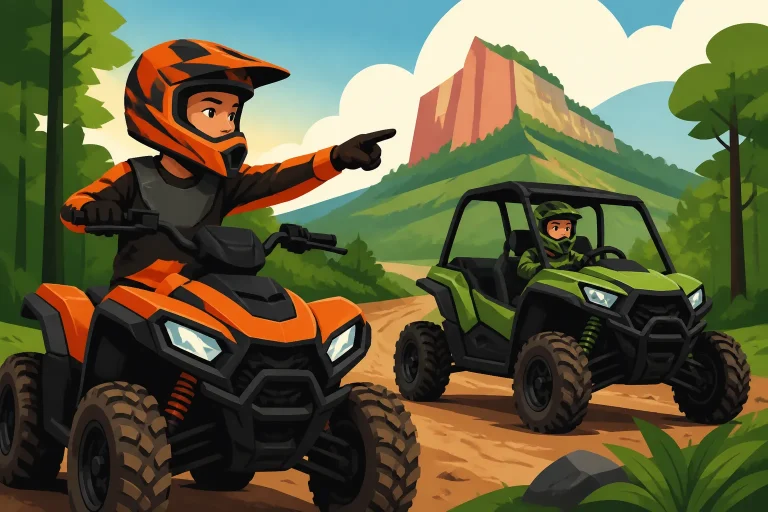
A guardian’s property can be an appropriate place for a child to learn, but the property’s ownership does not replace the need to follow age and supervision rules. Arkansas has rules concerning riders under 12, including direct adult supervision. Families should not assume a child can ride alone simply because the guardian owns or leases the land.
For practical purposes, plan on an adult who is at least 18 being actively responsible for a rider under 12. “Direct supervision” should mean more than being somewhere on the property or checking in occasionally. The adult should be close enough to observe the riding, respond promptly, and stop the activity if the child is losing control or approaching a hazard. Review Arkansas Rules for Riders Under Twelve and Direct Supervision by an Adult before setting up a ride.
Supervision is not a substitute for choosing an age-appropriate machine. A child should be able to reach and operate the controls, understand how to stop, and manage the machine’s weight and power. A small youth ATV is not automatically safe for every child of the same age, and an adult-sized machine may be too difficult for a young rider to control. Follow the manufacturer’s rider guidance, and do not carry a child on a machine that is designed for one rider.
A useful family plan includes clear boundaries and simple rules:
- Choose a defined riding area away from roads, ponds, steep banks, livestock, and equipment.
- Set a low-speed limit appropriate to the rider and terrain.
- Identify where the child may turn around and where riding is not allowed.
- Keep the supervising adult positioned where the child can be seen and heard.
- Stop the ride when visibility, weather, fatigue, or the child’s attention becomes a concern.
- Keep other children and bystanders out of the riding area.
A helmet and other protective gear are sensible even on familiar property. Private land does not make a rollover, collision, or head injury less serious. Check the fit of the helmet before each ride and use eye protection, gloves, sturdy footwear, and clothing that covers exposed skin. Arkansas rules may not require the same equipment in every private-land situation, but safety equipment can matter regardless of whether a particular item is legally required. For the broader state discussion, see Arkansas ATV Helmet Requirements.
An adult supervising a child should not operate another machine in a way that makes it difficult to watch the young rider. It is also wise to keep the supervising adult’s phone accessible, but not to treat a phone as a replacement for close attention. If a child is new to riding, a brief, flat practice area with a clear stop point is safer than sending the child onto a long route or uneven ground.
Registration, Decals, and Other Machine Rules
Private property does not necessarily remove Arkansas registration requirements. If the machine falls within the state’s ATV definition, registration rules may apply even if the owner says it will never be ridden on a public road or trail. The machine’s type and specifications matter, so do not assume every off-road vehicle is treated the same way. See What Arkansas’s ATV Statute Covers for the scope of the definition and Arkansas ATV Registration for Private Land Only Machines for the private-property issue.
Registration and public-land permits serve different purposes. Arkansas registration is a state requirement for covered machines; a forest permit is a separate access requirement for certain public riding areas. Having one does not automatically provide the other. Likewise, a registration decal is not a license plate or a blanket authorization to ride on roads. Review Arkansas ATV Decal Rules and Where It Goes for decal display details.
Before a family ride, check the machine’s paperwork and identification. The registered owner should keep registration information with the machine or in a reliable place that can be reached when needed. Taking a clear photograph of the serial number and keeping ownership documents can also help if the paperwork is misplaced. If the machine is borrowed, make sure the owner’s permission is clear and that the family knows who is responsible for it.
A guardian’s ownership of the land does not settle every question about a machine. Depending on the vehicle, Arkansas rules may treat a side-by-side, golf cart, dirt bike, or other motorized machine differently from an ATV. A machine that does not meet the statutory ATV definition may still be subject to other rules. If the vehicle is a UTV rather than a quad, see Arkansas UTV Registration Requirements.
For property-only use, keep these points separate:
- Land access: Does the guardian own or lease the exact ground being ridden?
- Rider rules: Is the rider old enough, and is the required supervision in place?
- Machine status: Does the machine need Arkansas registration?
- Trail access: Is a separate permit needed for the place where the ride occurs?
- Road use: Does the route enter or cross a road, and are road rules triggered?
A family may want to keep registration and ownership records in a waterproof pouch stored with the machine’s gear. A simple pouch sold through Amazon can help protect paperwork from mud and rain, but it does not replace carrying any proof a land manager or officer may require.
When the Ride Leaves Private Property
The moment the ride crosses the guardian’s property line, the rules may change. The next parcel might belong to another landowner, be part of a lease, or be public land managed for a particular use. A gate, trail, or old road visible from the property is not proof that the family has permission to use it.
On national forest land, the rider must follow the forest’s access rules. That can include a specific OHV permit, restrictions on where vehicles may travel, seasonal closures, and machine-width limits. Arkansas has separate forest riding areas with separate permit systems, so one pass should not be assumed to cover all riding. Read Arkansas Riders Need Two Different Forest Passes and How to Buy an Arkansas Forest OHV Permit before planning a public-land trip.
Wildlife management areas have their own vehicle rules. Some roads may be open to vehicles while gated, cabled, or posted routes remain closed. A hunting purpose or a nearby family property does not automatically authorize riding across a WMA. Check Arkansas AGFC WMA Rules for Riders and follow signs at the site; a closed gate should be treated as a boundary, not an invitation to find another way through.
Private parks are different again. The park controls entry and may set its own rules for age, supervision, helmets, waivers, machine size, and passengers. A guardian’s land permission has no effect on those park conditions. Before loading up, confirm directly with the park what documents and equipment it requires, especially when a child will ride.
Roads deserve particular caution. Arkansas generally restricts ATV and UTV operation on public roads, with limited exceptions and local rules that may apply to certain UTV use. A landowner’s permission does not make a public road part of private property. Avoid using a road as a shortcut between two parts of a property unless the route and the applicable law clearly allow it. For road-specific rules, see Arkansas ATV Road Rules: What 27-21-106 Says and Arkansas Makes Road Riding Unlawful by Default.
If the family plans a ride that connects private property to a public trail, treat it as two separate rides for planning purposes. Confirm the private-land permission first, then check the public-land permit, route, open dates, machine limits, and required equipment. Do not rely only on an old map or a trail line shown in an app; closures and access conditions can change.
A Practical Checklist for Guardians
Good planning is usually simpler than trying to resolve a dispute at a property line or trailhead. Before the first ride, answer these questions:
- Is the land owned or leased by the parent or legal guardian, or does someone else control it?
- Does the lease allow recreational ATV use, and are there any limits on where or when the machine can be used?
- Is the rider under 12, and is direct adult supervision arranged?
- Is the machine suitable for the rider’s size and experience?
- Does the machine need Arkansas registration, and is its decal displayed as required?
- Does any part of the planned route enter a public road, forest, WMA, or private park?
- If the ride reaches public land, has the correct permit and current access information been checked?
- Are helmets and other protective gear fitted and ready?
- Is the riding area clear of people, animals, vehicles, water hazards, and equipment?
- Does everyone know the boundaries, stop signal, and plan if the machine breaks down?
If the property is leased, check the actual lease rather than relying on a casual assumption that “the family has access.” A lease may allow hunting or farm work but restrict recreational vehicle use. The landowner may also impose conditions that are stricter than what state law requires. Where the lease language is unclear, ask the landowner or leaseholder before riding.
For a child, keep the first sessions short and predictable. Practice starting, stopping, turning, and using the controls in a level, open area. Build up only when the child can follow instructions and control the machine consistently. If the child becomes tired, upset, or distracted, end the ride rather than turning a small mistake into a serious one.
For multiple riders, consider whether the younger rider can be supervised without the adult splitting attention between machines. Keep a safe following distance and establish a rule that nobody rides ahead out of sight. If the terrain changes, stop and reassess before continuing. A familiar property can still have new hazards after rain, maintenance work, or changes in livestock and equipment placement.
Finally, keep the permission arrangement clear. If the guardian is not the landowner but holds a lease, retain the landowner’s permission where required by the lease. If a child is invited to ride on another family’s property, make sure the responsible adult knows the route and the supervising adult’s role. Clear permission and boundaries prevent misunderstandings, but they do not replace registration, supervision, or public-land requirements.
Frequently Asked Questions
Can a child ride an ATV alone on a guardian’s property?
Do not assume so. Arkansas has direct-supervision rules concerning riders under 12, and the fact that the guardian owns or leases the property does not automatically remove that responsibility. Check the current rule and provide close adult supervision.
Does guardian permission replace Arkansas ATV registration?
No. Permission answers whether the rider may use the land. Registration is a separate question that depends on the machine and Arkansas requirements. Private-property-only use does not necessarily remove registration obligations.
Does a guardian’s land need an OHV permit?
A forest OHV permit is for use in the relevant public riding area, not for ordinary riding on a guardian’s private property. If the planned route enters national forest land or another managed riding area, check that location’s permit and access rules.
Can a child ride on a relative’s property under the guardian-land rule?
Not automatically. A relative’s property is not necessarily land owned or leased by the child’s parent or legal guardian. Get permission from the person who controls the land, and check which age and supervision rules apply to the situation.
Disclaimer
This article is for general informational purposes only and does not constitute professional advice. Laws, prices and regulations vary by location and change over time. Consult a qualified professional for guidance on your specific situation.