Direct Supervision by an Adult
A child riding an ATV needs more than an adult somewhere at the property or trailhead. In Arkansas, direct supervision matters for young riders, but the practical details can depend on the machine and where you ride. Here’s how to supervise closely, check the rules for your destination, and avoid assuming that a permit or landowner’s permission replaces adult oversight.
What direct supervision means in Arkansas
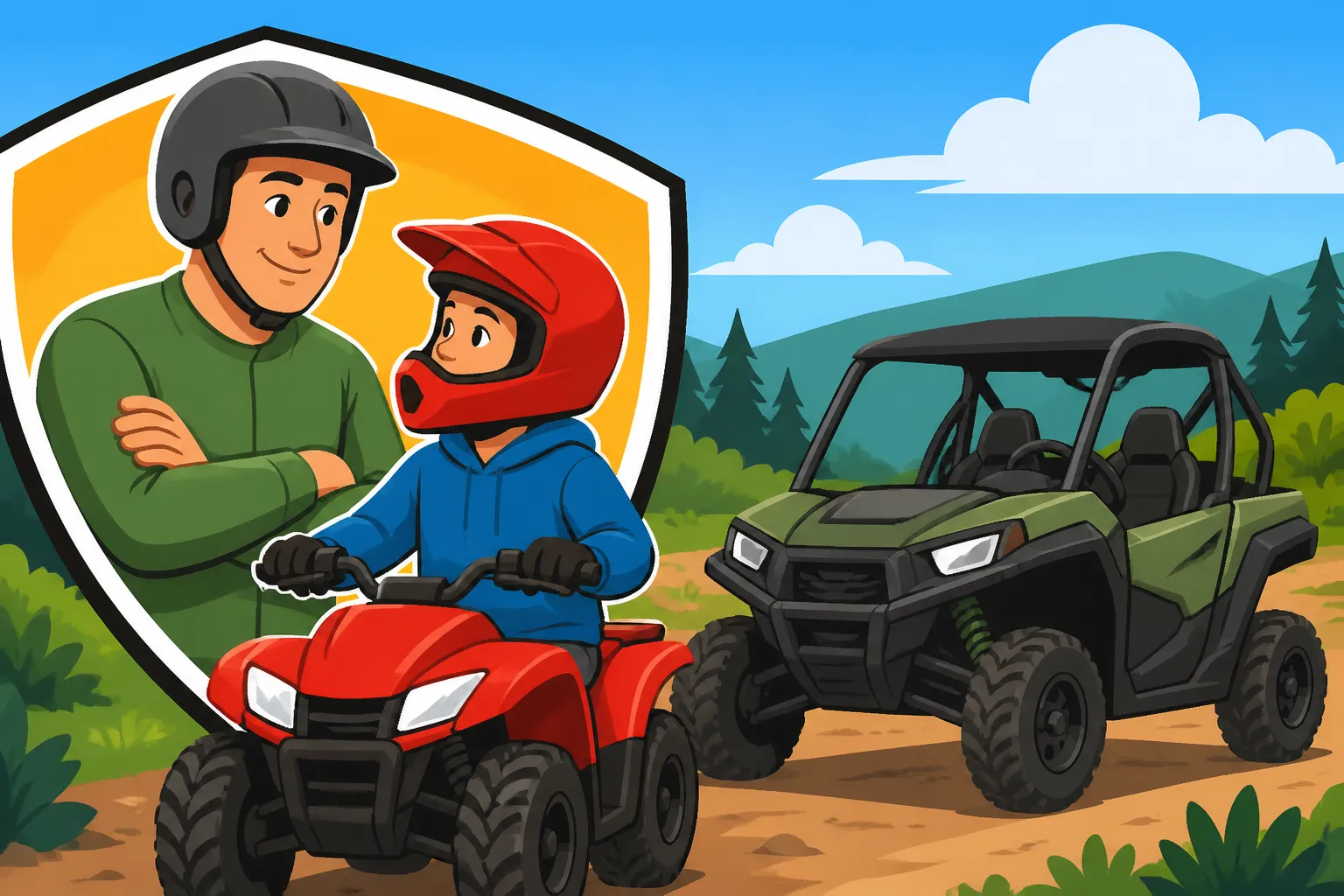
Arkansas’s youth ATV rules include direct adult supervision for riders under twelve. The supervising adult should be at least eighteen. The important practical point is that supervision means staying engaged and close enough to respond—not simply being present somewhere nearby.
The phrase “direct supervision” is not a reason to guess at how much distance is acceptable in every situation. Conditions differ between a quiet, level private yard and a busy trail with blind corners, steep grades, or other riders. A cautious approach is to keep the child within sight and hearing, remain close enough to stop the ride promptly, and avoid letting the child continue alone around a bend or out of view.
For a closer look at the age-related rule, see Arkansas Rules for Riders Under Twelve. The details of a machine’s legal classification and the place where it is being used can matter too, so don’t assume that one age rule answers every question about every ATV or UTV.
Direct supervision is active, not occasional
An adult who is supervising should be watching the rider and the surroundings, not focused on a phone, another task, or a separate group. The adult needs to be able to notice a change in the child’s speed, a loss of control, an approaching rider, or a hazard such as a rut or drop-off.
That does not necessarily mean the adult must be riding on the same machine. Whether an adult can supervise from a nearby vehicle, on foot, or from another position depends on the route, visibility, and setting. The safe standard is whether the adult can keep the child in view and respond in time. If terrain or brush blocks the view, the adult is too far away for effective supervision, even if the child is only a short distance away.
Direct supervision should also include setting limits before the machine starts. A child should know where the permitted riding area ends, what signals mean “stop,” and what to do if the adult is no longer visible. If the rider can’t reliably follow those instructions, the ride should stay in a smaller, more controlled area.
A UTV is not automatically the same as an ATV
A side-by-side may look like a larger ATV, but its legal category, controls, passenger setup, and operator requirements may differ. A rental park or trail system may also set its own minimum age and supervision policies for UTV drivers and passengers. Check the rules for the specific machine and venue rather than applying an ATV age rule to every off-road vehicle.
This distinction matters especially when a child will be a passenger. A child who is allowed to ride as a passenger is not necessarily allowed to operate the vehicle. The machine’s seat belts, handholds, seating capacity, and the venue’s passenger rules also matter. Review Arkansas Private Park Age Minimums and ask the operator how its rules apply to a child who will drive versus one who will ride as a passenger.
Supervision doesn’t replace permission or other rules
Adult oversight does not give a rider permission to use land without the owner’s consent. It also does not open a closed trail, make a machine legal on a road, or replace a required permit. These are separate questions:
- Is the child’s use allowed under the applicable youth rule?
- Is the land or route open to this type of machine?
- Does the rider have permission to be there?
- Does the location require a permit or have additional age rules?
- Is the machine being used in a way that is allowed?
A “yes” to one question does not settle the others. For example, a parent may supervise a child on private property but still need the landowner’s permission to ride there. A family with the required forest pass still needs to follow trail and youth rules. And an adult’s presence does not make ordinary road riding lawful. For the broader access rules, see Arkansas Rules With a Landowner’s Permission and Arkansas ATV Road Rules: What 27-21-106 Says.
Check the rules for the place and machine
The same family might ride in a backyard, on private land, at a commercial off-road park, in a national forest, or on a wildlife management area. Each setting can have different access, permit, and operating requirements. Supervision is one part of planning—not a substitute for checking the destination’s rules.
| Riding setting | What to confirm before the child rides | Supervision planning |
|---|---|---|
| Property owned by the family | Machine suitability, safe boundaries, and any applicable state requirements | Choose a small area with clear sightlines and no vehicle or pedestrian traffic |
| Another person’s private land | Permission, allowed routes, and any conditions the owner sets | Confirm the adult can stay close on the route the owner has approved |
| Private off-road park | Child operator and passenger ages, waiver rules, helmet requirements, and machine restrictions | Ask whether an adult must ride with the child or may supervise from nearby |
| Public forest trail | Trail access, machine limits, permits, closures, and youth rules | Pick a route the adult can safely follow and keep the child in view |
| Wildlife management area | Which roads or areas are open to vehicles and whether the intended use is allowed | Do not treat a hunting-related exception or access rule as general trail permission |
| Public road | Whether road use is permitted under the specific law or local ordinance | Do not assume adult supervision makes otherwise prohibited road riding legal |
Private property and landowner permission
On land owned by the child’s family, the family can choose a controlled riding area, but that does not remove the need to follow applicable law or use a suitable machine. A parent’s property may have slopes, ditches, fences, equipment, water, or nearby roads that make it a poor place for a beginner. Set clear physical boundaries and close gates or access points where needed.
On leased or borrowed land, confirm that the owner or leaseholder allows ATV or UTV riding. Permission may cover only certain roads or areas, and it can come with restrictions. A supervising adult should know those limits before the child starts. A child shouldn’t be sent ahead to “stay on the trail” if the adult hasn’t confirmed which trail is allowed.
For more on access questions, see Arkansas Rules on Land You Lease. Permission from an owner is not the same as a forest riding permit or a state registration requirement.
Private parks and rental locations
Private parks can set rules that are more restrictive than state law. A park may set a minimum age for driving, require a particular type of helmet, limit the machines children may use, or require an adult to accompany a minor. It may also have separate rules for riders bringing their own machine and customers renting one.
Call before traveling if a child is close to a minimum age or size requirement. Ask about the child’s role—driver or passenger—and give the park the machine type, if known. If you’re renting, ask whether the operator’s supervision policy requires the adult to be on the same machine or in a designated riding group. Don’t rely on a general statement that “kids are allowed.”
A waiver is not a substitute for safe supervision, and signing one does not necessarily mean a park will allow a child to ride. Read Arkansas Supervision at a Private Park and Arkansas Private Park Waiver Forms for related questions.
Forest trails and permits
Public riding areas can require permits, have seasonal closures, limit machine width, or direct riders to specified routes. Some systems are separate from one another, so a pass for one area may not cover another. Check the intended trail system’s current instructions before leaving home; see Arkansas OHV Permits: Two Forests, Two Prices for the distinction between forest permit systems.
A permit answers an access or fee question. It does not by itself establish that a child meets the applicable youth requirements, that a specific machine is allowed, or that a particular trail is suitable for a beginner. The adult should check the trail map and current notices, then choose a route that matches the child’s ability and the adult’s capacity to supervise.
Wildlife management areas require particular care. Some roads or uses may be permitted under specific conditions, while other areas are closed to vehicles. A parent’s presence does not change a closure. Review Arkansas WMA Vehicle Rules in Plain English before planning a ride on a wildlife management area.
Visitors from another state
A family visiting Arkansas should check the rules that apply where the machine will be ridden, not assume that its home-state practice is enough. A home-state registration decal or safety course may be relevant to some questions, but it does not automatically satisfy every Arkansas trail, land-access, or park requirement.
Ask the trail operator or land manager about the location, machine, and child’s age. If riding on private land, get the owner’s permission. If using a public riding area, check the area’s permit and closure information. For a state-level overview of out-of-state machines, see Arkansas Rules for an Out-of-State UTV.
How to supervise a young rider safely
Legal compliance sets a minimum. A responsible adult also has to judge whether the child, machine, route, and conditions are a good match. A child who can operate the controls in a driveway may not be ready for a rocky trail, loose gravel, mud, or a route with other vehicles.
Match the machine to the child
A young rider should be able to reach and operate the controls properly, understand how the machine responds, and stop it when asked. An adult should not rely on the machine’s size label or the child’s confidence as proof of a good fit. Check the manufacturer’s guidance, the park’s rules, and the child’s ability to control the machine without stretching, leaning dangerously, or losing a stable position.
The adult should also consider the machine’s speed and power, not only its physical size. A powerful ATV can accelerate or turn more sharply than a beginner expects. For a UTV, check whether the child is permitted to operate it and whether the seat, restraint system, and controls fit the intended rider. Never allow a child to ride as a passenger in a seat or position not designed for that use.
If a child struggles to understand directions, stop reliably, or keep a steady pace, choose a simpler setting or wait before riding. Adult supervision is not a way to compensate for a machine that is beyond the child’s ability.
Set the route and boundaries first
Before starting, point out the route, hazards, turnaround point, and places where the child must stop. Keep the first ride short and easy enough that the adult can observe the child without rushing. A short loop with good visibility is usually a better test than a long route where the adult may have to choose between keeping up and managing the terrain.
Agree on simple signals and instructions. For example, the child should know to stop if the adult signals, if the adult disappears from view, or if the child is unsure where to go. Make clear that the child should not try a new route, follow another group, or ride ahead to catch up.
Choose a location with room to stop safely. If there are blind corners, steep slopes, water crossings, deep mud, exposed edges, or heavy traffic, the adult may not be able to intervene in time. Skip those sections with a beginner rather than treating them as a test of confidence.
Stay close enough to respond
The adult’s position should change with the terrain. On open, level ground, the adult may be able to supervise from a nearby position while keeping the child visible. On a wooded trail, the adult may need to follow closely and keep the child within sight. On a narrow or steep section, it may be safer to stop, explain the route, and help the child decide whether to proceed.
Avoid sending the child around a bend while the adult waits out of sight. A radio or phone can help with communication, but it cannot replace direct observation when quick action may be needed. Trails can have poor cell service, and a child may not know how to explain their location under stress.
If several children are riding, one adult may not be able to supervise all of them directly, especially if they have different speeds or abilities. Keep the group small enough for the adult to see and manage. If the group spreads out, stop everyone and regroup before continuing.
Use protective gear and instruction
Use a properly fitting, purpose-designed helmet and other protective equipment appropriate to the machine and riding conditions. Eye protection helps with dust and debris; gloves and sturdy footwear can improve comfort and control. For UTV occupants, use the machine’s intended restraints and follow the operator’s safety instructions.
A helmet is not a replacement for judgment, and protective gear does not make a dangerous route appropriate for a child. Make sure the child knows how to start, stop, turn, and respond to changing terrain before going onto a trail. Consider a voluntary safety course or supervised practice session; Arkansas Safety Courses That Are Voluntary explains the role of training.
If ordering basic riding gear online, including through Amazon, check the manufacturer’s sizing and safety information rather than choosing by age alone. A helmet that is loose, poorly fitted, or uncomfortable may not protect as intended. Buy from a source that clearly identifies the product and its safety standard, and follow the helmet maker’s fit instructions.
Stop when conditions change
The ride should pause if the child becomes tired, upset, distracted, or less able to follow instructions. Stop as well if the adult loses sight of the child, weather reduces visibility, the trail becomes more difficult than expected, or other riders create pressure to go faster.
A child may say they are fine because they don’t want the ride to end. Watch for slower reactions, repeated mistakes, poor posture, or trouble keeping the machine on the intended route. Those are reasons to take a break or end the ride. The adult should never ask a child to continue just to keep the group on schedule.
A practical pre-ride checklist
Use a quick check before each outing, even on familiar land. The conditions, child’s ability, machine, and access rules can change between rides.
- Confirm the age and supervision rules. Check the rules for the child’s age, machine type, and destination. If the child is under twelve, arrange direct supervision by an adult at least eighteen years old.
- Confirm access. Verify that the land or trail is open to the machine and that the owner, operator, or land manager allows the planned ride.
- Check permits and closures. Confirm any required forest or park permit, current route restrictions, and seasonal closures. Don’t treat a permit as permission to ride anywhere in the area.
- Check the machine. Make sure it is suitable for the child, in sound operating condition, and equipped as intended. Confirm restraints and passenger seating for a UTV.
- Set the route. Choose a short, manageable route with sightlines and safe stopping places. Point out boundaries, hazards, and the turnaround point.
- Agree on signals. Make sure the child knows how to stop, what to do if the adult is out of view, and that they must not leave the agreed route.
- Wear protective equipment. Check helmet fit, eye protection, footwear, and other gear suited to the ride.
- Keep the group manageable. Make sure the adult can observe every child and respond without splitting attention across a large or spread-out group.
- Reassess during the ride. Stop if the terrain, visibility, weather, or child’s condition changes.
| Situation | Safer choice |
|---|---|
| The child is new to riding | Practice in a controlled, level area before attempting a trail |
| The adult cannot see the child around a bend | Stop and reposition before the child continues |
| The child wants to follow faster riders | Keep the child with the supervising adult instead |
| A trail is muddy, steep, or rocky beyond the child’s experience | Turn around or choose an easier route |
| The park’s age or passenger rule is unclear | Call the operator before paying or unloading |
| The adult is supervising several riders | Reduce the group or add another responsible adult |
| The child is tired or struggling to follow directions | Take a break or end the ride |
Common mistakes to avoid
- Assuming proximity equals supervision. An adult at the trailhead or campsite cannot directly supervise a child who is riding out of sight.
- Assuming a permit settles every rule. A permit can cover access to an area without making every route or machine appropriate for a child.
- Using the same rule for every vehicle. ATV, UTV, rental, and park policies may not match. Verify the specific machine and venue.
- Treating private property as rule-free. Landowner permission and youth supervision are separate questions, and the land itself may have hazards.
- Letting a child ride ahead to keep pace with adults. Adults should set the speed and route around the least experienced rider.
- Relying on a waiver. A waiver does not remove the need to follow park rules or supervise responsibly.
- Continuing after the adult loses sight of the child. Stop the group and re-establish safe contact before riding again.
Frequently Asked Questions
Does an adult have to ride on the same ATV as a child?
Not necessarily. Direct supervision is about keeping the child under close, attentive oversight, not automatically sharing a machine. The appropriate position depends on visibility, terrain, and the rules of the place where you ride. A park or rental operator may require a specific arrangement.
How old must the supervising adult be?
For the under-twelve ATV supervision rule, plan on an adult who is at least eighteen. Check the specific venue’s rules too, since a park or rental provider may set additional requirements.
Does direct supervision allow a child to ride on any trail?
No. Supervision does not override trail closures, machine restrictions, landowner permission, permit requirements, or road-use laws. Check each requirement separately before riding.
Do the same supervision rules apply to a UTV?
Don’t assume they do. The legal category and venue policy can differ by machine and by whether the child is driving or riding as a passenger. Confirm the rules for the specific UTV, location, and role.
Disclaimer
This article is for general informational purposes only and does not constitute professional advice. Laws, prices and regulations vary by location and change over time. Consult a qualified professional for guidance on your specific situation.