Proof of Insurance on the Machine
When an Arkansas UTV is permitted on certain town streets, it can be hard to tell whether insurance proof belongs in your wallet, glove box, or on the vehicle itself. The key is separating state rules from local permit requirements and checking that your policy covers the machine where you plan to ride. This guide explains how to handle proof of insurance without guessing.
Does Arkansas Require Proof of Insurance on an ATV or UTV
State rules and local street permits are different
Arkansas generally does not treat an ATV or UTV as a regular street vehicle simply because it is registered, insured, or equipped with lights. Road use is restricted, with specific exceptions and local rules that may apply to some UTVs. That means a policy or proof-of-insurance card does not, by itself, make a machine legal to drive on a public road. Start with [Arkansas Makes Road Riding Unlawful by Default] and check the rules for the exact place you intend to ride.
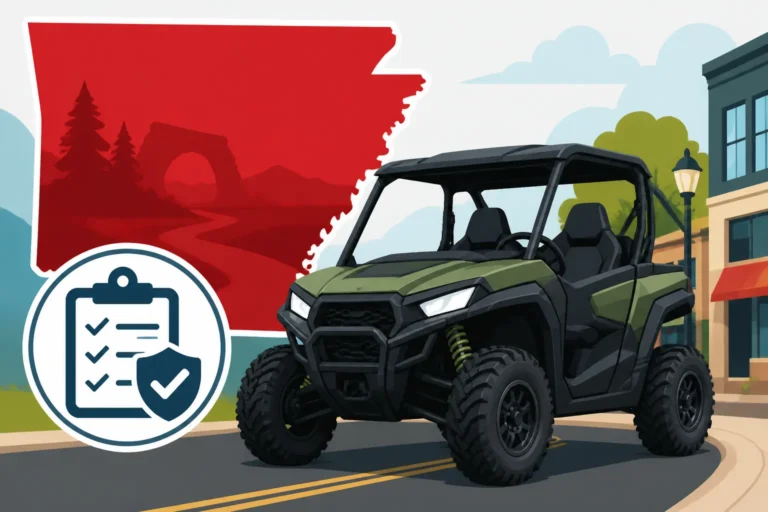
Some Arkansas towns can pass ordinances allowing certain UTVs on designated streets, subject to local requirements. Those requirements may include a city permit, particular safety equipment, a valid driver’s license, and proof of insurance. The details can differ from one town to another, and a permit in one town does not automatically give you permission to ride through a neighboring town. For a broader overview, see [Arkansas UTV Street Legal Rules by Town] and [What a Town Must Pass to Allow UTVs].
If you are riding off-road, on private land, or on a permitted city street, the insurance question may be different in each case. A machine that is used only on private property may not be subject to a city’s street-permit insurance rule. But the landowner’s requirements, a trail operator’s rules, or your own risk tolerance may still make coverage worth considering. Don’t assume that one rule covers every kind of riding.
“On the machine” usually means accessible, not permanently attached
People often ask whether they must stick an insurance card or policy document directly onto the ATV or UTV. In many situations, the practical issue is whether you can produce proof when asked, rather than whether the document is physically mounted to the vehicle. A local ordinance may specify what proof is required or how it must be presented, so read the town’s actual rules instead of relying on a general answer.
For a permitted street UTV, keep a current proof-of-insurance document with the machine or with the driver whenever it is used on public roads. That makes it easier to respond to a stop, a permit check, or a collision. If the town’s ordinance requires a particular form of proof, follow that requirement. A city permit sticker and an insurance card serve different purposes: one indicates local permission, while the other documents insurance. You can read more about permit display in [Displaying a City UTV Permit Sticker on Your Windshield].
For ordinary off-road riding, carrying proof may not be an express requirement in every situation. Still, keeping the policy details accessible can save time if there is a crash, a dispute over damage, or a question from a land manager. In short, don’t confuse “insurance is useful” with “Arkansas requires every ATV owner to attach proof to the machine.”
What to check before riding on a town street
Before taking a UTV onto a public street, identify the specific town and route. Ask the city clerk or the office responsible for permits whether the ordinance applies to your vehicle, whether that road is included, and what documents the driver must carry. If you will cross town lines, check each jurisdiction along the route. The local-option framework is not a blanket statewide street pass.
Also confirm that your machine meets the town’s equipment rules. Some ordinances may address features such as signals, mirrors, lights, or other safety equipment. Insurance proof won’t make up for missing equipment or an invalid permit. See [Arkansas Turn Signal Requirements for Street UTVs] for one example of the kinds of local equipment questions to check.
A straightforward checklist can keep the process manageable:
- Confirm that the town has an ordinance allowing the type of UTV you own.
- Check whether your planned street is included and whether any roads are excluded.
- Ask what insurance coverage and proof the town accepts.
- Confirm that the policy covers your machine on public streets, not just off-road.
- Carry current proof of coverage with the machine or driver.
- Keep the city permit and insurance document separate and easy to identify.
How to Confirm Your Policy Covers the Ride
Ask about public-road use specifically
An insurance policy for an off-road machine may not cover every use you have in mind. When you call your insurer, say plainly that the UTV may be driven on public streets under a local Arkansas ordinance. Ask whether the policy covers that use, the driver, and the route or jurisdiction involved. Avoid relying on a vague answer such as “the machine is insured.” You need to know what use the policy actually covers.
Ask the insurer what liability coverage applies if your UTV causes injury or property damage on a permitted street. You can also ask whether the policy includes physical damage coverage for the machine, whether passengers are covered, and what exclusions or restrictions might apply. The answers may depend on the policy and how the vehicle is classified, so get confirmation from the insurer or agent rather than assuming that an off-road policy automatically extends to road use.
It can help to request written confirmation or an updated proof-of-insurance document that clearly identifies the insured vehicle. Keep the agent’s contact information with your records. If you change vehicles, add a driver, or begin using the UTV on public roads after previously riding only off-road, contact the insurer again. A change in use is a good reason to review the policy.
Know what the insurance card does and does not prove
A proof-of-insurance card typically helps identify the policy and insured vehicle. It is not the full policy, and it may not explain every exclusion, permitted use, or coverage limit. If a town asks for insurance proof, confirm that the document you carry meets the town’s requirement. If you are unsure, show the document to the city clerk before riding.
The card also does not replace a city permit, vehicle registration or other required paperwork. These documents answer different questions: whether the machine has the required local authorization, whether applicable registration rules have been followed, and whether insurance coverage is in place. Keep them together in a protected place, but organize them so you can tell them apart quickly.
If you are stopped, stay calm and provide the documents requested. A deputy may ask about your permit, insurance, equipment, or where you are riding. The exact checks can depend on the situation and local ordinance; [What Arkansas Deputies Check at a Stop] is a useful companion topic. If you are crossing a highway rather than riding along it, review [Arkansas Rules for Crossing a State Highway] separately. Having insurance does not change the rules for crossing.
Make sure your proof stays current and readable
A paper card that has faded, gotten wet, or been tucked under tools for months may be difficult to use when you need it. Keep a clean copy in a protective sleeve or a secure storage compartment, and check the policy dates before a ride. If your insurer provides an electronic card, keep it available on a phone as a backup, but don’t assume a phone is the only acceptable form unless the town confirms that it is.
If multiple people use the UTV, make sure each driver knows where the proof is and understands any driver restrictions in the policy. A document that only the owner can find is not much help when another household member takes the machine out. For a group ride or family outing, agree in advance who is carrying the documents and who is responsible for the permit.
Store a backup copy separately from the primary one. For instance, you might keep a paper copy with the vehicle and a digital copy with the owner’s records. This is especially useful if a document is misplaced during a muddy ride or a stop at a trailhead. Protect personal information, and avoid leaving sensitive paperwork visible when the machine is parked unattended.
Keeping Insurance Proof Secure on Your ATV or UTV
Choose a storage spot you can reach quickly
A useful place for the proof is dry, secure, and easy to access without unloading gear. Depending on the machine, that might be a glove box, a lockable compartment, or a waterproof document pouch. Avoid placing paperwork where it can rub against tools, get soaked during a creek crossing, or blow out when a compartment is opened.
Some riders use an accessory storage compartment or document pouch to keep essential papers organized. SuperATV is one brand owners may encounter when comparing UTV accessories, but an accessory is not insurance and does not establish that your policy covers public-road use. Check the product’s fit and weather protection before storing important papers in it.
If your UTV has limited enclosed storage, a sealed pouch can help protect the card from dust and rain. SuperATV and other accessory makers may offer storage options, but the important point is choosing a secure location that works with your vehicle. Don’t keep the only copy somewhere that requires removing cargo or tools to reach it during a roadside check.
You may also want a small document sleeve for the registration or permit paperwork that applies to your machine. Keeping those items together can help, as long as each document remains legible and you don’t confuse the permit with insurance proof. SuperATV accessories are simply one possible storage route—not a substitute for checking the town’s requirements or talking with your insurer.
Use a simple document routine
Make checking the paperwork part of your pre-ride routine. Before leaving home, verify that the insurance proof is current, the city permit is valid if one is required, and the machine is being used on an allowed route. This takes little effort compared with arriving at a trail or town boundary and discovering that a document is missing.
A small envelope or sleeve labeled for vehicle documents can help, especially if your household owns more than one ATV or UTV. Keep each machine’s proof with the correct vehicle. If you transfer a document from one machine to another, double-check that it names the right insured vehicle; a card for a different UTV may not prove coverage for the one you are riding.
After renewing or changing a policy, replace the old proof rather than leaving several cards in the compartment. Multiple outdated documents can create confusion during a stop or after an incident. Keep the older policy documents at home with your records, and carry only the current proof needed for the ride.
A Practical Proof-of-Insurance Checklist
Before you ride
Use this quick comparison to separate the questions that are easy to mix up:
| Question | What to verify |
|---|---|
| Is the road open to this kind of machine? | Check state rules and the specific town ordinance |
| Is a city permit required? | Ask the town that controls the street |
| Does the town require insurance? | Confirm the ordinance’s coverage and proof requirements |
| Does your policy cover this use? | Ask your insurer specifically about public-road operation |
| Where should proof be kept? | Carry accessible, current proof with the machine or driver |
| Does proof replace the permit? | No; insurance evidence and local permission serve different purposes |
If you only ride on private land or off-road trails, the city-street permit process may not apply to your trip. But trail systems, private parks, landowners, or event organizers may have their own requirements. Check those rules before setting out, especially if you are traveling to a new riding area.
If you plan to take a UTV onto local streets, treat the town ordinance and your insurance policy as two separate checks. One confirms that the street use is allowed under local rules; the other confirms that your insurer covers the use. The broad overview at [Arkansas Insurance for a Street-Permitted UTV] can help you identify the right questions to ask.
If the rules are unclear
Don’t rely on a neighbor’s experience or an old social media post as the final word. An ordinance may be limited to certain streets, vehicle types, or permit conditions, and local rules can change. Contact the city clerk or other relevant town office and ask for the written requirements. Then give those requirements to your insurance agent so the policy question is answered in the same context.
When asking, be specific: “Does this ordinance allow my UTV on this street, and what proof of insurance must the driver carry?” Then ask your insurer: “Does my policy cover this UTV while it is driven on that permitted public street?” Getting a clear answer to both questions is more useful than simply asking whether the machine is insured.
Finally, remember that proof of insurance is only one part of riding legally and responsibly. Check the route, permit, equipment, driver eligibility, and any crossing rules separately. A document in the glove box can help demonstrate coverage, but it cannot turn a prohibited road into an approved route.
Disclaimer
This article is for general informational purposes only and does not constitute professional advice. Laws, prices and regulations vary by location and change over time. Consult a qualified professional for guidance on your specific situation.