Trailering Over Mountain Roads
A trailer that feels manageable on level ground can behave very differently on Arkansas’s steep grades, tight curves, and narrow mountain roads. Before towing an ATV or UTV toward places like Mena or the Ouachita National Forest, plan the route, check the trailer and load, and prepare for slow climbs and controlled descents. This guide covers the practical steps that make the drive safer and less stressful.
Plan an Arkansas mountain route before you hitch up
Choose roads for the trailer you are towing
The shortest route on a phone map is not always the easiest route with a trailer. Arkansas highways such as AR 7 and AR 23 pass through hilly, winding areas, and local roads near trail destinations can be narrow or have limited places to pull over. A turn that is simple in a passenger car may require extra room when you are towing a long trailer.
Before leaving, compare possible routes and think about your whole setup: tow vehicle, trailer length, loaded weight, and turning radius. Look for steep grades, sharp bends, low-clearance structures, restricted roads, and places where traffic may build up. Do not assume a road is suitable just because a mapping app draws a route along it.
Apps such as onX Offroad can help you explore outdoor destinations and keep a map handy, but treat any app as a planning aid rather than the final authority on whether a road is open or appropriate for your trailer. Confirm road conditions and restrictions through applicable local or land-management information, especially if your route includes forest roads. For more pre-trip planning, see Arkansas Trail Conditions Before You Tow.
Leave room for changing conditions
Mountain roads are more demanding when wet, foggy, or covered in loose gravel. Rain can reduce traction on a climb and make a downhill turn harder to manage. Fog can limit how far ahead you can see, while fallen branches or storm damage may narrow a road without much warning.
Build flexibility into your schedule. If weather turns poor, consider waiting, choosing a less demanding route, or postponing the trip rather than trying to make up time on a winding road. A relaxed arrival is worth more than reaching the trailhead on a tight schedule.
It also helps to check the final approach to your destination, not just the highway portion. A trailhead may have a steep entrance, a small parking area, or a turn that is awkward for a long trailer. Destination information such as Arkansas Trailheads With Trailer Parking can help you think ahead, but verify that the parking area fits your particular rig.
Plan your arrival and backup options
Before setting out, identify where you can safely stop if you need to check a strap, let traffic pass, or reassess conditions. Avoid assuming that a scenic overlook, private driveway, or narrow shoulder is a suitable stopping place for a truck and trailer. If the road is too tight to turn around, a missed turn can become a difficult problem.
For popular destinations, consider arriving early and having an alternate staging plan. Lots can fill, and turning around in a crowded parking area is stressful even on level ground. A little advance research on Where to Stage When a Lot Fills can help you avoid making last-minute decisions with a loaded trailer.
Prepare the tow vehicle, trailer, and ATV or UTV
Check capacity and condition before loading
Start with the vehicle and trailer manuals. Confirm that the tow vehicle is rated for the loaded trailer and that the trailer’s tires, wheels, axle, hitch, and coupler are appropriate for the load. The combined weight matters: the machine, trailer, fuel, tools, spare tires, and riding gear all add up.
Inspect the basics before every trip. Check tire pressure while the tires are cold, look for cuts or bulges, and make sure the trailer lights and signals work. Examine the safety chains, breakaway equipment if fitted, coupler latch, and hitch connection. If something is worn, damaged, or unfamiliar, resolve it before heading into the hills.
Do not rely on how the trailer “usually feels.” A trailer can pull differently when loaded with a heavier side-by-side, when cargo is placed differently, or when tire pressure is low. If you have concerns about towing capacity or hitch setup, ask a qualified trailer or vehicle professional to review your combination.
Load the machine securely and distribute weight
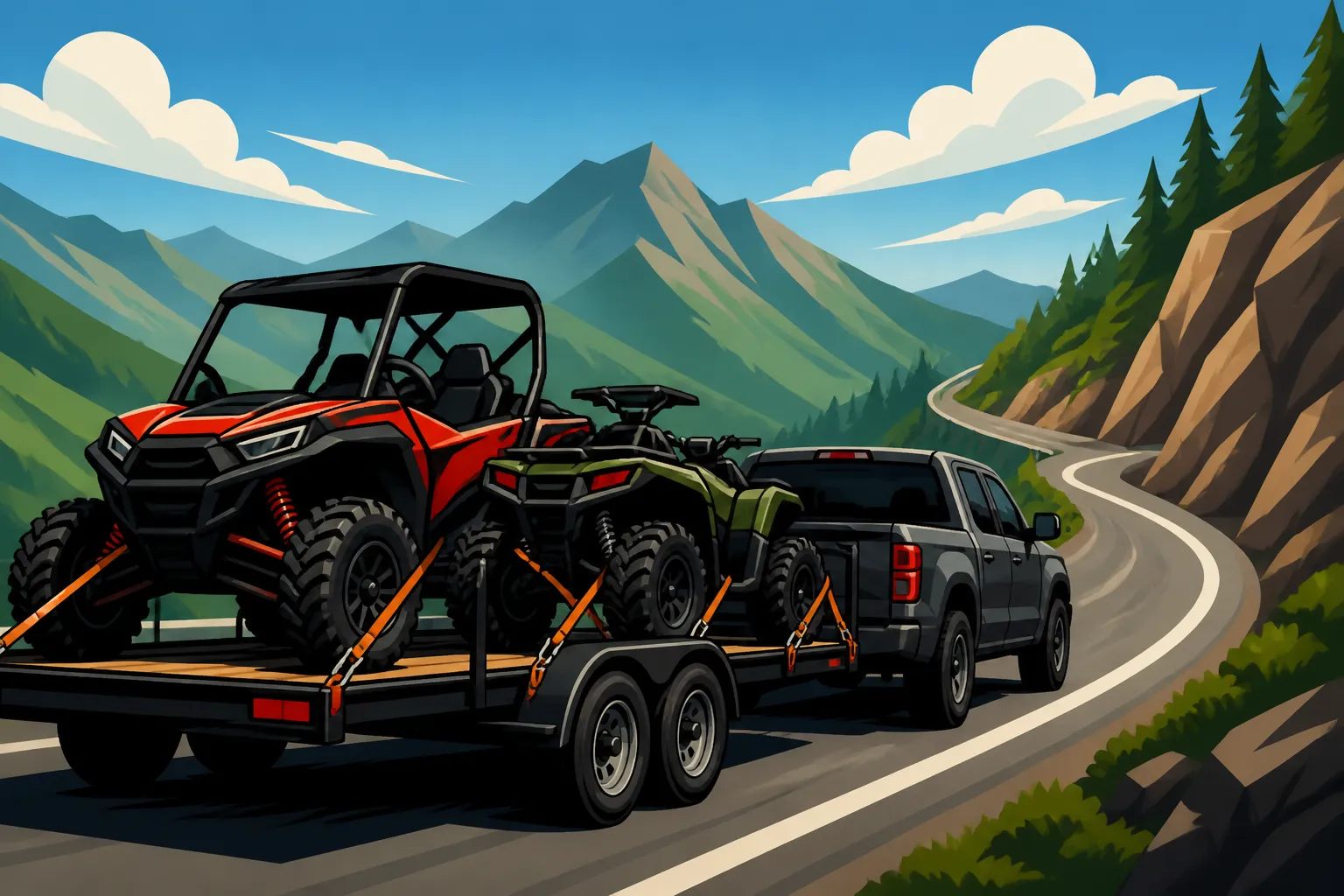
Position the ATV or UTV according to the trailer manufacturer’s guidance and your tow vehicle’s requirements. Keep the load balanced and secure it at suitable tie-down points using straps in good condition. A machine that can shift, bounce, or roll even slightly can affect trailer stability and put stress on the tie-downs.
After securing the machine, check the straps again. Suspension movement can loosen a strap shortly after you begin driving, so make a safe stop soon after departure and inspect the load. Repeat checks during longer trips, especially after rough pavement, sudden braking, or a sharp turn.
Keep loose items from moving around the trailer. Fuel containers, toolboxes, coolers, and riding gear should be secured in a way that does not interfere with the machine or tie-downs. A tidy load is easier to inspect and less likely to become a distraction if the road gets bumpy.
Use a practical pre-departure checklist
A short written checklist can prevent the frustrating mistake of arriving in the Ouachitas and discovering a light is out or a ramp was left behind. Walk around the rig rather than checking items from the driver’s seat. If another person is traveling with you, ask them to confirm the lights and straps while you test them.
| Area | What to check before departure |
|---|---|
| Tow vehicle | Tires, mirrors, lights, hitch connection, and towing capacity |
| Trailer | Tires, wheel condition, lights, coupler, safety chains, and loading ramps |
| Machine | Tie-down points, fuel security, key removal, and stable positioning |
| Cargo | Straps, tools, riding gear, and anything that could shift |
| Route | Road conditions, destination access, weather, and backup stopping options |
Put essential items where you can reach them without climbing over a load: a flashlight, gloves, basic tools, spare straps, and a tire-pressure gauge. A paper map can also be useful where cell service is unreliable; Carrying a Paper Map as Backup covers why it is worth having a non-phone option.
Drive mountain roads with a trailer
Manage speed before curves and descents
The safest time to reduce speed is before a curve or steep grade, not halfway through it. Enter turns at a speed that gives you room to steer smoothly, and leave more following distance than you would without a trailer. A loaded trailer needs additional space to slow down, and sudden braking on a bend can unsettle the combination.
On long descents, avoid riding the brakes continuously. Use the tow vehicle’s appropriate lower gear or engine-braking setting, following the vehicle manual, and maintain a controlled speed. If you are unfamiliar with towing on hills, practice the basic feel of your vehicle and trailer on less demanding roads before taking on a steep, winding route.
Do not let pressure from drivers behind you dictate your speed. If traffic stacks up and there is a safe, legal place to pull over, let it pass. On narrow roads, never stop on a blind curve or steep grade simply to make room. Wait for a suitable turnout or a location with clear visibility.
Give yourself space on tight turns and narrow roads
A trailer tracks inside the path of the tow vehicle when turning. Take corners slowly and leave enough room to avoid curbs, ditches, rocks, and soft shoulders. This matters on narrow approaches to trail areas, where an unpaved edge may not support the trailer’s weight.
If an oncoming vehicle appears on a tight section, avoid making a hurried move toward a weak shoulder. Look for a safe, visible place to yield, and communicate calmly with the other driver when possible. If you are unsure whether the trailer can pass comfortably, stop in a safe location and assess rather than forcing the maneuver.
Use your mirrors often, but do not depend on them alone. Check the trailer before backing, and ask a passenger to guide you if one is available. If you are traveling alone, get out and look as many times as needed. A few extra minutes are far less frustrating than a damaged fender or a trailer wedged against an obstacle.
Stay ready for remote stretches
Some rural and forest-area roads offer limited services and inconsistent mobile coverage. Carry drinking water, a charged phone, a basic first-aid kit, and any essential medications. Tell someone your general plan and expected check-in time, particularly if you are towing into an area where you may not have reliable reception.
Keep enough fuel for the tow vehicle and avoid letting the tank run low before a long climb or a remote stretch. If your vehicle begins behaving unusually, or the trailer starts swaying, respond smoothly. Avoid abrupt steering or hard braking; reduce speed gradually and find a safe place to stop and inspect the setup.
If the route involves forest roads, distinguish between roads that are open to public vehicle travel and routes intended for off-highway machines. A trail shown on a map is not automatically a legal or suitable road for towing. Check local access information and trail notices before driving onto an unfamiliar route.
Arrive safely and get set up at the trailhead
Choose a safe place to unload
When you reach the riding area, do not rush to unload in the first open patch of ground. Look for a level, stable space away from traffic, other trailers, and the main trail entrance. If the lot is crowded, wait for room or use a suitable staging area rather than blocking access while you maneuver.
Set the tow vehicle and trailer as securely as the site allows before lowering ramps. Follow the trailer’s instructions, keep bystanders clear, and make sure the machine is stable before anyone climbs aboard. On uneven ground, take extra care that ramps are firmly seated and cannot slide during loading or unloading.
A destination such as Wolf Pen Gap: Arkansas’s Best Known OHV Complex may draw riders traveling with different trailer sizes and setups. Research the area’s access and parking details before the drive, and consider Staying in Mena for a Riding Weekend if you want lodging and more time to plan around local road conditions.
Recheck the trailer before heading home
After the ride, clean mud and debris from the machine and trailer where practical, then check straps, lights, tires, and the hitch before departing. A long day on the trail can make it easy to overlook something simple. Check that ramps are secured and that gear is stowed rather than left loose in the bed or trailer.
If rain or a storm changed the road conditions during your ride, reassess the return route before leaving. The road that felt manageable in the morning may be slicker, darker, or busier later. Review Arkansas Trail Closures After a Storm when weather has affected the area, and do not assume a route remains passable just because you used it earlier.
Make the trip easier next time
After you get home, note what worked: where you stopped, which grades felt demanding, whether the trailer fit the parking area, and what you wished you had packed. This is especially useful if you return to the same part of the Ouachitas or explore another area near Ozark or Mena.
A route-planning app such as onX Offroad may help you keep destination notes and map context together, but record important road and access details in a way you can use offline. For a later trip, compare your notes with current local conditions rather than assuming that last season’s route is still open or suitable.
Trailering over Arkansas mountain roads is mostly about preparation and patience. A roadworthy setup, a route that suits the whole rig, and a willingness to slow down or change plans can make the drive much less stressful. onX Offroad can be one planning tool among several, while road-condition checks and sound judgment remain essential.
Disclaimer
This article is for general informational purposes only and does not constitute professional advice. Laws, prices and regulations vary by location and change over time. Consult a qualified professional for guidance on your specific situation.