Arkansas Permits Are Per Vehicle
If you’re taking more than one ATV or UTV onto an Arkansas riding area, the permit question is easy to miss: does one pass cover the whole group, or does each machine need its own? For many public-land OHV permit systems, the permit is tied to the vehicle, not the rider. Here’s how to think about that rule, avoid buying the wrong pass, and keep forest permits separate from registration and private-park fees.
What “Per Vehicle” Means
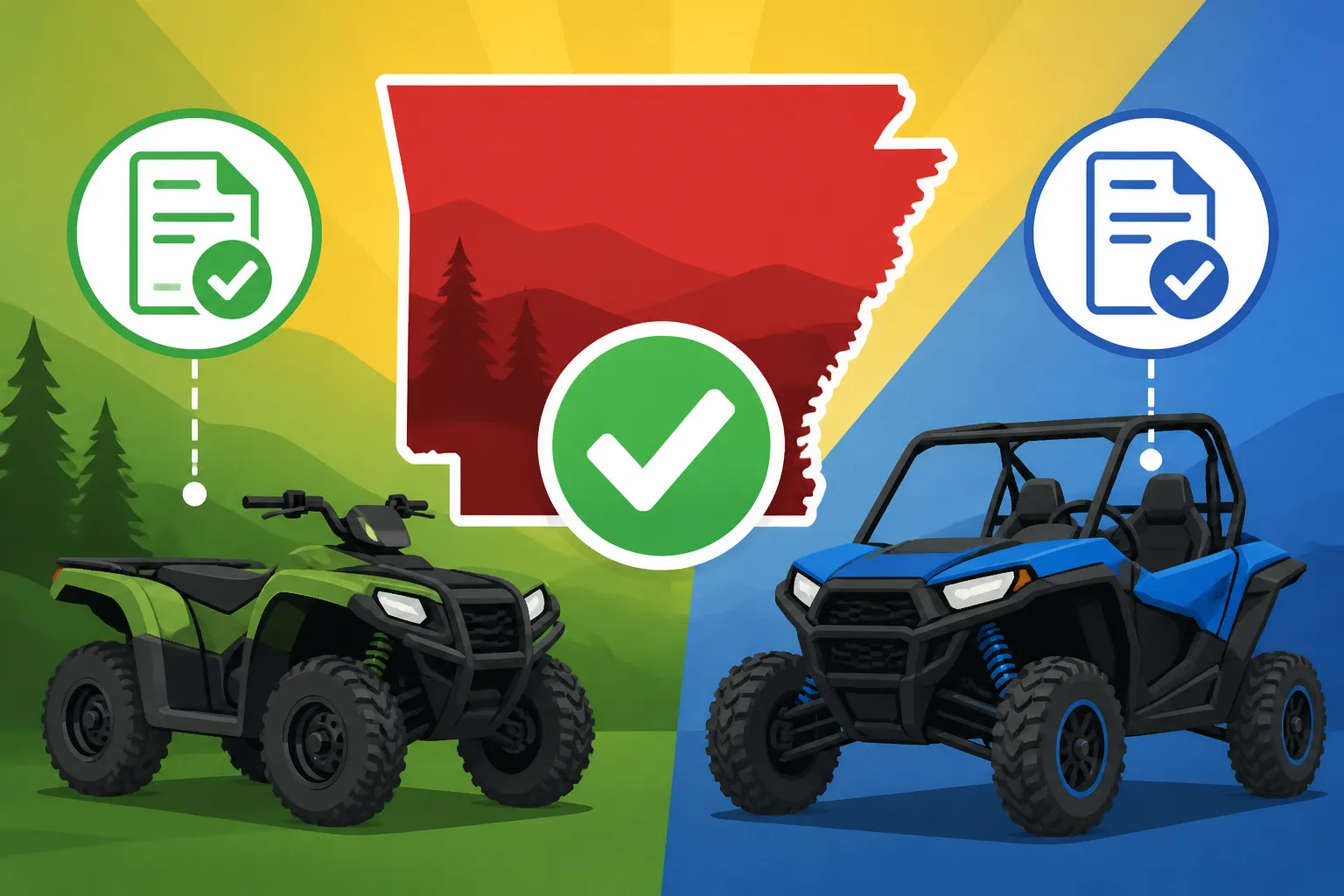
When a riding permit is required per vehicle, each ATV or UTV that enters the permitted area needs its own permit. A single permit generally does not cover a convoy just because the machines belong to the same family, are transported on the same trailer, or are ridden by people who bought passes together.
The permit is associated with a particular machine or its use in that permitted area. It is not a group ticket for the people riding, and it is not a pass for the truck and trailer that brought the machines. If you unload three machines and ride all three, plan on needing a permit for each one, subject to the area’s current rules and any specific exemptions.
That distinction matters when comparing permits with other kinds of access charges. A trail pass may be charged per vehicle, while a campground fee might be charged per site, and a private park may use a day-use or rider-based fee structure. Don’t assume the pricing unit for one charge applies to another.
| Situation | What to check |
|---|---|
| You bring several machines | Whether every machine needs its own permit |
| Several people share one machine | Whether that machine’s permit covers its use; don’t buy extra permits just for additional riders unless the rules require them |
| You own machines used on different forest systems | Whether each system requires a separate permit |
| You rent a machine | Whether the rental operator has already arranged the required permit |
| You ride at a private park | The park’s own access and fee rules |
| You’re visiting from out of state | Whether you need the same area permit as other riders, plus any separate registration or decal required |
For Arkansas riders, the important first step is identifying where you plan to ride. Public OHV routes in the Ouachita National Forest and Ozark-St. Francis National Forests do not necessarily share one permit. The broader comparison is in Arkansas OHV Permits: Two Forests, Two Prices and Arkansas Riders Need Two Different Forest Passes.
A permit requirement is also not the same thing as Arkansas ATV registration. Registration and its decal are state paperwork; a forest OHV permit is an access requirement for a particular riding area. One does not automatically stand in for the other. For the state side, see Arkansas ATV Registration: One Time, Never Renewed.
How the Rule Works Across Arkansas Riding Areas
Arkansas riders often plan a trip around a town, trail network, or weekend destination, but permits usually follow the land manager and the specific riding system—not the destination name alone. A nearby trailhead can serve routes with different rules, and a permit for one system may not work on another.
National forest OHV areas
On designated public-land OHV routes, check the current permit rules for the forest or trail system you intend to use. In general, if that system requires a pass per vehicle, each machine you take onto the permitted routes needs a pass. A group of riders should count machines, not people, when estimating how many vehicle permits to obtain.
The two Arkansas national forests are separate administrative systems. Do not assume that a pass purchased for an Ouachita riding area will cover an Ozark-St. Francis trail, or the reverse. The fact that both permits are associated with Arkansas forest riding does not make them interchangeable. Why One Forest Pass Does Not Cover the Other explains the practical distinction.
Examples of destinations where you should verify the applicable permit include Wolf Pen Gap in the Ouachita National Forest and Mill Creek OHV Trail System in the Ozark-St. Francis National Forest. Check the land manager’s current instructions for the exact riding area, how the permit is sold, what counts as display or proof, and whether the route is open. Don’t rely only on an old pass, a friend’s recollection, or a search result for a different trailhead.
Public areas that are not forest OHV systems
Other public land can have its own vehicle-access restrictions. Wildlife management areas, for example, may open some roads to vehicles while closing gates, levees, food plots, or other areas. Having a forest OHV permit does not give you permission to ride wherever you want on public land. Likewise, an access rule for a wildlife management area does not automatically satisfy a national forest permit requirement.
Before setting out, identify both the land manager and the exact route. A trail that appears close to a forest road on a map may be governed by a different access rule, may not be open to motorized vehicles, or may have seasonal restrictions. For more on this distinction, see Arkansas WMA Vehicle Rules in Plain English.
Private parks and commercial riding areas
Private off-road parks set their own admission, waiver, machine, and riding rules. A forest permit usually isn’t a substitute for the park’s required admission, and a park admission pass does not serve as a national forest OHV permit. Some parks may include certain access costs or provide their own process, but that is a detail to confirm with the operator rather than assume.
If your weekend includes both a private park and a national forest trail, treat them as separate stops. Ask what each location requires for every machine and whether the rules change for rentals, guided rides, or overnight stays. A permit issued for one venue should not be treated as a universal Arkansas riding pass.
Counting Machines and Choosing a Permit
The simplest way to avoid a shortfall is to make a list of every machine that will actually ride. Count the ATV or UTV being operated, not the number of owners, drivers, passengers, or tow vehicles.
For example, if four people ride together in two side-by-sides, the relevant count for a per-vehicle permit is generally two machines—not four people and not one group. If each person rides a separate ATV, the count is four. A passenger normally does not require a second vehicle permit merely for being a passenger, but follow the area’s current rules, particularly if the machine changes during the day or a rider switches vehicles.
Decide between day and annual options by machine
Some permit systems offer different durations, such as a day option and an annual option. Compare them for each machine that will ride. If your group has two machines, you may need to consider the permit choice for each one separately; buying an annual pass for one does not automatically cover the other. The comparison in Arkansas Annual Versus Day Permits can help you think through how often each machine will be used.
When weighing options, consider:
- How many days each machine will ride in that system
- Whether the machines will be used together or on different trips
- Whether the annual permit is valid for the dates and area you plan to visit
- Whether permits are transferable, replaceable, or tied to a particular machine
- Whether the permit must be displayed on the machine or whether another form of proof is accepted
- Whether the system has a separate daily fee, trailhead payment, or other requirement
Do not treat the annual option as a universal pass. It may apply only to a particular forest or permit program. And don’t assume a day permit lasts a full 24 hours or covers more than one machine; check the terms provided by the issuing authority. Current duration, price, and purchase details should always be confirmed with that authority.
Count the riding machines, not your trailer
A trailer can carry several ATVs, but the trailer is not the same thing as a permit for those machines. If all the ATVs are unloaded and ridden, count each one under the applicable vehicle rule. If a machine stays on the trailer and is never used in the permitted area, the permit question may be different—but verify how the land manager defines entry, use, or access before relying on that distinction.
This is especially useful when someone in the group brings a spare machine. A spare that remains parked at camp may not be treated the same way as one that is ridden on the trails. If the spare is swapped into active use, don’t assume the pass assigned to another machine transfers with it. Check the permit’s terms before the trip.
Treat a machine change as a question, not a workaround
A pass may be linked to a machine, a specific permit record, or a display requirement. That can make machine swaps important. If one ATV breaks and a friend lends you another, or if two riders exchange machines, ask whether the existing permit remains valid. Don’t move a decal or proof of purchase unless the issuing authority’s instructions say that is allowed.
For a second machine you own, the practical default is to plan for a separate permit wherever the system charges per vehicle. [Arkansas Permit for a Second Machine] focuses on that situation. If you have a fleet or several family machines, make a permit record for each one so it’s clear which pass belongs to which vehicle.
Rentals, Visitors, and Mixed Groups
A rental adds another person to the paperwork conversation: the operator. The rental company may include a permit, sell or arrange one separately, or expect the renter to obtain it. Don’t guess based on what another shop did or on the fact that the machine is already registered.
Before paying a rental deposit, ask specifically:
- Is the permit for the exact trail system included?
- Is it valid for the day and route in my booking?
- Is the permit attached to this rental machine, or do I need to purchase one?
- What proof must I carry or display?
- If the rental machine is changed, does the permit change with it?
- Does a guided tour handle the permit differently from a self-guided rental?
The answers can differ between rental operators and riding areas. A rental reservation may include machine use without including every forest or trail access requirement. Confirm the details with the operator and, when needed, with the land manager. For related questions, see Arkansas Permit for a Rental Machine and Arkansas Rentals and Trail Permits.
Out-of-state visitors should also separate an area permit from state registration or decals. A forest pass is about access to the relevant riding system; registration rules concern the machine under state law. Depending on where you ride and the machine’s status, you may need to consider both. A visitor’s home-state registration does not necessarily answer every Arkansas requirement, and an Arkansas forest permit does not replace registration. See Do Out-of-State Riders Need an Arkansas Registration Decal? for the state-registration side.
For mixed groups, make one person responsible for checking the rules, but keep the permit count tied to the machines. A group organizer can collect the make, model, identifying number, permit type, and proof for each vehicle. That makes it easier to notice a missing pass before everyone is ready to leave the trailhead.
Be careful with shared ownership. Two friends may jointly own a UTV, but ownership does not turn a vehicle-specific permit into two separate permits or make it cover another machine. Conversely, two riders sharing one permitted vehicle usually shouldn’t be counted as two vehicles solely because both will drive at different times. Follow the current permit instructions for the area.
Buying, Displaying, and Keeping Proof Straight
Buy or obtain a pass through the official channel specified by the land manager. Permit systems can use online sales, local outlets, or self-service stations, and the available options can change. The current process matters: an old screenshot or a third-party listing may not prove that you have a valid permit for the right forest, date, and machine. Buying a Pass Before You Leave Home covers why it helps to sort this out before towing to a remote trailhead.
After purchase, follow the instructions exactly. Some passes may need to be displayed on the vehicle; others may have specific proof-of-purchase or placement instructions. Use the permit’s own guidance rather than inventing a location or putting a sticker where it can be obscured, damaged, or confused with state registration. A registration decal and an OHV access permit serve different purposes, even if both are stickers.
Keep a backup record. A photo of the receipt or confirmation can be useful if you need to show what you purchased, but it may not replace a required physical display. Save the permit details with the machine’s records, and note which system it covers. If you manage several ATVs, label the paperwork by machine rather than keeping every receipt loose in one folder.
A small weather-resistant document pouch or an adhesive sleeve can help keep receipts and trip paperwork organized in a truck or trailer. Amazon is one place riders may look for a simple pouch, but a storage accessory does not replace the official display method. Amazon listings are not the authority on permit validity, and a clear sleeve should never obscure a required decal or alter how the land manager says it must be shown.
For equipment storage, Amazon may also have inexpensive organizers for sorting printed confirmations by vehicle. Keep sensitive personal details secure, and avoid putting a paper receipt somewhere it can blow away or get soaked. A third useful Amazon search is for a compact waterproof document wallet to keep in the tow vehicle, separate from whatever proof must be on the machine. The important part is organization, not the brand or accessory: follow official display rules first.
Before departure, check that each riding machine has the right permit for the planned system, that the pass is valid for the date, and that you can produce any required proof. Then check for closures, route restrictions, width limits, seasonal conditions, and any other rules that are separate from the permit. A pass authorizes only the access described by its terms; it does not guarantee every trail is open or suitable for every machine.
If a permit is lost, damaged, or attached to a machine that is no longer available, contact the issuing authority before moving or replacing it. Do not assume you can transfer it to another ATV, print a replacement, or ride while a replacement is pending. The permitted use and replacement procedure are determined by the program.
Common Mistakes to Avoid
The most frequent mistake is buying one permit for the whole family when the system requires one for each machine. The opposite can happen too: people buy a pass for every rider even though the system charges per vehicle. Count machines first, then read the program’s terms.
Other avoidable errors include:
- Buying a permit for the wrong forest or trail system
- Assuming a state registration decal is the same as a forest access permit
- Treating a private park admission pass as valid on public forest trails
- Assuming a rental includes a permit without asking
- Assuming an out-of-state registration removes the need for an area permit
- Moving a permit from a broken machine to a replacement without approval
- Thinking a receipt alone satisfies a display requirement
- Failing to check whether a trail is open or whether a machine fits its restrictions
If you are unsure, ask the issuing authority a specific question: “I have two machines and will ride both on this trail system on these dates. How many permits do I need, and how should each be displayed?” That is much more useful than asking whether “the group” needs a pass, because it makes clear that the rule is being applied to vehicles.
A short pre-trip checklist can prevent a frustrating turn-around:
- Identify the land manager and exact riding system.
- Count every ATV or UTV that will be ridden.
- Confirm the permit requirement and purchase option for that system.
- Get one permit per vehicle if the program requires it.
- Confirm what must be displayed and what proof to carry.
- Verify that the route is open and suitable for the machines.
- Keep permit records organized by vehicle.
Permits are easiest to handle before the group loads up. Treat each machine as its own entry into the permitted area, keep forest access passes separate from registration and park fees, and check the official instructions whenever the trip involves a rental, a different forest, or a machine swap.
Disclaimer
This article is for general informational purposes only and does not constitute professional advice. Laws, prices and regulations vary by location and change over time. Consult a qualified professional for guidance on your specific situation.