Arkansas Fire Restrictions in Dry Months
Dry weather can turn an ordinary ride or campsite stop into a fire-risk decision. In Arkansas, restrictions may vary by public land, conditions and current alerts, so a rule that applies in one place may not apply nearby. Here’s how to check what’s in force, understand the rules around campfires and cooking, and reduce the risk of your ATV or UTV starting a fire.
How Arkansas fire restrictions work
There is no safe assumption that the same fire rule applies across every riding area in Arkansas. A national forest, a state-managed wildlife area and land overseen by another federal agency may have different rules. Restrictions can also be temporary: land managers may impose them when conditions are dry, then change or lift them as conditions shift.
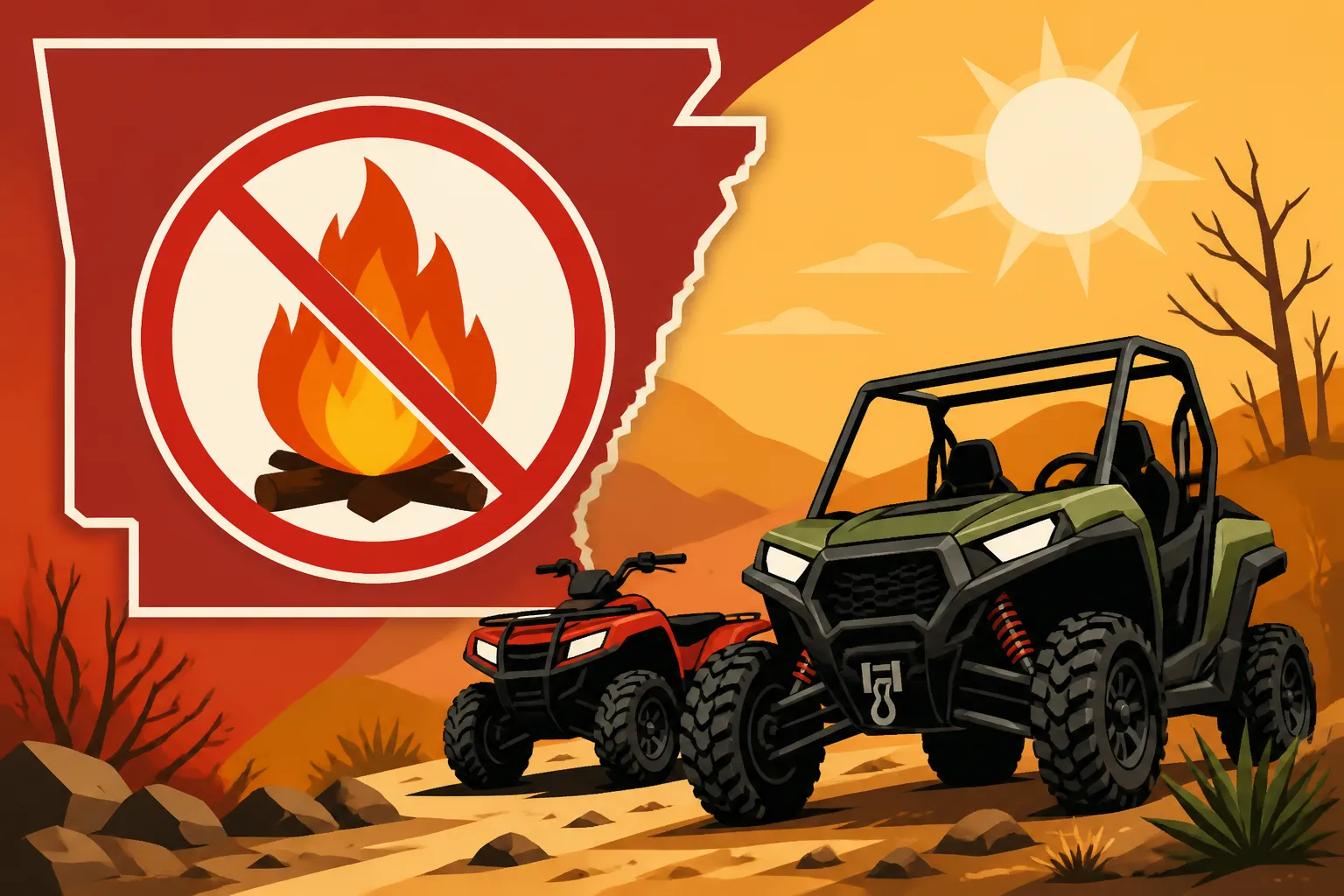
According to the USDA Forest Service, during dry fire-season months in Arkansas national forests, federal land managers may enact temporary burn bans that prohibit campfires, charcoal grills and wood-burning stoves. Gas or propane cooking devices are typically still permitted, but riders should verify the specific instructions for their destination before relying on an exception.
A general notice that conditions are dry is not a substitute for checking whether a restriction is active. Before leaving, look for current closure notices and fire alerts from the agency responsible for the land. If the notice is unclear, contact the local managing office and ask what kinds of fires and cooking devices are allowed, where the restriction applies, and whether it affects campsites as well as trail areas.
The distinction matters when a ride crosses or approaches land with different managers. The National Park Service oversees regulations within the boundaries of the Buffalo National River, so do not assume a Forest Service notice describes the rules there. Check with the agency responsible for the specific destination. Arkansas National Forest Riding Explained can help with the broader question of riding in national forest areas, but current fire restrictions still need to be checked separately.
| Situation | Practical response |
|---|---|
| A temporary burn ban is in force | Follow its exact restrictions; do not assume a different cooking method is allowed unless the notice says so. |
| A gas or propane device appears to be permitted | Confirm that the active notice allows it and follow any stated conditions. |
| The fire notice is unclear or seems out of date | Check with the local land manager before lighting, cooking or camping. |
| You are unsure which agency manages the destination | Identify the land manager first; rules may differ across nearby public lands. |
| The trail or campground is closed | Do not use it as a place to stop and make a fire; check official alerts for access updates. |
A fire restriction can apply even when there is no visible smoke or active fire nearby. Treat the current notice as the controlling guidance for that location. Do not rely on what was allowed on a previous trip, what another rider says, or what appears permitted at a neighboring recreation area.
For more on changes that affect access, see Arkansas Trail Closures After a Storm and Arkansas Trail Conditions Before You Tow. Those topics are not substitutes for fire alerts, but they reinforce a useful habit: check official conditions before committing to a route.
Spark arrestors and fire risk on the trail
A burn ban is only part of fire prevention. The condition of the machine matters, too. According to the USDA Forest Service, internal-combustion engines on off-highway vehicles operating in the Ozark-St. Francis National Forests must have a properly installed and maintained spark arrester. Do not treat this as optional equipment or assume an arrestor is working because it is present.
Arkansas law also prohibits operating an ATV with a modified exhaust or with a removed or modified spark arrester, according to the Arkansas State Legislature. Some public wildlife management areas also enforce “Factory Exhaust Only” rules. Before riding, check the equipment rules for the specific area as well as the general forest requirements. Arkansas Spark Arrestor Requirements explains the equipment issue in more detail.
If your machine has recently been repaired or modified, inspect the exhaust and spark-arresting equipment before heading out. A part that is loose, damaged, missing or altered may not meet the requirement. If you are unsure whether a replacement part is suitable, ask a qualified shop or check with the land manager. Replacement parts may be available through powersports dealers and marketplaces such as Amazon, but confirm that a part fits your machine and satisfies the applicable requirement before buying or installing it.
Land managers also advise visitors to avoid parking vehicles in tall grass because a hot engine or exhaust pipe can ignite dry vegetation. Choose a cleared, designated stopping area where available. If the trail shoulder is dry and overgrown, do not use it as a convenient place to take a break.
Other sensible precautions follow from the same risk. Keep the machine on designated routes, avoid riding into dry vegetation, and do not leave a running vehicle unattended near grass or brush. These are practical steps to reduce ignition risk, not a substitute for a current restriction or a land manager’s instructions.
A compliant machine does not make every activity safe or permitted. A properly maintained spark arrester does not authorize a campfire during a burn ban, and a cooking device that is normally allowed may be restricted by a particular notice. Treat equipment compliance and fire restrictions as separate checks.
When planning a forest ride, review both access requirements and conditions. Some Arkansas national forest riding areas have their own permit or fee requirements, separate from fire rules. Arkansas OHV Permits: Two Forests, Two Prices covers that distinction, while Arkansas Trail Etiquette Locals Expect offers broader advice for sharing the trail responsibly.
Campfires, cooking and campsite decisions
When a restriction is active, read its wording carefully instead of guessing what counts as a fire. The USDA Forest Service says temporary restrictions in Arkansas national forests may prohibit campfires, charcoal grills and wood-burning stoves. If the notice bans those methods, do not use them even if the fire would be small, contained or supervised.
Gas and propane cooking devices are typically still permitted under these restrictions, according to the USDA Forest Service, but “typically” does not mean universally. A specific order may add conditions or prohibit additional activities. Check the current notice for the area and follow its exact terms. If the notice does not clearly address your device, ask the land manager before using it.
The same caution applies to campsite choices. A designated campsite is not proof that a fire is allowed there under current conditions. Confirm the rules for the location, and do not move a fire to an unmarked area simply because it seems sheltered or less dry. If a restriction prohibits the activity, choose a permitted alternative rather than trying to find a loophole.
For a trip where cooking matters, plan around the rules before packing. Confirm whether your intended device is allowed, bring only equipment you can use lawfully, and have a no-cook backup if restrictions change. Avoid assuming that an item is acceptable because it is sold as portable or intended for camping; the relevant question is what the active notice allows.
Also check whether an alert includes closures beyond fires. A land manager may issue instructions that affect access or activities in a specific area. If a trail, campsite or recreation site is closed, do not enter or use it based on older information. For route planning, Arkansas ATV Trails: Where to Ride and Arkansas Trail Conditions Before You Tow may help you organize a visit, but always verify the current official notice for your destination.
When a restriction appears to change during your trip, follow the latest instructions available from the responsible agency. Do not treat a sign seen at another trailhead, an old screenshot or a rider’s recollection as confirmation that the rules are the same where you are now.
A practical check before you ride or camp
Use a short pre-trip routine so fire safety does not become an afterthought once you reach the trailhead.
- Identify the land manager. Confirm whether the riding or camping area is managed by the Forest Service, the National Park Service or another agency. Rules for one property do not automatically apply to another.
- Check current alerts. Look for active fire restrictions, closures and special instructions from the agency responsible for the destination. If anything is unclear, contact its local office.
- Confirm what the notice covers. Check whether it addresses campfires, charcoal grills, wood-burning stoves, gas or propane devices, and any other activities you plan to do.
- Inspect the machine. Confirm that the spark arrester is installed and maintained as required, and that the exhaust has not been modified in a way that violates the applicable rules.
- Plan where to stop. Avoid parking in tall grass, and use a cleared, suitable area rather than dry vegetation at the edge of a route.
- Have a backup plan. Be prepared to skip a fire or use a different permitted cooking arrangement if conditions or restrictions change.
If you cannot verify that an activity is allowed, do not assume it is. Contact the managing office or choose a plan that does not depend on a fire. The extra check can prevent a trip from ending with a violation, a closed-area problem or, much worse, a wildfire.
Disclaimer
This article is for general informational purposes only and does not constitute professional advice. Laws, prices and regulations vary by location and change over time. Consult a qualified professional for guidance on your specific situation.