Arkansas Hot Springs State Forest WMA Ban
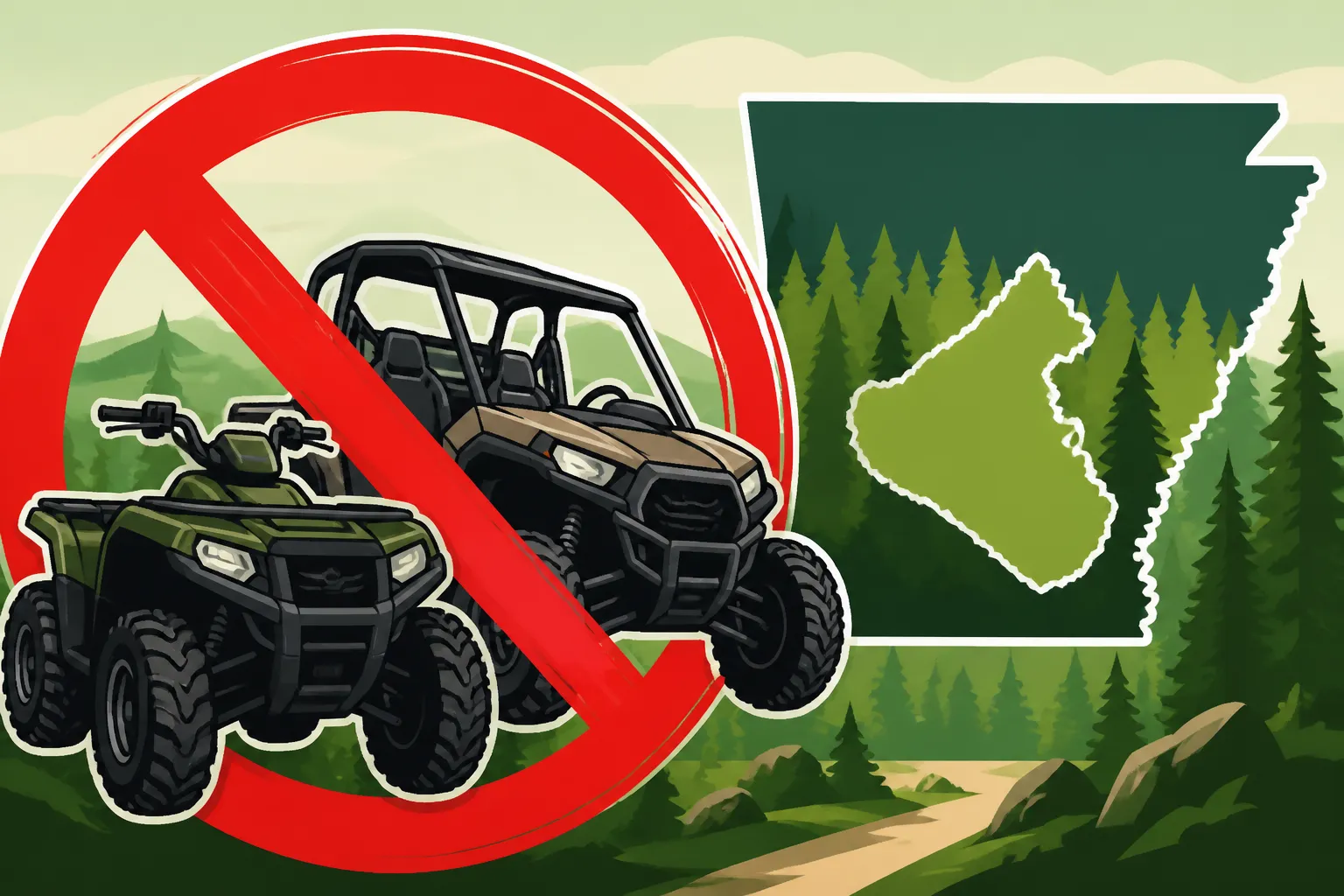
The Hot Springs State Forest WMA is not a place to assume an ATV or UTV can go just because a nearby forest road or trail is open. The key is to separate this WMA’s restrictions from Arkansas forest permits, hunting access and riding areas elsewhere. Here’s how to interpret the ban, avoid a boundary mistake and choose a legal alternative.
What the Hot Springs State Forest WMA ban means
Treat the Hot Springs State Forest WMA as closed to ATV and UTV riding unless a current official notice clearly authorizes a particular use. A trail that looks rideable, a gate that happens to be open, or a route shown on an older map is not permission to enter. The safe approach is to check the current WMA rules and boundary information before unloading a machine.
The restriction is about where you ride. It is not a general statement that ATVs and UTVs are prohibited throughout Arkansas, nor does it automatically apply to every nearby riding area. Arkansas has separate rules for state wildlife management areas, national forest OHV routes, private parks and locally permitted streets. The requirements for one place do not establish access at another.
For practical purposes, do not ride an ATV or UTV on the WMA’s roads, trails, openings or other land unless the responsible agency’s current information specifically allows that type of machine and use. Do not infer permission from a road being passable by a car or truck: a route open to some traffic may still be closed to off-highway machines. These distinctions are covered more broadly in Arkansas WMA Vehicle Rules in Plain English.
What counts as riding on the WMA
The restriction can be easy to overlook when a route crosses different kinds of property. A ride may start on a public road, pass through private land and then enter WMA property without a dramatic change in terrain. The map boundary—not the condition of the ground—determines which rules apply.
Think of the WMA boundary as a hard stop for recreational ATV or UTV travel unless you have confirmed a specific authorization. This includes:
- Riding along a road or track inside the boundary.
- Leaving a road to travel across woods, fields or an opening.
- Using a route to connect two otherwise legal riding areas.
- Following a group that appears to know the route.
- Riding to a hunting location because the machine is being used for a purpose other than recreation.
A machine’s registration, decal, license plate or forest permit does not by itself grant permission to ride on WMA land. Those documents answer different questions, such as whether a machine is registered or whether a particular forest trail system requires a pass. They do not replace the land manager’s access rules.
Don’t rely on informal clues
An open gate is not the same as an open ATV route. Gates can be left open for authorized workers, land management, permitted users or other vehicles. Likewise, tire tracks only show that a machine has been there; they do not establish that riding is allowed.
Old forum posts, social media comments and past trips can also be misleading. Access rules, closures and maps can change, and riders may be describing a different parcel or trail system. If two sources disagree, use current information from the agency responsible for the WMA and ask for clarification before riding.
Why forest permits do not override the WMA restriction
Arkansas riders may need a forest OHV permit for certain designated trail systems. That requirement is separate from the rule that determines whether a machine may be on a particular WMA. A permit is valid only within the area and under the conditions it covers; it is not a statewide pass for public land.
This distinction matters because the region has several kinds of public and private land. A rider can have the correct pass for a designated forest trail and still be prohibited from riding on a nearby WMA. Conversely, a WMA’s restrictions do not automatically cancel a permit’s validity on a separate trail system.
The difference between the two forest permit systems is explained in Arkansas Riders Need Two Different Forest Passes and Arkansas OHV Permits: Two Forests, Two Prices. Those passes relate to particular trail areas. They should not be treated as permission to cross into a WMA where ATV or UTV use is barred.
| What you have or see | What it tells you | What it does not prove |
|---|---|---|
| Arkansas ATV registration or decal | The machine has completed the relevant registration process | That the WMA allows the machine on its land |
| A forest OHV pass | The pass may meet requirements for the trail system it covers | That it covers a WMA or another forest |
| A WMA map showing public land | The property boundary or management area may be identified | That every vehicle type may use every route |
| An open gate or visible tire tracks | Someone can physically travel through the location | That recreational ATV or UTV use is authorized |
| A hunting license or hunting trip | The rider may be engaged in a regulated activity | That a machine may be ridden anywhere on the WMA |
| Permission from a private landowner | The owner may allow access to that private parcel | That permission extends onto neighboring public land |
Before a trip, confirm both the location and the activity. Ask whether the exact parcel is the Hot Springs State Forest WMA, whether ATV and UTV riding is permitted there, and whether any authorization applies to the route you intend to use. If the answer only discusses a forest pass or general public access, ask specifically about the WMA restriction.
For a broader explanation of which WMAs allow motorized riding and which do not, see Arkansas WMAs That Allow ATVs and Those That Do Not. The agency’s rules may vary by area, road, season and purpose, so a general summary is useful for orientation but should not substitute for current, area-specific information.
How to check a route before you unload
The most useful check happens before the machine comes off the trailer. Once a group is on the ground, it is tempting to follow a route that looks clear and sort out the rules later. That creates avoidable risk, especially where public boundaries are close together or trail information is incomplete.
Use this process when planning a ride near Hot Springs State Forest WMA:
- Identify the exact destination. Get the name of the riding area and the starting point. Do not use “near Hot Springs” as the only location description; it can refer to several different properties and trail systems.
- Check the property boundary. Use a current agency map or another reliable land-boundary source. Look for WMA labels, public-land boundaries and any route-specific access notes.
- Confirm the machine type. Ask about ATV and UTV access specifically. “Vehicles allowed” can mean ordinary road vehicles, agency vehicles or other authorized traffic rather than recreational off-highway machines.
- Check the purpose and route. A road that serves a permitted activity may not be open for general trail riding. Confirm that the exact route and the planned use are allowed.
- Ask about current closures. Weather, land management, maintenance or seasonal conditions can affect access. Confirm that the route is open on the day you intend to ride.
- Keep the answer with your trip information. Save the relevant map or official notice, and note which agency or office confirmed the rule. If a sign at the site conflicts with an older map, stop and seek clarification rather than riding past it.
For more on the distinction between open routes and closed areas, Arkansas WMA Roads Open to Vehicles and Arkansas WMA Gated and Cabled Barriers offer useful context. A road can be physically present without being open to every vehicle or every kind of travel. Gates, cables and barriers should be treated as restrictions, not invitations to find a way around them.
When information is unclear
If you cannot determine where the boundary runs, do not use the machine to investigate. Park in a clearly authorized area and contact the agency responsible for the land. Give a precise location, such as a trailhead name, road name or map coordinate, and ask whether recreational ATV or UTV riding is permitted at that point.
If you receive a general answer such as “the forest is open” or “you need a pass,” follow up with a direct question: “Does that permission apply to the Hot Springs State Forest WMA, and may I ride an ATV or UTV on this specific route?” The wording matters because a nearby forest trail, a public road and a WMA can have different rules.
If no one can confirm permission, choose another riding area. This is more than a paperwork precaution. A rider who crosses a property line without checking can end up far from the nearest legal staging area, with no simple way to turn around without crossing more restricted land.
Hunting, work and other special-purpose access
A common point of confusion is whether using a machine for hunting changes the answer. Arkansas WMA rules can treat activities differently, and there may be specific provisions for named areas or particular purposes. But a general hunting-related rule should not be assumed to apply to the Hot Springs State Forest WMA.
Do not treat a hunting license, an open season, a leased hunting property or a trip to a deer stand as automatic permission to ride a quad or side-by-side on the WMA. The authorized route, machine type, dates and purpose all matter. A provision that applies to one WMA may not apply to another.
This is especially important when traveling between a campground, parking area, hunting camp and a hunting location. “Travel to and from camp” may have a narrow meaning under the rule in question. It does not necessarily permit recreational riding along the way, taking a shortcut or using a closed road. Verify the rule for the exact WMA and route before relying on any hunting-related exception.
If your plan involves a hunt, check [Arkansas Hunting License and Quad Access] and Arkansas WMA Roads Open to Vehicles, then confirm how those general rules apply to the Hot Springs State Forest WMA. Ask specifically whether the intended machine can be used on the planned route during the dates of the trip. Do not assume that permission to hunt includes permission to ride.
Work and official access also need to be distinguished from public recreation. An agency employee, contractor or other authorized operator may have access for a defined task. That does not make the route open to riders generally. Similarly, a machine being used for property maintenance on private land does not have permission to continue onto adjacent WMA land.
When the purpose is genuinely different from recreation, confirm the authorization with the responsible land manager before entering. Keep the authorization limited to what it actually covers: a specific activity, location, time or route. If you do not have clear permission for your machine and use, stay off the WMA.
Where to ride instead and how to avoid a boundary mistake
The ban does not mean you have to cancel an entire trip to the Hot Springs area. It means your ride needs to be planned on land that allows the machine and activity you have in mind. Options may include a designated OHV trail system, a private off-road park or another property where access has been confirmed.
For each alternative, check its own requirements. A forest trail system can have a permit, route or vehicle-width rule. A private park can set its own access, operating and safety conditions. A public road may have separate rules for motor vehicles and does not automatically become an ATV trail. Do not use a nearby WMA as a connector between legal riding locations unless the agency confirms that crossing is allowed.
Arkansas Trails Near Little Rock and Arkansas Trail Conditions Before You Tow can help with broader trip planning. For a privately operated option, check the current information for Hot Springs Off-Road Park in Arkansas. Confirm the park’s access conditions and current operating status directly before you travel; private facilities set their own rules and may change availability.
If you are towing a machine to the area, choose a staging point that is clearly outside the restricted property and authorized for parking. Do not block gates or use an unmarked pull-off simply because another vehicle is there. Make sure the route from the staging area to the legal trail begins on land where your machine is allowed.
A short pre-ride checklist
Before leaving home, confirm:
- The name and boundary of the area where you plan to ride.
- That recreational ATV or UTV use is allowed on the exact property.
- That the route is open to your type of machine and intended use.
- Whether a permit, registration document or other pass is required.
- Whether closures, seasonal limits or route restrictions apply.
- Where you can legally park and unload.
- How to turn around without entering the WMA.
- What to do if signs or maps at the site differ from your saved information.
At the trailhead, read the signs rather than relying only on what you checked earlier. If the signs identify a WMA or prohibit ATV and UTV travel, do not enter. If the boundary or restriction is unclear, stop and ask before proceeding. Carrying a valid permit is useful only when you are within the area it covers.
The same care applies on the way out. A return route can cross a different parcel from the one you entered, and a trail that appears to reconnect with a public road may pass through restricted land. Plan the full route in both directions and leave room to backtrack without crossing a boundary you have not checked.
Frequently Asked Questions
Can I ride an ATV or UTV on the Hot Springs State Forest WMA if I have a forest permit?
Not on that basis alone. A forest permit applies to the trail system or area it covers; it does not override the WMA’s ATV and UTV restriction. Confirm access for the exact property and route.
Does an open gate mean the route is open to ATVs?
No. A gate may be open for authorized access or another vehicle type. Check the current rules and posted signs before riding past it.
Can I ride there to reach a hunting spot?
Do not assume so. Hunting access and machine access are separate questions, and an exception for one purpose or WMA may not apply here. Confirm the rule for the exact route and activity with the responsible agency.
If a road is open to cars, can a side-by-side use it?
Not automatically. A road’s vehicle access rules may distinguish between ordinary road vehicles and off-highway machines. Check whether ATV or UTV use is specifically allowed.
What should I do if maps and signs seem to conflict?
Stop and do not proceed into the uncertain area. Follow the current on-site restriction while you seek clarification from the agency responsible for the land.
Disclaimer
This article is for general informational purposes only and does not constitute professional advice. Laws, prices and regulations vary by location and change over time. Consult a qualified professional for guidance on your specific situation.