Arkansas Self-Service Fee Stations
A self-service fee station can be a convenient last stop before an Arkansas trail ride, but it is easy to mistake it for a place to handle every kind of ATV paperwork. These stations are for specific riding-area or forest permits, not state registration. Here’s how to use one, what to bring, and what to check before you leave home.
What an Arkansas self-service fee station does
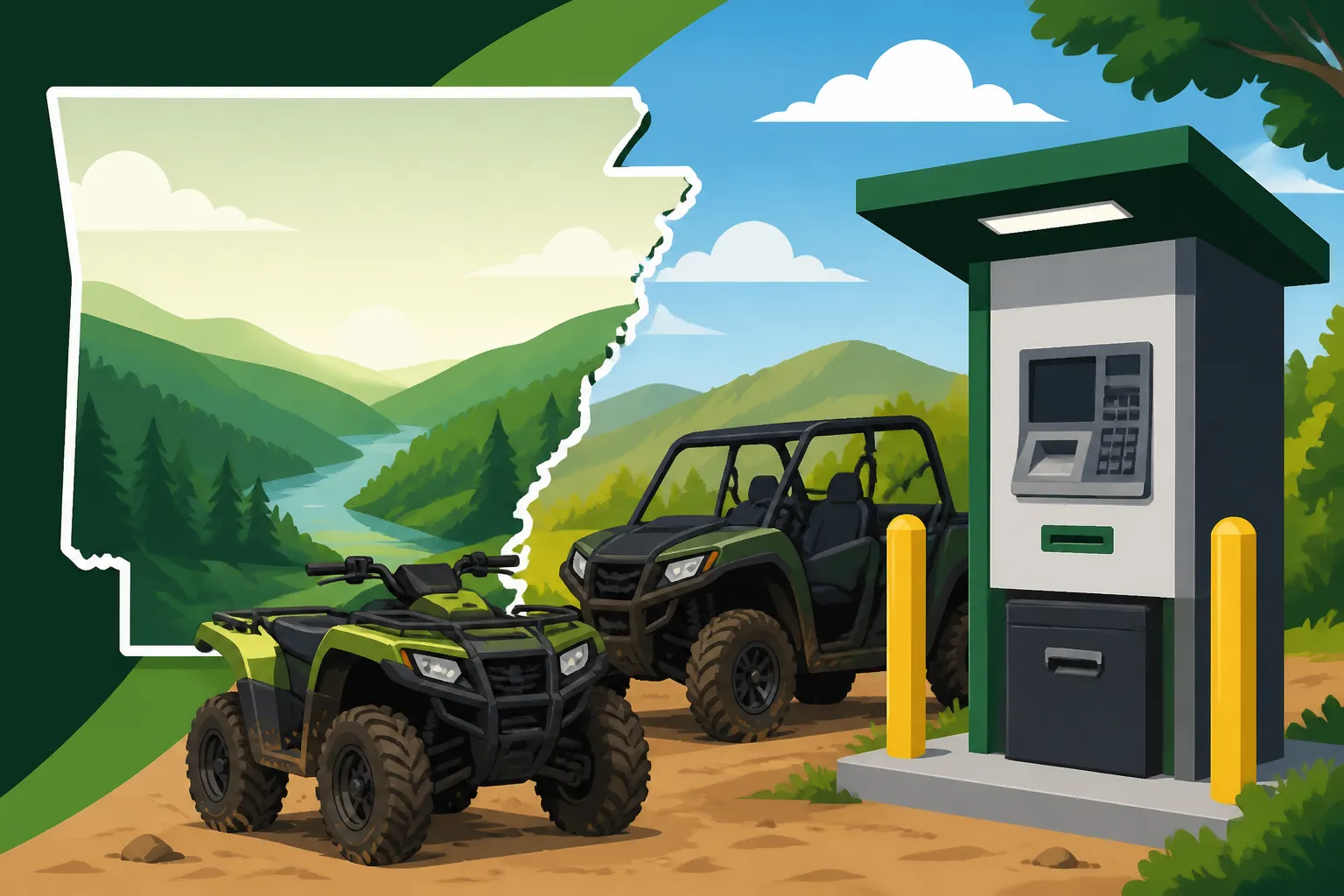
A self-service fee station is an unattended way to pay for a permit or fee required at a particular riding area. Instead of visiting a staffed office, you follow the posted directions at the station, complete the required payment process, and carry or display the permit as instructed.
The important qualifier is particular. A station is not a statewide ATV registration counter, and paying at one does not automatically give you permission to ride everywhere in Arkansas. Forests and riding areas can have separate permit systems. A pass that works in one area may not satisfy the rules in another. The difference matters if your trip includes more than one trail system; Arkansas Riders Need Two Different Forest Passes explains why one forest pass may not cover another.
A self-service station also is not a substitute for checking whether the riding area is open. A fee paid at a trailhead does not override a closure, a seasonal restriction, a machine-width limit, or a rule about where vehicles may travel. Confirm the current trail status and local requirements before loading up. For Wolf Pen Gap, for example, check How to Check Wolf Pen Gap Trail Status before you tow there.
There are two kinds of paperwork riders commonly confuse:
- Arkansas ATV registration is state paperwork for a qualifying machine. It is handled through the state’s registration process, not through a forest fee station. Read How to Register an ATV in Arkansas if you need to sort out state registration.
- A riding-area or forest OHV permit is permission to use a specific trail system or public-land area under that system’s rules. A self-service fee station may be one way to obtain it.
A permit station therefore solves a narrow but useful problem: it lets a rider pay for the applicable access permit at or near the riding area when that option is offered. It does not confirm that the machine is registered, insured, within width limits, or otherwise eligible to ride.
This distinction is especially useful for visiting riders. A registration decal from your home state may address state registration requirements, but it does not necessarily replace an Arkansas forest or trail-system permit. Check both sets of rules rather than assuming one document covers everything. The broader comparison in Arkansas OHV Permits: Two Forests, Two Prices is a helpful starting point.
Before you drive to the station
Treat the station as a backup or convenient purchase point, not as your entire trip plan. Before leaving, identify the exact riding area, find its current permit instructions, and check what options are available. Some permits may be available online or through another authorized channel; others may be offered at a local self-service station. Procedures can differ by forest and site.
The official instructions for the specific riding area should answer practical questions such as:
- Is the station operating and accessible?
- Which permit or pass is sold there?
- What payment methods are accepted?
- Is the permit valid for a day, a longer period, or another stated term?
- Does the pass apply per rider, per machine, or under another rule?
- Do you need to display a physical permit, keep it with you, or follow another proof-of-purchase instruction?
- Are there separate requirements for another forest or trail system on your itinerary?
Do not rely on a photo of an old sign or a recollection from a previous trip for payment details. A station may be unattended, and there may not be a clerk nearby to answer questions or make change. If the payment method is not clear from current official information, contact the responsible office or managing organization before you travel. How to Buy an Arkansas Forest OHV Permit covers the purchase question more broadly, including options besides a trailhead station.
Check the location, not just the trail name
A popular riding destination can have more than one access point, and a fee station may not be located at every entrance. Confirm the station’s location against the official map or directions for the area. Also check whether the route you plan to use actually reaches the intended trailhead. A navigation app may direct you to a nearby road or campground rather than the permit station.
This matters on a long tow day. If you arrive after dark, find a closed gate, or discover that the station is at another entrance, your options may be limited. Save the managing agency’s directions offline, note the trailhead name, and have a backup plan for obtaining the permit before you ride.
Know which pass you need
Arkansas riding areas do not all use one interchangeable OHV permit. Forest boundaries and trail-system rules can make the distinction easy to miss, particularly on a multi-day trip. A pass for one forest does not automatically authorize riding in another. If you expect to ride at more than one location, list each one separately and verify the permit for each.
For each destination, write down:
- The trail system or forest you intend to ride.
- The permit required for that location.
- Where and how the permit can be obtained.
- How the permit must be carried or displayed.
- Any current closures, machine restrictions, or route limitations.
That simple check prevents the common mistake of arriving with a valid pass that is valid for the wrong place.
How to use a self-service station
Stations may not all be set up exactly alike, so follow the signs and instructions at the site rather than assuming every kiosk works the same way. A common self-service arrangement uses posted directions and a payment process completed by the rider. If there is an envelope, form, ticket, or receipt involved, fill it out as directed and retain the portion you are told to keep.
A careful process looks like this:
- Stop and read the entire sign. Check that the station serves the riding area you are about to use and that the permit type matches your trip.
- Confirm the fee and payment method. Use the current posted amount and accepted method. Do not guess or leave an improvised payment if the instructions do not authorize it.
- Complete the required information legibly. If the station asks for machine or owner details, provide them accurately. If you are unsure what a field means, do not invent an answer; use the contact information provided by the managing organization.
- Follow the payment directions exactly. Place payment only where the instructions say. If the system calls for an envelope or tear-off portion, use it as directed.
- Keep proof of purchase. Save the receipt, permit stub, or other proof you are instructed to retain. If an electronic confirmation is issued, keep it accessible offline.
- Display or carry the permit as required. A permit may need to be attached to the machine, kept with the rider, or shown in a specified way. Read the current directions instead of assuming.
- Take a moment to check the machine and route rules. Paying is not a waiver of trail restrictions. Confirm that your machine is allowed on the route and that you are not entering a closed section.
If the station is damaged, empty, unclear, or apparently out of service, do not assume you can ride without a permit. Look for the official alternative purchase method or contact the responsible office. If no solution is available, the safer choice is to postpone riding in that area until you can confirm what is required.
What to bring
A little preparation makes an unattended station less frustrating. Consider bringing:
- A payment method accepted at the site, confirmed in advance.
- A pen, in case you need to complete a paper form.
- Your machine’s identifying information, if the station or permit process requests it.
- A charged phone with the permit instructions and confirmation saved.
- A small waterproof pouch to keep paper proof legible.
- A headlamp or flashlight if you could reach the trailhead in low light.
A basic pen and water-resistant document pouch are practical items to keep in the tow vehicle. If you are replacing worn trail gear, Amazon may be one place to look for a pouch, but choose one that closes securely and is easy to access. You do not need special equipment to use a station; the goal is simply to keep the permit and proof from getting wet, lost, or covered in trail dirt.
Avoid putting a paper permit somewhere that could fall off on the first rough section. If the instructions require it to be displayed on the machine, secure it as directed and check it again before leaving the trailhead. For more on proof and presentation at a specific site, see Carrying Your Forest Permit at Mill Creek.
What the station does not cover
The fee station is only one piece of a legal, prepared ride. It does not register your ATV or side-by-side with the state, and it does not replace any required state decal. It does not grant access to every public road, wildlife area, private property, or forest road. It also does not change rules about trail closures or machine eligibility.
It is not state registration
Arkansas state registration and forest access permits have different purposes and are handled through different processes. A state registration decal is not proof that you have paid the fee for a particular forest trail system. Conversely, a forest permit is not proof that the machine has completed any state registration requirement that applies to it.
If you have not sorted out registration, start with Arkansas Registration Paperwork Checklist and confirm the requirements that apply to your machine and situation. Questions can differ for an ATV, a side-by-side, a newly purchased machine, or a machine brought in from another state.
This is also why “I paid at the trailhead” is not a complete answer if an officer or ranger asks about the machine’s paperwork. The pass may answer the access-permit question; it does not necessarily answer registration, proof-of-ownership, or other compliance questions. What a Forest Ranger Checks on an Arkansas Trailhead offers a useful overview of the kinds of issues riders should be ready to address.
It is not a road-use permit
A forest or riding-area pass does not make an ATV or UTV legal on every public road. Road rules are separate from trail-access requirements, and the fact that a trailhead sits beside a road does not authorize riding on that road. Before leaving the designated riding area, check the applicable rules and local restrictions. For the statewide road-law overview, see Can You Drive an ATV on the Road in Arkansas?.
It does not erase land and trail restrictions
A paid permit does not authorize travel behind a closed gate, across a prohibited area, or onto land where you lack permission. Stay on routes open to your machine, obey posted signs, and respect barriers. If a route is closed because of weather, maintenance, seasonal conditions, or another restriction, the permit does not override that closure.
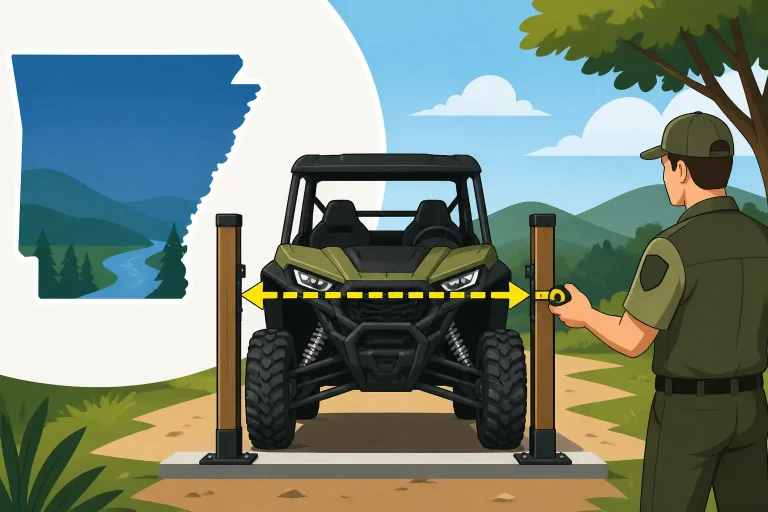
Nor should a rider assume that every machine is allowed simply because the permit can be purchased. Trail systems may impose width limits or other equipment rules. Confirm your machine’s dimensions and eligibility before setting out, especially if you ride a wide side-by-side. A station may collect the fee without measuring your machine or checking every restriction.
Choosing between a station and another purchase method
If a self-service station is available, it can be handy for riders who are already at the designated access point. But buying before departure may be a better fit when the ride is remote, the station’s payment options are limited, or you want to avoid handling paperwork at the trailhead.
| Situation | Self-service station may be useful | Buying or checking ahead may be wiser |
|---|---|---|
| You are riding one known trail system | You can confirm the correct station and permit on arrival | Useful if you want proof in hand before towing |
| You are visiting multiple areas | Only if the station sells the exact permit for that area | Better for checking whether separate permits are needed |
| You may arrive after dark | Only if the station is accessible and instructions are clear | Often safer to confirm the process before travel |
| You are unsure about payment methods | Not ideal to discover this at the kiosk | Confirm accepted payment options first |
| You are riding with a group | Convenient if each machine’s permit process is clear | Helps avoid delays and confusion at the entrance |
| You already have an online confirmation | Follow the specific rules for carrying or displaying it | Save a copy offline and bring any required printed version |
For current purchase options, use the managing organization’s official information. The instructions in Arkansas Permits Bought on Recreation.gov can help explain an online route where that system applies, but do not assume every Arkansas OHV permit is bought there. Some areas use different processes. Check the specific destination.
There is also a practical difference between a daily permit and a longer-term option. Which one makes sense depends on how often you ride, where you plan to ride, and the terms of the available permits. Compare the actual conditions rather than choosing solely by the name of the pass. Arkansas Annual Versus Day Permits explains the decision in more detail. Any current cost or term should be confirmed directly with the official provider before purchase.
Group rides and multiple machines
When a group arrives together, it is easy to assume that one payment covers everyone. Do not make that assumption. A permit may be issued under a per-machine system, or the applicable rules may define coverage another way. Check the official terms for the exact area. The overview in Arkansas Permits Are Per Vehicle can help you understand why this question matters.
Assign one person to verify the permit instructions before departure, but make sure every rider knows what proof must be carried or displayed. If each machine needs its own permit, keep the confirmations organized by vehicle. A photo of a receipt may help as a backup, but it should not replace a required physical permit or display method.
For a group, create a short checklist with each machine’s permit status, registration paperwork, and any machine-specific restrictions. This is more reliable than passing around a single phone screen at the trailhead while people wait with trailers behind them.
Keep proof accessible
Paper can get wet, fold, or disappear in a glovebox. Electronic confirmations can be hard to retrieve when cell service is weak. Use the method required by the permit rules, and keep a backup where practical. A photo saved locally on a phone can be useful, but it is not a substitute if the rules specifically require a printed permit or an attached decal.
A small document pouch from Amazon can help protect paper permits and receipts in a tow vehicle or riding pack. Keep it separate from loose tools and wet riding gear. If you carry multiple passes, label them by destination so you do not accidentally show the wrong one.
Do not alter, reproduce, or move a permit from one machine to another unless the provider’s rules expressly allow it. If a permit is lost or damaged, ask the managing organization how to replace it rather than trying to recreate it yourself. Questions about lost passes and replacements are covered in Arkansas Permit Replacement If Lost.
Common mistakes to avoid
Most station problems come from assumptions, not complicated paperwork. A few checks can prevent a wasted trip or an avoidable citation.
- Assuming every station uses the same system. Follow the instructions at the specific site.
- Assuming cash is always accepted. Confirm payment methods before driving out.
- Assuming a forest pass works across all forests. Verify each destination separately.
- Treating a trail permit as state registration. These documents serve different purposes.
- Believing payment guarantees trail access. Closures and machine restrictions still apply.
- Leaving proof in a place you cannot reach on the trail. Carry or display it as required.
- Counting on cell service to retrieve a confirmation. Save needed documents offline.
- Waiting until the trailhead to learn the requirements. Check permits and trail conditions before towing.
- Assuming one group payment covers multiple machines. Confirm how permits are issued for that area.
- Riding when the station or instructions are unclear. Find an official alternative or wait until you can verify the rule.
A good routine is to confirm the location and rules before leaving, pay through an authorized method, retain proof, and make one final check at the entrance. If the station’s signs conflict with information you found earlier, follow posted directions only when they are clearly current and contact the managing organization when the difference affects whether you can ride.
Self-service stations are meant to make access easier, not to replace trip planning. Know which area you are entering, which pass applies, and how it must be carried or displayed. Then check that the trails are open and your machine is allowed. With those details handled before the first ride, the station becomes a quick stop rather than the start of a paperwork problem.
Disclaimer
This article is for general informational purposes only and does not constitute professional advice. Laws, prices and regulations vary by location and change over time. Consult a qualified professional for guidance on your specific situation.