Measuring Width at Check-In
A machine can fit on a trailer and still be too wide for a trail gate. If you are riding in Arkansas, the useful measurement is the ATV or UTV’s actual outside width—not just the number in a brochure. Here’s how to measure before you travel, what to check at a trailhead, and how to avoid confusing a permit with permission to pass a narrow gate.
What “width at check-in” means
At a trailhead, check-in may involve confirming your permit, reviewing posted rules, or making sure your machine can use the route. Where a width restriction applies, the practical question is whether the machine can pass through the narrowest gate or other marked restriction without touching it or leaving the designated route.
There is not one measurement procedure that applies at every Arkansas riding area. Forest routes and private parks can have different rules, and a machine that is allowed on one trail may not be allowed on another. Read the current signs and trail information for the place you plan to ride. Arkansas ATV Trails With Width Limits and Arkansas Gates That Stop 72-Inch Machines are useful starting points when you are checking whether a particular machine may fit.
A brochure’s width figure is helpful, but it is not always the final answer. The stated dimension may not include every accessory, or your machine may have been modified since it left the factory. Tires, wheel offset, fender extensions, mirrors, racks, or other parts can affect the widest point. If you are close to a posted limit, measure the machine itself rather than relying only on a model specification.
A permit is also not a guarantee that a machine can use every trail. A permit gives access under the applicable permit rules; width restrictions, gate closures, and route-specific limits still matter. Arkansas riders may also need to distinguish between permits for different forest areas. See Arkansas Riders Need Two Different Forest Passes and Arkansas OHV Permits: Two Forests, Two Prices before planning a trip across more than one riding area.
How to measure your ATV or UTV accurately
The goal is to find the machine’s widest outside-to-outside dimension in the configuration you will actually ride. Use a level surface and a tape measure long enough to span the vehicle. A basic tape measure from a hardware store or Amazon can do the job; the important part is taking the measurement carefully and including anything that sticks out.
Set the machine up as it will be ridden
Park on firm, level ground. Set the wheels straight, make sure the tires are inflated as intended, and put the machine in its normal riding configuration. If you normally ride with mirrors, hand guards, fender flares, or other accessories installed, measure with them in place. Don’t measure a stripped-down machine and assume it represents the vehicle you plan to take through a gate.
For a side-by-side, check both the front and rear. The widest point may be at the tires, fenders, mirrors, or bodywork, and the front and rear dimensions may not match. On an ATV, handlebar accessories or hand guards may extend beyond the body or tires. Measure each area that could be widest rather than assuming the axle or body panel sets the width.
If an accessory folds or can be removed, do not assume you may fold or remove it to get through a restriction. Confirm that the trail operator allows that configuration, and make sure the change does not affect safe operation or violate a posted rule. The safest plan is to measure the machine in the condition you intend to ride it.
Measure across the widest points
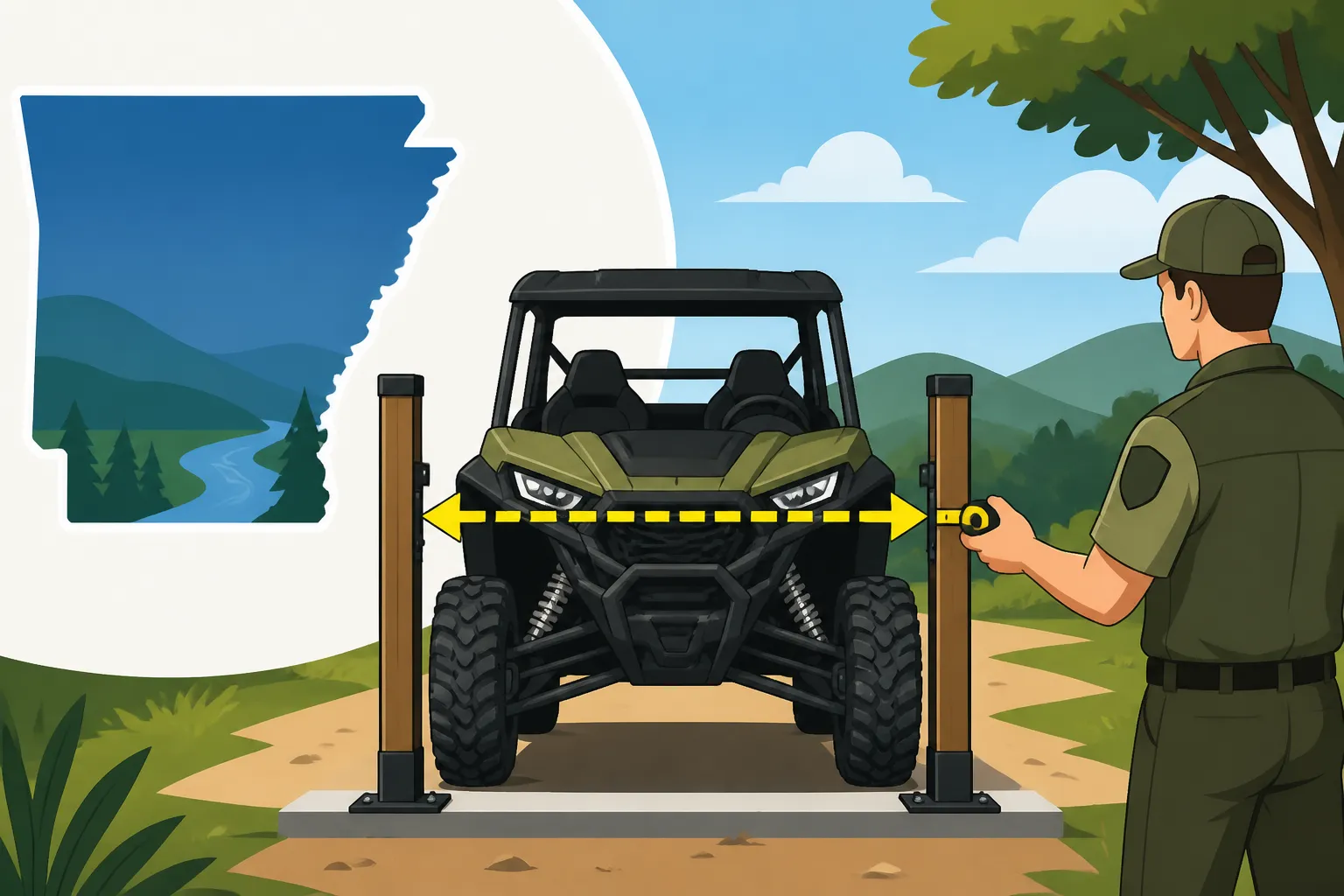
Have a second person help if possible. One person can hold the tape at one side while the other checks that it reaches the corresponding outside edge on the opposite side. Keep the tape straight and level; a diagonal measurement can give a misleading result.
Measure from the outermost point on one side to the outermost point on the other. Depending on the machine, those points could be tire sidewalls, fender edges, mirrors, or an installed accessory. If one part sticks out farther than the tire, include it. Record the result and note where you measured, so you can repeat the check later.
Take more than one measurement if the shape is irregular. For example, check across the front tires, rear tires, mirrors, and any visibly protruding accessories. The largest reliable measurement is the number to compare with a stated width limit. If your result is close to the posted maximum, leave room for uncertainty rather than treating a borderline measurement as a definite pass.
| Check | What to do | Why it matters |
|---|---|---|
| Tires | Measure across the outer sidewalls at the widest point | Tire size, pressure, or wheel setup may change the machine’s width |
| Body and fenders | Check the widest bodywork or fender extensions | Aftermarket parts can extend beyond factory dimensions |
| Mirrors and accessories | Include installed parts that project outward | The brochure figure may not include them |
| Front and rear | Measure both ends rather than assuming they match | Some machines are wider at one end |
| Posted limit | Compare your largest measurement with the current rule | Limits and access can vary by route |
Check the specification, but don’t stop there
The manufacturer’s specification can help you screen a machine before you buy or tow it, but confirm what the listed width represents. A specification may describe the vehicle body or a standard configuration. It may not account for later additions or changes.
If the machine is modified, record the modifications and measure again. Wheel spacers, different wheels, tires, widened fenders, mirrors, and cargo accessories can change the outside dimension. Even if a part seems small, it can determine whether the machine clears a narrow gate.
Take a photo of the tape across the widest point if you want a record for trip planning. A photo does not replace the trail’s rules or an on-site decision, but it can help you remember which point you measured and share the setup details with a riding companion.
What to check at the trailhead
Before unloading or entering a trail, read the posted information for that specific access point. Look for width limits, gate restrictions, closed routes, and instructions about which trails are open to your machine. Do not assume that a limit you saw online applies to every trail in the area, or that a route shown on an older map remains open.
Some Arkansas trail gates are designed to prevent wider machines from entering. A gate’s visible opening is not necessarily a dependable substitute for the posted rule: the opening can be difficult to judge by eye, and the usable clearance may depend on the gate structure or approach. Do not try to squeeze through by angling the machine, riding on an edge, or pushing past a barrier. If the machine does not clearly meet the route’s requirement, ask the site contact or choose an appropriate route.
At check-in, be ready to provide the machine’s make and model and explain any modifications if asked. A ranger or trail staff member may assess whether the machine meets the rules for that area. The precise practice can vary, so a measurement you took at home is useful preparation, not a promise that staff will make the same decision. For an overview of the kinds of checks that may come up, see What a Forest Ranger Checks on an Arkansas Trailhead.
If you are unsure, ask before unloading or riding toward a gate. Have the trail name, machine model, and your widest measurement ready. A clear question is more useful than asking only whether a machine is “UTV-sized” or “stock.” Those descriptions do not tell staff how wide your specific setup is.
Check conditions and access information shortly before leaving, especially if your trip depends on one particular trail. Weather, maintenance, or other closures can change which routes are available. How to Check Wolf Pen Gap Trail Status, Arkansas ATV Trail Map Downloads, and Arkansas Trail Conditions Before You Tow can help you plan, but posted directions at the site should take priority.
Common measurement mistakes and a safer plan
A few small errors can turn a planned ride into a frustrating trip. The most common is using the manufacturer’s width as though it covers every accessory. Another is measuring only the front or only the tires, even when mirrors, fenders, or the rear body extend farther. Measuring from the center of each tire instead of the outer edges also produces a number that is too small for a gate check.
Avoid measuring while the machine is parked on uneven ground or while the front wheels are turned. Don’t pull the tape diagonally to get a more convenient reading. If two measurements differ, repeat them on level ground and use the largest accurate result. If you cannot tell whether an attachment should count, ask the trail operator rather than guessing.
A practical pre-trip process is:
- Find the specific riding area and trails you plan to use.
- Check current posted width limits and access information for those routes.
- Measure the machine in its actual riding configuration, including outward-projecting parts.
- Compare the largest measurement with the applicable limit, leaving a margin if you are close.
- Contact the site if the limit or your measurement is unclear.
- Recheck signs at the trailhead before proceeding.
If your machine is too wide for one route, do not assume it can be made acceptable by deflating tires, removing safety equipment, or forcing the machine through a narrow opening. Find a route or riding area that allows the machine as configured. For general trail behavior and respecting closures, Arkansas Trail Etiquette Locals Expect offers useful planning context.
The simplest way to avoid a check-in surprise is to measure before you load. Confirm the rules for your exact riding destination, include every part that adds width, and treat a posted restriction as a firm limit rather than a challenge to test in person.
Disclaimer
This article is for general informational purposes only and does not constitute professional advice. Laws, prices and regulations vary by location and change over time. Consult a qualified professional for guidance on your specific situation.