Arkansas Supervision at a Private Park
Arkansas private off-road parks may allow children to ride, but “an adult is coming along” does not automatically meet a park’s supervision rules. Requirements can depend on the child’s age, whether they are driving or riding as a passenger, and the machine being used. Check both the park’s policy and the applicable Arkansas rules before you book.
What supervision means at a private park
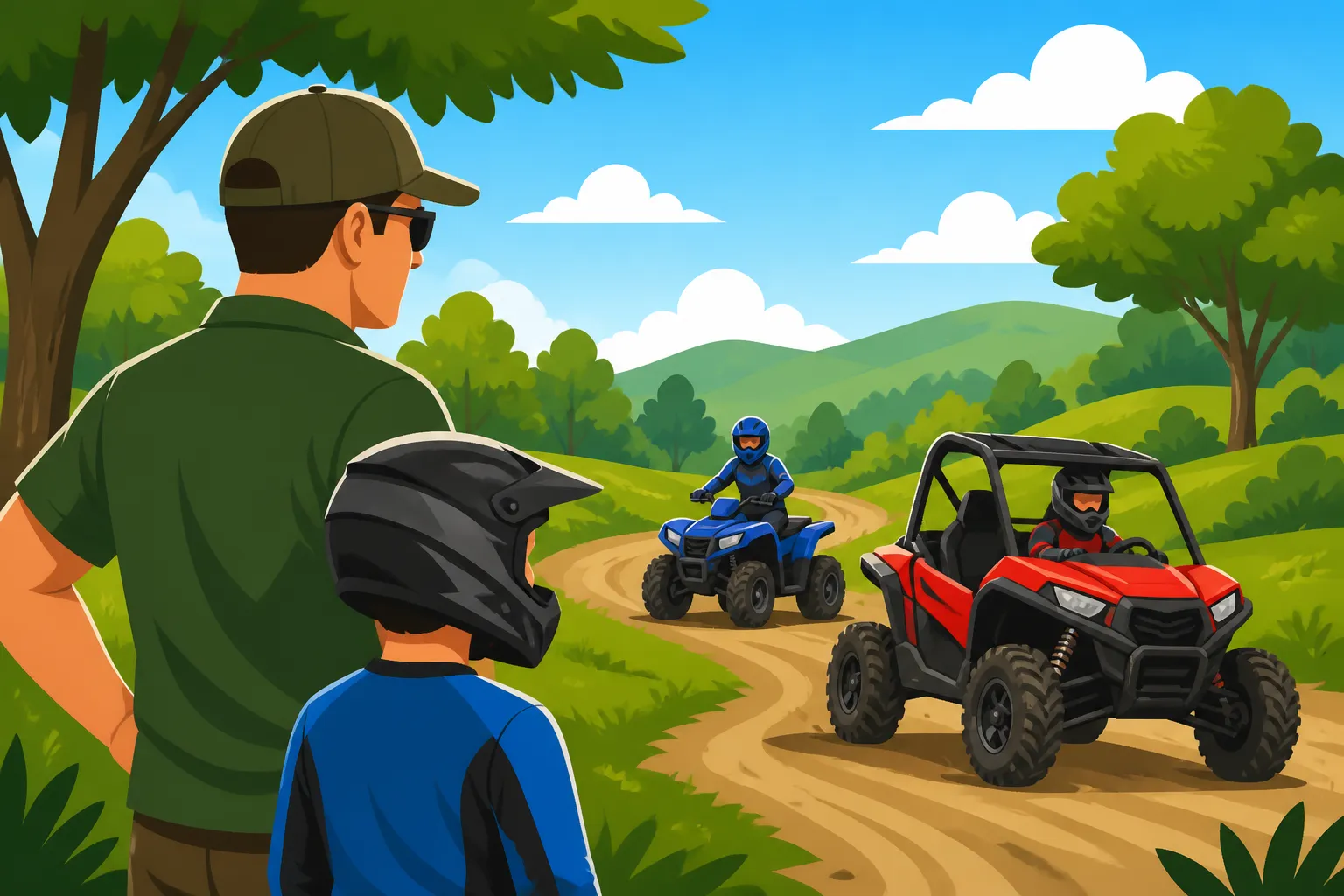
At a private park, supervision is more than having an adult somewhere on the property. The park may expect a responsible adult to stay close enough to watch the child, respond quickly, and help prevent unsafe riding. A supervisor who is back at the campsite, in a different trail area, or riding far ahead may not meet that standard.
Some parks may require an adult to accompany a young rider on the machine. Others may allow the child to operate a machine independently if an adult remains nearby. The details are park-specific, so ask what the operator means by “direct supervision” rather than assuming that one arrangement works everywhere. Direct Supervision by an Adult explains the practical meaning of that phrase.
Arkansas requirements for young ATV riders and a private park’s own policies are related, but they are not interchangeable. State law may set a baseline for particular settings, while a private operator can impose stricter conditions for access, equipment, or riding. A park can also decide that a child is too young or too small for a particular machine even if a general state rule does not prohibit the activity.
The supervising adult may also need to be at least 18. Confirm who qualifies: the park may require a parent or legal guardian, or it may accept another adult who has the parent’s permission. Do not assume that an older sibling or a young adult in the group can supervise. Why the Supervising Adult Must Be Eighteen or Older covers that distinction.
| Situation | What to confirm with the park |
|---|---|
| Child driving an ATV | Minimum age, required supervision, and any machine-size or experience limits |
| Child riding as a passenger | Whether passengers are allowed and whether the operator must meet an age requirement |
| Adult riding a separate machine | Whether the adult must remain within sight, within a certain distance, or on the same trail |
| Child in a side-by-side | Seat, restraint, passenger-age, and supervision requirements |
| Group ride with children | Whether each child needs an adult assigned to them and whether adults may ride in the lead or follow |
A park’s staff may use “supervise” to mean close observation rather than riding together. That can be difficult to manage on a long or winding trail. Ask how staff expect the adult to keep the child in view, and whether trail difficulty affects the rule.
State rules, park policies, and permits are separate
A private park’s admission policy is not the same as a state registration rule or a public-land permit. Registration and decals address whether a machine meets Arkansas requirements for registration; a forest or trail permit may apply to designated public riding areas. Neither one automatically grants permission for a child to ride at a private park, and neither replaces the park’s age and supervision rules.
Likewise, permission to ride at a private park does not mean the same machine is allowed on every public trail. Public land can have separate rules on machine type, permits, route access, and young riders. If your trip includes both a private park and a public riding area, check each location independently. The rules in Arkansas Private Park Age Minimums are a useful companion when age is the main question, while Arkansas Rules for Riders Under Twelve addresses the broader issue of young riders.
Do not treat an out-of-state registration decal or a home-state safety card as an automatic exemption from a private operator’s rules. A park can ask for information about the rider, machine, or supervising adult even when the family has already met requirements elsewhere. If the park accepts documents from another state, ask which ones and whether they must be shown at check-in.
For a trip that includes forest trails, verify the permit separately. Arkansas riders may encounter different permit systems on different public lands; a permit for one area may not cover another. A private park generally sets its own admission and operating conditions, so ask the park what is included in the entry process and what must be handled separately.
How to check the rules before you go
Policies can differ between parks and between machine types. Calling ahead is especially useful if the child is close to an age cutoff, has never ridden before, or will be a passenger rather than the driver.
- Identify the exact riding location. Confirm that the place is a private park and not a public trail system or a mix of private and public routes.
- Give the child’s age and role. Say whether the child will drive a quad, ride as a passenger, or sit in a side-by-side.
- Describe the machine. Share its type, size, seating arrangement, and whether it has passenger restraints. If you are renting, ask whether the rental company has additional rules.
- Ask what “supervision” requires. Find out if an adult must ride with the child, travel on a nearby machine, or remain within sight. Ask whether the adult must be a parent or guardian and whether there is a minimum age.
- Ask about separate park requirements. Confirm age limits, rider orientation, helmets, waivers, and any restrictions on passengers or particular trails. [Arkansas Private Park Helmet Rules] and Arkansas Private Park Waiver Forms address two common check-in questions.
- Confirm what to bring. Ask whether the adult needs identification, whether the child’s parent must sign paperwork, and whether the park supplies protective gear.
- Get the answer in writing if it affects your booking. An email or message can help avoid a disagreement at check-in, though staff may still apply current safety rules on arrival.
Be clear when asking. “Can my child come?” is less useful than “My child is 11 and would ride as a passenger in a two-seat side-by-side. Must an adult be in the vehicle, and what age must the driver be?” A specific question is more likely to get an answer you can plan around.
If the child is a first-time rider, ask whether the park has a required orientation or beginner area. A family may meet the age rule and still be turned away from a particular route because of terrain, machine capability, or the child’s experience. An orientation does not replace close supervision, but it can help the child understand basic controls and trail etiquette before heading out.
Planning a safer visit with a child
The adult’s job is not only to satisfy a check-in requirement. Children can misjudge speed, terrain, and stopping distance, and trail conditions can change. Choose a route and machine that match the child’s size and ability, not just the adult’s preferred ride.
Before setting out, make sure the child knows how to stop, how to signal a problem, and what to do if the group gets separated. Agree on simple rules: stay with the assigned adult, do not pass without permission, stop when asked, and never follow another rider onto an unfamiliar route. If the adult cannot keep the child in view, stop and regroup rather than continuing with the group split apart.
Use properly fitted protective equipment. Check the park’s helmet policy in advance, and ask whether its gear is appropriate for the child’s size. A helmet that shifts or blocks vision is not a good fit. Eye protection, gloves, sturdy footwear, and clothing suited to the weather can also help make a ride more manageable. Amazon may be one place to compare basic gear, but confirm sizing and safety suitability before purchasing.
For a child riding as a passenger, check the machine’s design and the park’s policy. A seat that appears large enough is not proof that the vehicle is intended for a child passenger. Ask whether the child can reach the footrests, use the restraints correctly, and sit securely without leaning or shifting dangerously. Never assume that a lap or cargo area is an acceptable passenger seat.
If an adult is supervising from a separate machine, plan how the group will stay together. The adult should be able to keep pace without pressuring the child to ride beyond their ability. On a narrow trail, at a junction, or when visibility is limited, pause and confirm the child is still with the group. A faster adult riding far ahead may technically be present but may not provide meaningful supervision.
Finally, treat a park’s waiver, orientation, or admission approval as separate from the decision to ride. Signing a form does not make an unsuitable machine or route safe, and approval at one park does not establish permission at another. If staff say a child cannot use a machine or trail, ask whether there is a suitable alternative rather than trying to work around the restriction. For additional context on operator expectations, see Arkansas Private Park Insurance Rules and Arkansas Supervision Rules for Small Children.
Disclaimer
This article is for general informational purposes only and does not constitute professional advice. Laws, prices and regulations vary by location and change over time. Consult a qualified professional for guidance on your specific situation.