Arkansas Supervision Rules for Small Children
Arkansas Supervision Rules for Small Children
Letting a young child ride an ATV or UTV raises two separate questions: whether Arkansas allows the child to operate it, and whether the machine, land and supervision are suitable. The key age threshold is 12, but an adult’s presence does not make every ride lawful or safe. Here’s how to think through the rules and plan a ride responsibly.
What Arkansas Requires When a Rider Is Under 12
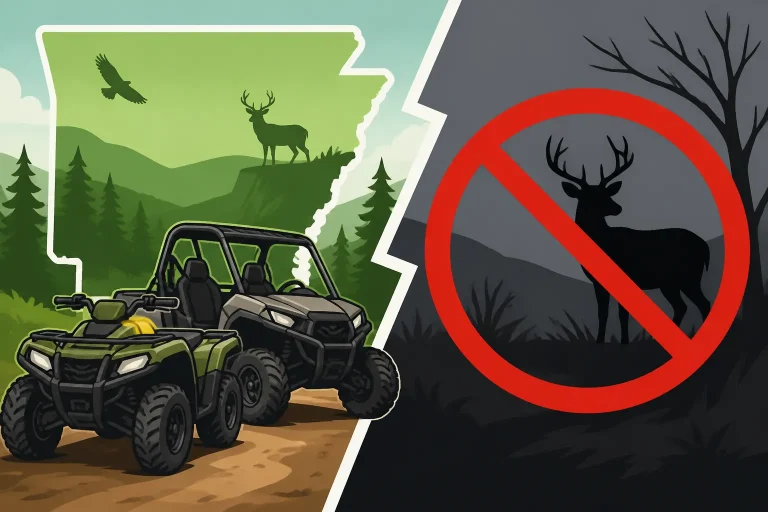
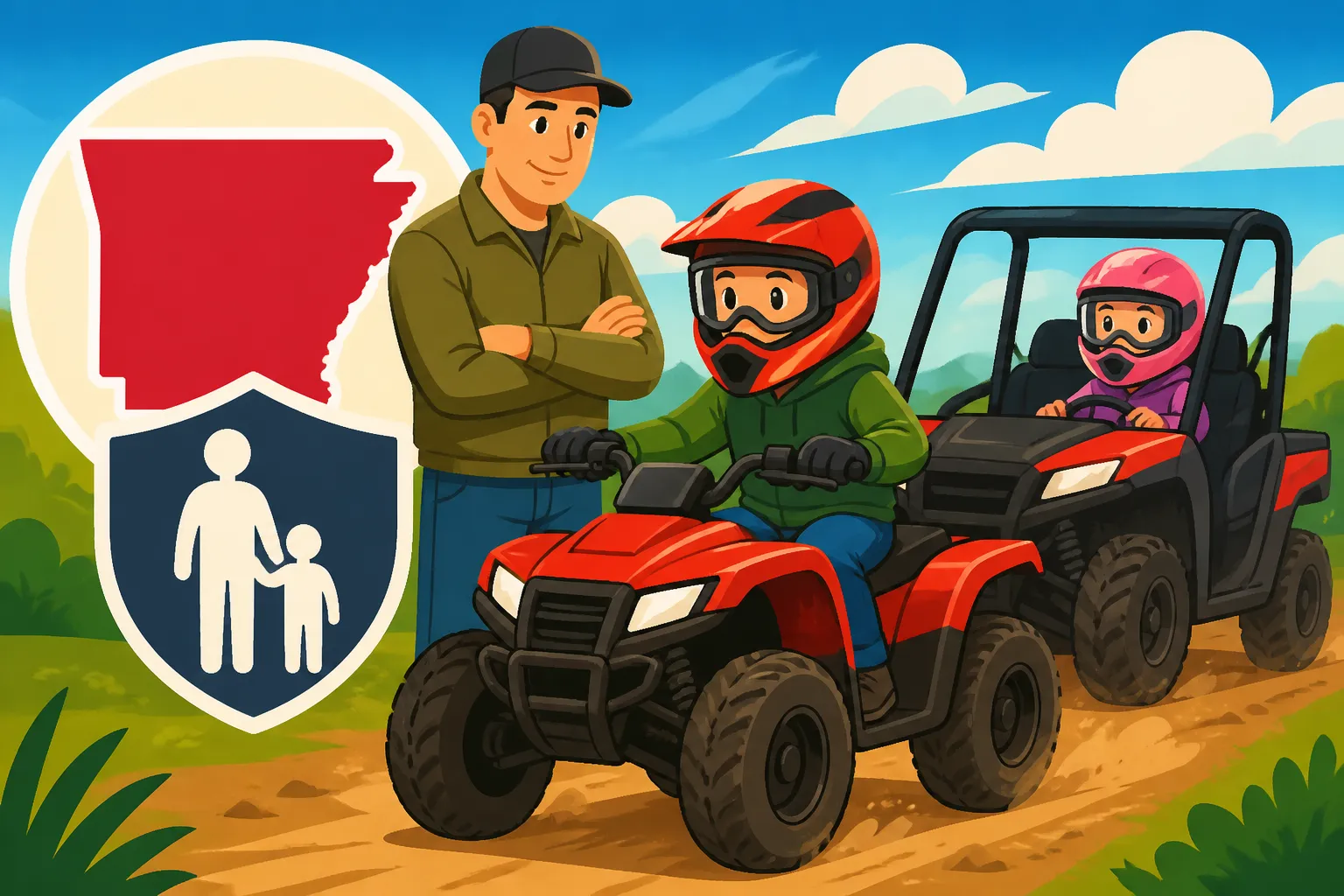
Arkansas has special rules for children under 12 who operate an ATV. In general, a child in this age group must be under the direct supervision of an adult who is at least 18. The land where the child rides matters too: the ride must take place on land the child’s parent or guardian owns or leases, or on land where the owner has allowed the riding.
Those conditions work together. An adult supervising a child on land where riding is not allowed does not solve the land-access problem. Likewise, having permission to ride somewhere does not remove the supervision requirement for a rider under 12. For a broader overview of the age-related rules, see Arkansas Rules for Riders Under Twelve.
| Question | Practical answer |
|---|---|
| How old is the young-rider threshold? | The special rule applies to children under 12. |
| Who must supervise? | An adult at least 18 years old must directly supervise. |
| Where may the child ride? | On land owned or leased by the parent or guardian, or land where the owner permits the ride. |
| Does supervision allow road riding? | No. Supervision does not override road restrictions, land rules or trail requirements. |
| Is an adult’s presence enough at a public riding area? | Not necessarily. Check that area’s access rules, permit requirements and age policies before going. |
Direct supervision means active oversight
Direct supervision is more than being somewhere on the same property. A supervising adult should be close enough to monitor the child’s riding, notice changing conditions and intervene promptly if needed. Watching from a house, vehicle or distant trailhead may not provide meaningful supervision, especially where terrain, trees or distance block the view.
The precise application can depend on the facts and the place where the ride takes place. A prudent approach is to keep the adult within sight and close enough to stop the ride or reach the child quickly. The adult should also be attentive rather than splitting focus between riding, a phone, other children or unrelated tasks. For a fuller explanation of the requirement, see Direct Supervision by an Adult and Adult Supervision Rules for Arkansas Riders Under 12.
The supervising adult does not necessarily have to be the child’s parent. But the adult should understand the conditions of the ride, have permission to be on the land and be capable of responding to an emergency. A child’s older sibling or friend should not be assumed to qualify: the adult-supervision rule calls for someone at least 18. More detail is available in Why the Supervising Adult Must Be Eighteen or Older.
The land must be appropriate and authorized
A parent or guardian’s property is not the only possible place to ride, but permission matters. A child may be allowed to ride on land owned or leased by a parent or guardian, or on land where the landowner has given permission. If the ride is on someone else’s property, ask first and be specific about where the child may go, when riding is allowed and what kind of machine will be used.
Written permission is a sensible precaution. It creates a record of what the owner agreed to and can help prevent misunderstandings about boundaries, gates, trails or other riders. See Riding on a Guardian’s Land and Written Permission From an Arkansas Landowner for related land-access questions.
Private property is not automatically open to riding simply because it looks unused or because a child has ridden there before. A lease, club arrangement, posted boundary or change in ownership can affect access. Ask the person with authority over the land rather than relying on a neighbor’s assumption. Permission to ride also does not automatically allow access across adjoining property to reach the riding area.
Make the Machine and the Child a Safe Match
Meeting the supervision rule is a legal starting point, not proof that a child is ready for a particular machine. A young rider’s size, coordination, judgment and experience should match the vehicle. A machine that is too powerful, heavy or tall can be difficult for a child to control, even when an adult is nearby.
Choose a machine the child can control
The child should be able to reach and operate the controls without stretching, leaning dangerously or losing a secure grip. They should be able to sit in a stable riding position and understand how to use the throttle and brakes. Before a ride, confirm that the controls work and that the child can demonstrate the basic actions in a quiet, controlled area.
Do not use engine size or a manufacturer’s suggested age as the only measure of suitability. Two machines with similar specifications may feel very different to a small rider. Terrain, tires, load and the child’s experience also affect how manageable a vehicle is. If the child cannot stop smoothly, turn predictably or follow simple instructions, the ride should wait or use a more appropriate machine.
A child should never be carried as a passenger on a one-rider ATV. A passenger can shift the balance, interfere with the controls or be thrown during a sudden stop. If the plan involves a UTV, use only seating designed for passengers, and make sure the child can sit properly and use the available restraint system. A lap in an adult’s arms is not a safe substitute for a passenger seat.
Build skills before increasing difficulty
Start with a flat, open area free of traffic, steep slopes, trees, ditches and obstacles. Explain how to start and stop, where the child may ride, what signals to use and what to do if the machine stalls. Give one instruction at a time, then let the child repeat it. A short practice session is usually more useful than a long ride that pushes a new rider past their attention span.
Keep early rides slow and brief. Do not add passengers, towing, water crossings or steep terrain while the child is still learning basic control. If the child becomes tired, upset or distracted, stop. Fatigue and excitement can make it harder to follow instructions, and an adult may not be able to correct a mistake once the vehicle is moving quickly.
A safety course can be worthwhile even when it is not mandatory. It can help a family discuss controls, protective equipment and responsible riding before going to a trail or park. See Arkansas Safety Courses That Are Voluntary for more on training options.
Wear protective equipment every ride
A properly fitted helmet is a core safety item for a child operating an ATV or riding in an off-road vehicle. Add eye protection, gloves, long sleeves, long pants and sturdy footwear that covers the ankle. Clothing should fit securely and stay clear of moving parts. Avoid loose drawstrings or items that could catch on the machine.
The helmet should fit the child now, not be purchased with room to grow. A helmet that shifts, lifts or blocks vision may not protect properly. Retailers such as Amazon can offer a way to compare sizes and features, but check the helmet’s safety certification, return policy and fit; do not assume a product is suitable based on a listing alone. For state-specific helmet information, see Arkansas ATV Helmet Requirements.
Protective gear does not make an unsuitable ride safe. A helmet cannot compensate for excessive speed, a machine that is too large, riding beyond the child’s ability or a lack of direct adult oversight.
Where the Rules Apply and What Supervision Does Not Allow
The under-12 supervision rule is not a general permission to ride anywhere. Arkansas land-access rules, road restrictions, public-land regulations and private facility policies can add limits. Check each layer before loading the machine.
Public roads remain a separate issue
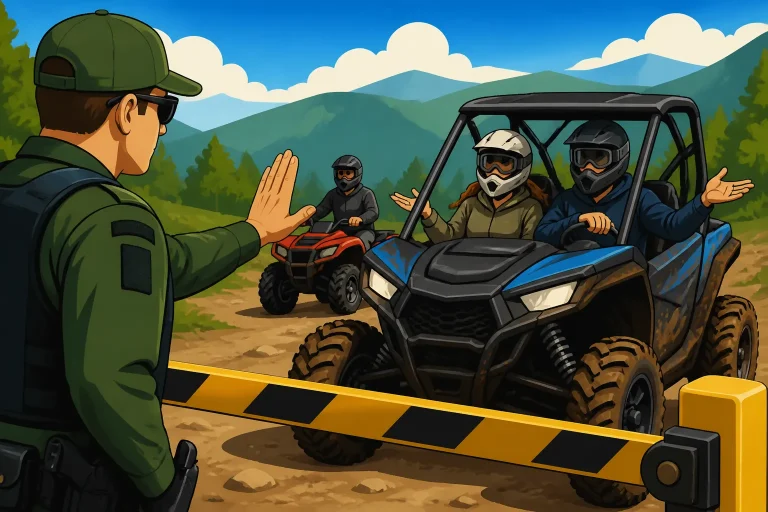
An adult’s supervision does not authorize a child to ride an ATV on a public road. Arkansas restricts off-road machine use on public roads, subject to specific exceptions and local rules. Those exceptions are limited; a child’s age, parental permission or adult supervision does not create a new one. Review Arkansas ATV Road Rules: What 27-21-106 Says before considering any road use or crossing.
Even when a route appears quiet or is used by other riders, it may still be a public road or otherwise closed to ATVs. Do not let a child follow an adult onto a road unless the route is clearly lawful for that machine and the child’s use. A permitted highway crossing, where applicable, is different from riding along the road.
Forest trails, wildlife areas and parks have their own rules
A place that allows ATV riding may set its own age limits, supervision conditions, machine restrictions, permits and hours. Public land can have designated routes and seasonal or temporary closures. A forest permit or access pass does not necessarily grant access to every road or trail, and it does not replace the child-supervision rule.
Arkansas forest riding can involve separate permit systems for different areas, so check the rules for the exact destination. Wildlife management areas also have vehicle restrictions that can differ from ordinary trail systems. See Arkansas Riders Need Two Different Forest Passes and Arkansas AGFC WMA Rules for Riders when planning public-land riding.
Private parks may impose rules that are stricter than state minimums. A park might set a minimum age for operating or riding as a passenger, require a waiver, restrict certain machines or require protective equipment. Contact the park directly before traveling with a child. Check Arkansas Private Park Age Minimums and Arkansas Private Park Waiver Forms for questions to ask.
Do not assume a small machine is exempt
A small youth quad may still be an ATV subject to applicable riding rules. A child-sized engine, short wheelbase or recreational use does not automatically remove the need for supervision or land permission. Some vehicles may fall into a different legal category depending on their design, but a label such as “youth model” does not settle that question.
If the machine is unusual, homemade, electric or configured differently from a standard ATV, verify how it is classified before riding. Also check its owner’s manual for operating limits and the manufacturer’s rider recommendations. A machine’s classification can affect which rules apply, while its design affects whether it is suitable for the child.
A Practical Pre-Ride Routine for Parents and Supervisors
A consistent routine helps adults catch problems before a child starts moving. Use it even for a familiar property, because weather, terrain and machine condition can change between rides.
- Confirm the child’s age and the applicable rule. If the rider is under 12, arrange direct supervision by an adult at least 18 and plan the ride on land where it is allowed.
- Confirm access. Identify the property owner or responsible land manager. Get permission in advance where needed, preferably in writing, and make sure the child knows the approved boundaries.
- Check the destination’s restrictions. For a trail, public land or private park, verify age rules, routes, permits, closures, machine limits and passenger requirements. Do not rely on an old pass or a previous visit as proof that access remains the same.
- Inspect the machine. Check the tires, brakes, throttle, steering, controls and protective guards. Confirm that the machine is suited to the child and has no obvious damage.
- Fit protective equipment. Make sure the helmet stays secure and does not obstruct the child’s vision. Add eye protection, gloves and clothing suitable for the weather and terrain.
- Set boundaries and signals. Show the child the allowed area, stopping point and route. Agree on a simple signal to stop immediately, and explain that the child must stop if they lose sight of the supervisor.
- Practice first. Have the child demonstrate starting, stopping and turning in an open area before entering a trail or rough ground.
- Stay close and attentive. Keep the child in view and near enough to intervene. Do not let the child ride ahead around blind corners or disappear over a hill.
- Stop when conditions change. End the ride if the child tires, the weather worsens, the trail becomes difficult, visibility drops or the adult can no longer supervise effectively.
The routine should be adjusted to the vehicle. A UTV may involve seat belts and passenger seating; an ATV generally calls for a single rider who can control the machine alone. In either case, the adult must make sure the child can follow instructions and is not being put in a position that exceeds their ability.
What to do when a child is ready to ride farther
Progress gradually. A child who handles a flat yard well may not be ready for rocky ground, mud or a busy trail. Increase only one difficulty at a time, such as ride duration or terrain, and keep the adult close. If a child is not yet able to follow stop commands consistently, keep them off moving equipment until they can.
For family rides with multiple machines, do not let the supervising adult become separated from the child. Keep the group small enough for the adult to monitor, and avoid having one adult supervise children who are spread across different trails. Set a clear regrouping point and establish what to do if a machine stops or the group becomes separated.
A responsible supervisor also needs to be able to respond. That means knowing where the child is riding, carrying a way to contact help when possible, and understanding basic first aid. On remote trails, prepare for limited cell service and carry essentials suited to the route. Adult supervision is not simply a legal formality; it is the practical safety system that helps prevent a small problem from becoming a serious one.
Frequently Asked Questions
Can a child under 12 ride an ATV in Arkansas?
A child under 12 may ride only when the applicable conditions are met, including direct supervision by an adult at least 18 and riding on land where the child is permitted to ride. Road, public-land and facility rules may impose additional restrictions.
Does the supervising adult have to be the child’s parent?
The adult supervisor does not necessarily have to be the parent, but must meet the age and direct-supervision requirements. The parent or guardian should still ensure the ride is authorized, appropriate and properly supervised.
Can a child ride on a neighbor’s land?
Only if the landowner has allowed it and the other requirements are met. Ask the owner directly, confirm the boundaries and keep a written record of permission where appropriate.
Does adult supervision make road riding legal?
No. Supervision does not override Arkansas road restrictions. Check the law and local rules for any specific exception before a ride or crossing.
Can a child under 12 ride in a UTV?
The answer depends on the machine’s classification, its passenger seating and the destination’s rules. Use only a designated passenger seat and restraint system, and check the park or land manager’s age policy before going.
Disclaimer
This article is for general informational purposes only and does not constitute professional advice. Laws, prices and regulations vary by location and change over time. Consult a qualified professional for guidance on your specific situation.