Arkansas Rules for Riders Under Twelve
A child under twelve can enjoy an ATV or UTV ride in Arkansas, but age is only one part of the decision. The machine, the land, the supervising adult, and any trail or park rules all matter. This guide explains how to think through those requirements, prepare a child for a ride, and check the rules that apply before you unload.
What Arkansas’s under-twelve rule means
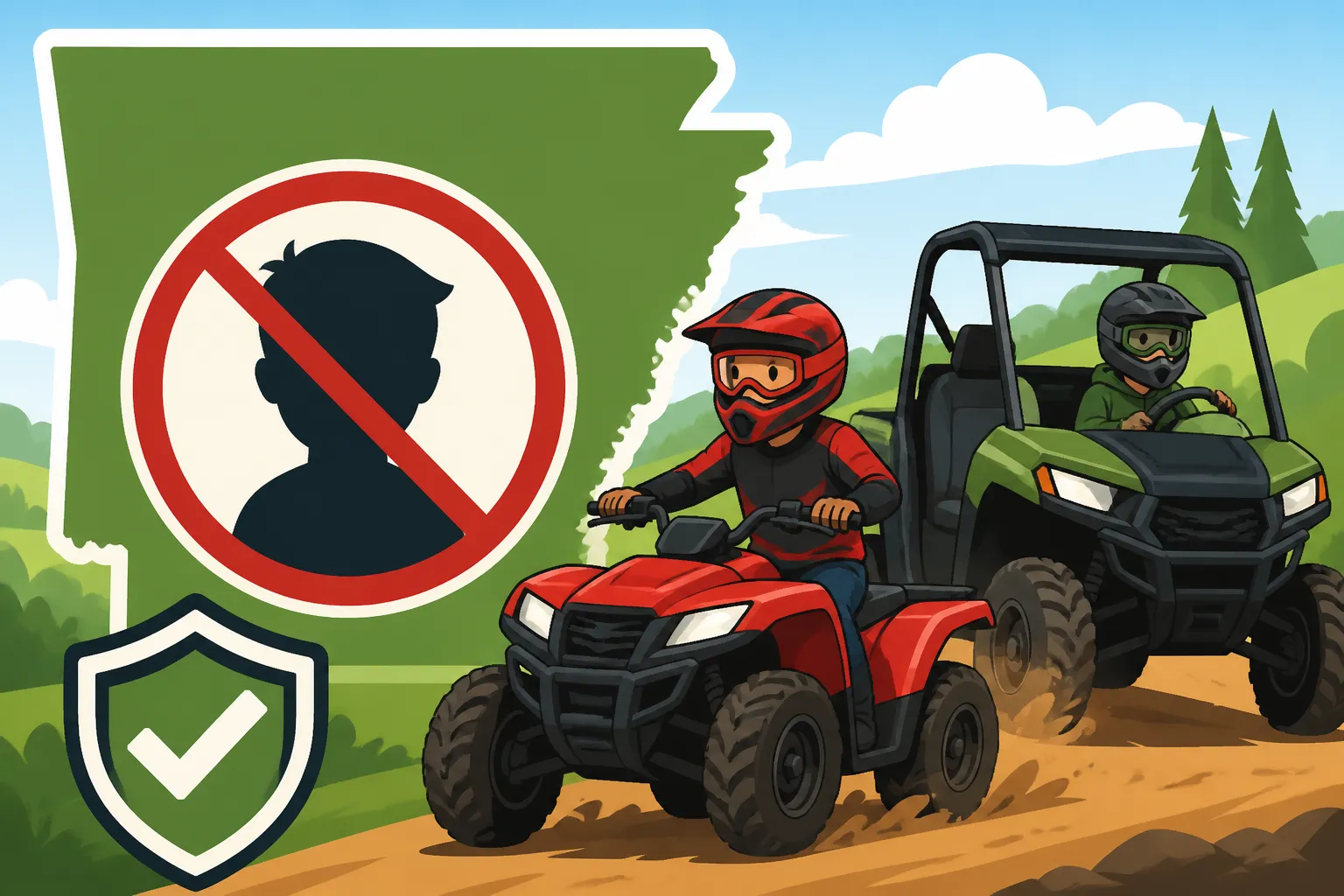
The key idea is direct adult supervision. A child under twelve should not be treated as an independent rider on the assumption that the adult is somewhere nearby. The adult needs to be actively supervising the child while the machine is being operated.
That does not mean every riding situation is automatically allowed once an adult is present. The rule is only one part of the picture. You still need to know whether the machine can be used on that land, whether the landowner has allowed access, and whether a public trail or private park has additional requirements.
It also matters what kind of machine the child will ride. “ATV” and “UTV” are often used casually as broad labels, but Arkansas laws and riding-site rules can define or treat machines differently. A small youth quad, an adult-sized ATV, and a multi-seat side-by-side are not interchangeable for either safety or legal purposes. If you are unsure how a machine is classified, start with Arkansas’s 50-Inch, 1,000cc ATV Definition and Arkansas UTV Registration Requirements.
Direct supervision is an active responsibility
A supervising adult should be close enough to see what the child is doing, communicate with them, and intervene if a hazard develops. Watching from a distant campsite, following in another group, or assuming that an older child will keep the younger one safe is not a good substitute for direct supervision.
The practical standard should be stricter than “I can see the trail from here.” A child may need help reacting to a rut, stopping at a trail junction, avoiding another vehicle, or handling a machine that feels unfamiliar. Supervision works only if the adult is paying attention and can respond promptly.
The adult should also be capable of supervising that particular ride. A parent may be responsible for several children, operating another machine, towing a trailer, or managing a group. If those responsibilities make it difficult to focus on the child, arrange another adult to help or choose a simpler ride.
Adult supervision does not make every machine suitable
A child can be supervised and still be placed on a machine that is too large, too heavy, too powerful, or too difficult to control. The legal question of supervision is separate from the practical question of whether the child can safely reach the controls and handle the vehicle.
Do not use an adult ATV’s speed limiter or an adult’s reassuring presence as a substitute for a properly sized machine. A child should be able to operate the controls as designed, maintain a stable position, and stop the vehicle without relying on an adult to reach over and do it for them.
The same is true for passengers. A child riding as a passenger on a UTV has different risks from a child operating a youth ATV. A passenger must fit the seat and restraint system, understand how to stay seated, and be allowed by the vehicle’s instructions and the riding location’s rules. A seat being physically available does not automatically mean it is appropriate for a small child.
Confirm the current rule before relying on a summary
Age and supervision rules can depend on the law that applies to the machine and location. Forest land, a wildlife management area, a private park, and private property may each have their own rules. Before a trip, check the applicable state requirements and the rules published by the land manager or park.
For a broader outline of the state-level topic, see Arkansas Rules for Riders Under Twelve. If the ride involves public roads, do not assume the under-twelve supervision rule gives permission to ride there. Road use is a separate issue, covered in Can You Drive an ATV on the Road in Arkansas?.
Who can supervise and what good supervision looks like
A useful first step is to identify one adult as the child’s designated supervisor for each part of the ride. Avoid vague arrangements such as “the adults will keep an eye on them.” Clear responsibility helps prevent the situation where each adult assumes someone else is watching.
The supervising adult should know the child’s machine, understand its controls, and be prepared to stop the ride if the child is tired, frightened, distracted, or riding beyond their ability. The child should also know which adult to follow and what to do if they become separated.
Set the adult’s role before the engine starts
Before riding, agree on a few basic points:
- Which adult is supervising the child on the trail or practice area.
- Whether that adult will be riding alongside, ahead, or behind.
- What signal the child should use to ask to stop.
- Where the group will stop if anyone becomes separated.
- Who is responsible for checking the child’s helmet and other equipment.
- What the adult will do if the child cannot manage an obstacle or wants to turn back.
If the adult is riding a separate machine, make sure the arrangement allows the adult to monitor the child throughout the route. A group that spreads out around blind corners or through dusty sections can make supervision ineffective. For a young or inexperienced rider, keep the group small and the pace slow enough that the adult can remain attentive.
If a child is riding on a UTV as a passenger, the driver is not automatically in a good position to supervise every need. The driver must concentrate on driving. A second responsible adult can help monitor the child, check that they remain seated, and communicate with the driver. If no second adult is available, choose a simple, short route and avoid distractions.
Direct does not have to mean controlling every moment
Good supervision lets a child learn while keeping the adult close enough to respond. Constantly grabbing the handlebars or issuing a new instruction every few seconds can make a new rider more confused. Instead, teach one skill at a time in a safe area, give the child room to practice, and step in when needed.
For a beginner, this usually means practicing on a flat, open area before going onto a trail. Start with starting, stopping, steering, and following a simple direction. Move to uneven ground only when the child can control the machine on easier terrain. Do not treat a child’s success in a driveway as proof they are ready for rocky trails, steep slopes, mud, or water crossings.
Choose an adult who is alert and available
The supervising adult should not be impaired, distracted, or occupied with tasks that make close attention unrealistic. That includes drinking alcohol, using a phone while riding, managing a complicated convoy, or trying to supervise several children on different machines at once.
If a child is operating a machine, the adult should be able to stop and help without creating another hazard. On a narrow trail, that may mean choosing a place to pull over before giving instructions. On a busy private park, it may mean staying on a beginner route rather than attempting to keep up with faster riders.
Supervision should also include judgment about when to end the ride. Children may not recognize fatigue, overheating, fear, or loss of concentration quickly enough to speak up. Ask regularly how they are feeling, and stop before they become exhausted or upset.
Where a child may ride in Arkansas
The location determines much more than the scenery. It can determine whether riding is allowed at all, what kind of vehicle is permitted, which route may be used, and whether a pass or other authorization is required.
A child’s age does not grant permission to enter land or ride a route that is otherwise closed. Before setting off, work through the access rules for the exact place you plan to ride.
Private property
On private land, get permission from the owner or person who controls access unless you own or otherwise have a clear right to use the property. Permission to enter does not necessarily mean permission to ride anywhere on the land. The owner may limit the route, the hours, the machines, or the number of riders.
For a child, make sure the permitted area is appropriate for their skill. A landowner’s permission does not make a steep hill or a road used by trucks safe for a beginner. Ask about gates, livestock, equipment, water hazards, and other traffic. If the child will ride on land that you lease rather than own, check the lease and get the owner’s permission where needed. Arkansas Rules on Land You Lease and Written Permission From an Arkansas Landowner explain why access permission should be treated as a separate question from vehicle registration.
Public trails and forest land
A public trail may be open to OHVs but still have restrictions. Check the current trail status, machine-width limits, permit requirements, and any seasonal closures before travelling. A trail’s being visible on a map does not guarantee it is open to every machine or rider.
Arkansas forest riding can involve separate permit systems for different forest areas. A permit for one area should not be assumed to cover another. Some permits are associated with the machine rather than with each person riding it, but you should confirm the current terms for the exact trail system and vehicle. Arkansas Riders Need Two Different Forest Passes and Arkansas Permits Are Per Vehicle are useful starting points.
Young riders need a route that matches both their ability and the machine they are using. A trail marked for OHV use may still include loose rock, narrow turns, steep grades, blind corners, or other riders travelling at a different pace. Check the trail description and recent conditions. If the route seems uncertain, choose a simpler area rather than relying on the adult to manage every obstacle as it appears.
Wildlife management areas
Wildlife management area rules are not the same as general forest-trail rules. Access may be limited to roads that are open to vehicles, and some roads, openings, levees, or gated areas may be closed to riding. Hunting access can also have its own conditions.
Do not interpret a hunting trip, a lease, or a child’s supervision as permission to ride wherever an ATV can physically travel. Read the rules for the specific area and look for posted signs and barriers. Start with Arkansas AGFC WMA Rules for Riders and Arkansas WMA Access for a Quad.
Private off-road parks
Private parks set their own admission, age, supervision, equipment, waiver, and machine-use policies. Some may require a helmet or other protective gear even where state law does not require it. A park may also restrict which trails a youth rider can use or require an adult to accompany the child.
Call or check the park’s current rules before leaving home. Ask specifically whether a child under twelve may operate the planned machine, whether the adult must ride with the child or may supervise from another vehicle, and whether the child can ride as a passenger. A general statement that “families are welcome” does not answer those questions.
Roads and crossings
A child should not be taken onto a public road simply because the group is travelling between trail sections or because an adult is present. Arkansas road rules are a separate legal issue, and road exceptions are limited. A local ordinance or a specific exception may affect certain routes, but it does not create a general right to ride an ATV or UTV on roads.
If a planned route includes a road crossing, confirm where and how crossing is allowed. Never use a road crossing as an excuse to ride along the road unless that use is specifically legal. The details are covered in Arkansas Rules for Crossing a State Highway and Arkansas Makes Road Riding Unlawful by Default.
Permits, registration, and reciprocity for a young rider
A common source of confusion is treating every decal, pass, and permit as if it does the same job. It does not. A state registration decal, a forest trail permit, a private park admission, and permission from a landowner are separate things.
For a child riding an adult-owned machine, the paperwork usually concerns the vehicle and the place where it will be ridden, not the child’s age alone. But do not assume that one form of authorization covers all the others.
| Requirement | What it generally addresses | What it does not automatically provide |
|---|---|---|
| Arkansas ATV registration | The state’s registration requirement for a qualifying machine | Permission to ride on a particular trail or private property |
| Forest or trail permit | Access under the rules of a specific trail system or land manager | State registration or permission to use a different forest |
| Private park admission or waiver | Entry under that park’s rules | A right to ride on public land or roads |
| Landowner permission | Access to land controlled by that owner | A permit, registration, or permission for other property |
| Adult supervision | The required oversight for a young rider where applicable | Permission to use a closed route or an unsuitable machine |
Registration is not the same as trail access
Arkansas registration requirements depend on the type of machine and the applicable rules. A registration decal does not make a machine street legal, and it does not mean every public trail is open to it. Likewise, a forest permit is not a substitute for state registration if registration is required.
If the machine belongs to a parent or another adult, keep the registration information with the machine and make sure the adult knows where the records are. Do not assume a young rider needs a separate registration simply because they are the person operating the vehicle. Confirm the requirements for that machine, especially if it is a UTV, a youth model, an imported machine, or a vehicle with unusual dimensions.
For registration basics, see Do You Need to Register an ATV in Arkansas?. For forest access, check the permit rules for the actual destination rather than relying on a registration decal as proof of trail authorization.
Permits usually follow the vehicle and the destination
When a trail system requires a permit, check whether it is issued per vehicle, what proof must be displayed or carried, and whether it applies to the machine you plan to bring. A family riding more than one machine should not assume a single pass covers the whole group. At the same time, a child riding as a passenger may not need a separate vehicle permit if the permit is tied to the machine. The specific land manager’s current terms control.
Check the start date and validity area before buying or travelling. Also confirm whether the permit must be displayed on the machine, carried by the rider, or shown in another way. If you are travelling from out of state, ask whether your home-state registration or decal is recognized for that destination. Reciprocity for a decal does not necessarily settle permit requirements.
Visitors should check both home-state and Arkansas rules
An out-of-state registration or OHV decal may be relevant to whether a machine is recognized, but it should not be treated as a universal pass. A visiting family should check Arkansas rules for the machine and the rules of the forest, park, or public land where it plans to ride.
The same caution applies in the other direction. Arkansas registration does not automatically meet every requirement in a neighbouring state, and a trail permit from another state does not automatically apply in Arkansas. For a visiting rider, Do Out-of-State Riders Need an Arkansas Registration Decal? is a useful place to begin, followed by the specific trail system’s permit information.
Keep proof easy to find
Before departure, keep registration details, permit confirmation, landowner permission, and emergency contact information where the supervising adult can reach them. If the trail system accepts a digital permit, save it for offline access where possible and know what the ranger or park employee expects to see.
A young rider may not be able to explain the family’s paperwork at a stop. The supervising adult should be prepared to answer questions and show the relevant documents. Review [Arkansas Proof of Ownership on the Trail] if you are unsure what paperwork may be useful to carry.
Choosing a machine and protective equipment for a child
The safest machine is not necessarily the smallest one in the garage or the one that looks easiest to manage. It is a machine the child can operate as intended, in a setting suited to their experience, while wearing equipment that fits.
Do not use age alone as the measure. Children of the same age can differ substantially in height, strength, coordination, attention, and experience. Follow the machine manufacturer’s age and size guidance, and do not modify a machine in a way that makes the controls unpredictable.
Check fit and control before riding
For a child operating an ATV, check whether they can sit in a stable position, reach the controls, steer without stretching, and use the brakes as intended. Their hands and feet should reach the controls without losing a secure position. They should be able to understand and demonstrate how to stop.
For a UTV passenger, check whether the child fits the seat and restraint system correctly. A shoulder belt that rides across the face or a lap belt that cannot be positioned as designed is a warning that the child may not fit the seating position safely. Never carry more people than the machine has approved seating positions for. Do not place a child on a cargo bed or allow them to ride outside the cab.
For a child driving a UTV, be especially cautious. A UTV’s steering, weight, acceleration, braking, and rollover risks differ from a small youth ATV. Confirm the manufacturer’s guidance and the park’s rules rather than assuming that an adult-sized side-by-side is appropriate because it has seat belts.
Helmets and eye protection
Even if a particular Arkansas law does not require a helmet for every ATV rider, that is not a reason to skip one. A properly fitted helmet is one of the most important pieces of protective equipment for a child. The helmet should be intended for the activity, fit securely, and stay in place when the child moves their head. Replace it after a significant impact or if it is damaged.
Eye protection matters on dusty trails, in brush, and when other machines are travelling nearby. Goggles or suitable protective eyewear help keep dust and debris out of a child’s eyes. A child who cannot see clearly is more likely to miss a rut, a branch, or another rider.
The rules of a forest, private park, rental company, or organized event may require gear beyond the state baseline. Check the site’s current rules before travelling. Arkansas Safety Courses That Are Voluntary discusses training options, and Arkansas Private Park Helmet Rules is relevant when the destination is a private park.
Clothing and practical supplies
Dress the child for the ride, not just the weather at the parking lot. Closed-toe footwear, gloves, long sleeves, and long pants can help reduce scrapes from branches, grit, and contact with the machine. Avoid loose clothing that could catch on controls or moving parts.
Carry water, especially on a warm day or a longer route. A child may not notice dehydration or fatigue until they are already struggling. Bring a first-aid kit suited to the trip, a charged phone or communication device where service is available, and a paper map or offline route information for areas with weak reception.
When shopping for safety gear, focus on fit, intended use, and the manufacturer’s guidance rather than appearance alone. Amazon can be one place to compare helmet sizes, goggles, gloves, and protective clothing, but confirm sizing carefully and check that a helmet is designed for off-road riding. If ordering through Amazon, leave enough time to try the gear and exchange anything that does not fit securely. A product listing is not a substitute for a proper fit check.
Preparing a child and managing the ride
A calm practice session is more useful than a long first ride. The goal is not to prove that a child can keep up with adults; it is to help them build control and good habits in a setting where the supervising adult can respond.
Start with a short briefing
Before starting the engine, explain a few simple rules in language the child can remember:
- Stay with the supervising adult and the group.
- Stop when signalled, and do not pass another rider without permission.
- Do not ride beyond the route or into a closed area.
- Keep hands and feet in the proper position.
- Tell the adult immediately if the machine feels wrong or they feel tired, frightened, or unwell.
Have the child show you how they will stop, where they will place their hands and feet, and how they will signal for help. If they cannot clearly demonstrate the basics, practise more before leaving the staging area.
Practice in steps
Begin on a flat, open area away from other vehicles and obstacles. Let the child practise starting, stopping, turning, and maintaining a controlled pace. The adult should stay close, give one instruction at a time, and avoid making the practice area more complicated than necessary.
Move to a beginner route only after the child shows consistent control. Keep the first trail short. Stop at safe places to check how the child is doing, and do not let the group’s schedule pressure them into continuing. If the route becomes harder than expected, turn around when it is safe rather than treating completion as the goal.
A safety course can be useful even if it is not mandatory for the child’s situation. Training can teach risk awareness, basic machine control, and safe riding habits. Look for instruction appropriate to the child’s age and vehicle. A course does not replace adult supervision, but it can make that supervision more effective.
Keep the group manageable
The supervising adult should be able to keep the child in view and maintain a pace the child can manage. On a group ride, put the child near the adult who is responsible for them, not at the edge of the group where they may be separated. Agree on a stopping point and a regrouping plan before riding.
Dust can reduce visibility. A tight group may also create pressure to follow the machine ahead too closely. Leave enough space for the child to stop safely, and pause if the group becomes spread out. At trail junctions, have the adult stop and confirm the route instead of expecting a child to choose correctly under pressure.
Watch for fatigue and changing conditions
A child’s ability can change as the ride continues. Heat, cold, rain, dust, noise, and a difficult surface can all affect concentration. A rider who handled the first section well may struggle later.
Shorten the ride if the child becomes quiet, distracted, frustrated, or slow to react. Stop if they complain of discomfort, feel unwell, or lose confidence. Weather and trail conditions matter too. Wet clay, loose rock, muddy ruts, and standing water can transform an easy route into a difficult one. Check conditions before setting out and be willing to change plans.
Have a separation and emergency plan
Children should know what to do if they cannot see the supervising adult. A simple plan may be to stop in a safe place, turn off the machine if they can do so safely, stay where they are, and wait for the adult. Do not tell a child to ride around looking for the group; that can make a separation worse.
The adult should know how to contact the other members of the group and the relevant land manager or emergency services. In areas with limited cell service, share the route and expected return time with someone who is not on the ride. Make sure everyone knows where the vehicle and trailer are parked.
Common mistakes and a before-you-go checklist
The most preventable problems usually come from assuming that one rule answers every question. A child may be properly supervised but riding a machine that does not fit. A machine may be registered but not permitted on the selected trail. A family may have permission to enter private land but not to ride across a neighbouring parcel.
Mistakes to avoid
- Treating nearby as supervised: The adult should be attentive and able to respond, not merely somewhere on the property.
- Assuming permission covers every route: A landowner or park may allow access while restricting particular roads, trails, or machines.
- Using an adult machine because an adult is present: Supervision does not solve a poor fit or a lack of control.
- Confusing registration with trail permits: A state decal and a forest or park pass serve different purposes.
- Assuming every public area has the same rules: Forest trails, wildlife management areas, local routes, and private parks can differ.
- Letting the group set the child’s pace: Adults should adapt the ride to the child, not expect the child to keep up.
- Riding a road because it connects two trails: Road access requires separate legal authority.
- Skipping a gear check: A helmet that is loose or a belt that does not fit cannot provide the intended protection.
- Continuing after conditions change: Rain, heat, fatigue, or trail damage can make a route unsuitable.
- Relying on a verbal understanding within a large group: Name the adult responsible for the child and agree on the plan before riding.
Before leaving home
Use this checklist for a child under twelve:
- Confirm the current Arkansas rules for the machine and the planned riding location.
- Check whether the machine’s type, size, and width are allowed on the route.
- Confirm permission from the landowner or the current access authority.
- Check whether the destination requires registration, an OHV permit, a park pass, or another authorization.
- Ask the park or land manager about any age-specific rules, supervision terms, and safety gear.
- Choose a machine that fits the child and follows the manufacturer’s guidance.
- Check helmet, eye protection, clothing, footwear, and any UTV restraint system.
- Assign a specific adult to supervise the child throughout the ride.
- Plan a short, manageable route with safe places to stop.
- Agree on signals, regrouping points, and what the child should do if separated.
- Check weather, trail conditions, closures, and communication coverage.
- Carry useful documents and emergency contacts where the supervising adult can reach them.
A child’s first ride should be a learning experience, not a test of endurance or courage. If the child is ready, the machine fits, the location allows the ride, and the adult can supervise closely, a short and well-planned outing is a much better start than an ambitious all-day route.
Disclaimer
This article is for general informational purposes only and does not constitute professional advice. Laws, prices and regulations vary by location and change over time. Consult a qualified professional for guidance on your specific situation.