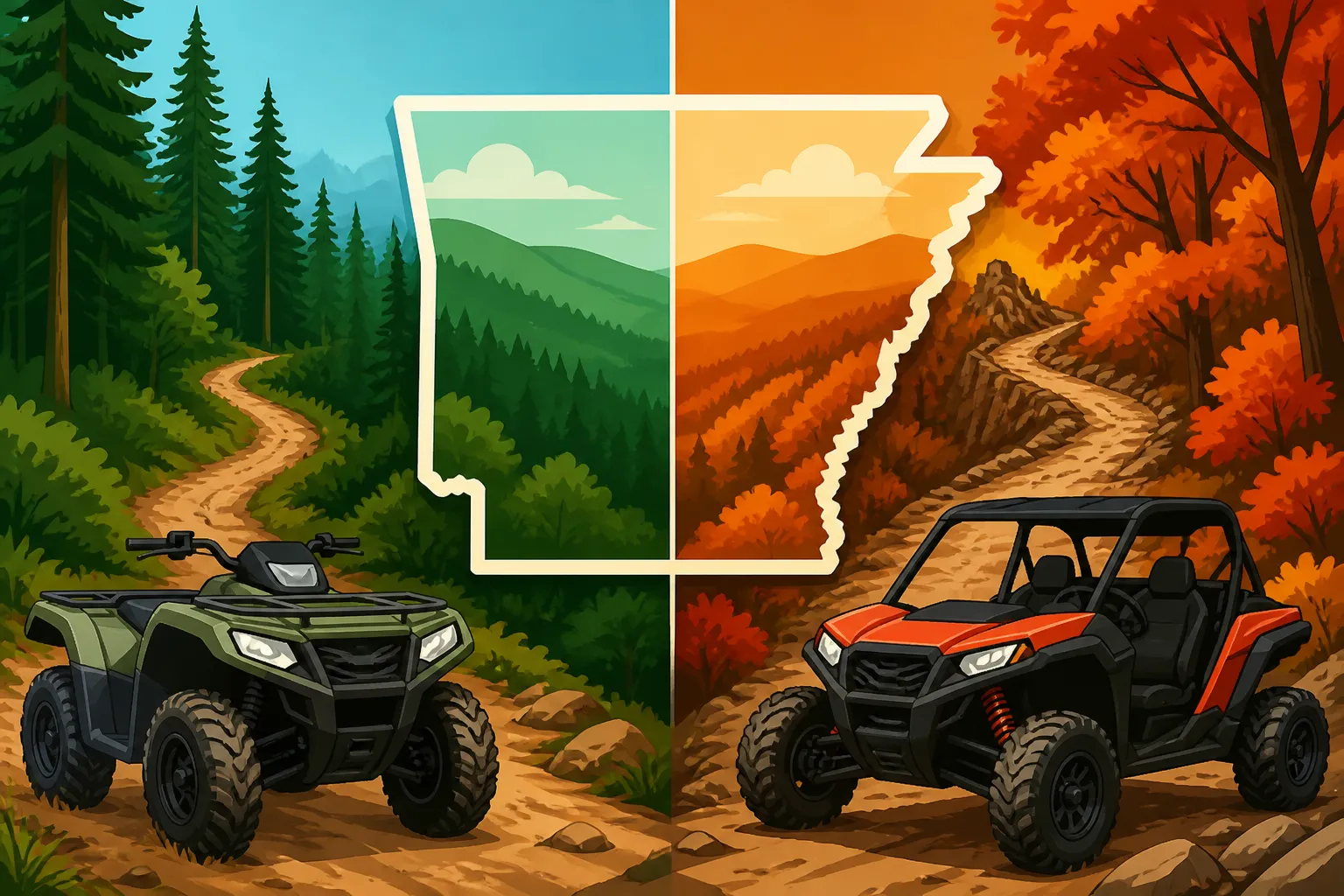
Two Forests and Two Separate Passes
Arkansas riders planning trips in both the Ouachita and Ozark-St. Francis National Forests can’t assume one OHV pass covers both. The forests have separate permit systems, and buying the wrong pass can leave you without the authorization you need at a trailhead. Here’s how to match the pass to your destination, check the details, and avoid confusing forest permits with other riding requirements.
Why Arkansas has two separate forest passes
The Ouachita National Forest and the Ozark-St. Francis National Forest are separate national forest units, with different OHV permit arrangements. A pass issued for one does not automatically authorize riding in the other. If your trip includes trails in both forests, plan to obtain the permit or permits that apply to each riding area.
The practical rule is simple: identify the forest and trail system first, then confirm which pass that specific location requires. Don’t choose a pass based only on where you live, where you’re staying, or the fact that both destinations are in Arkansas.
| Where you plan to ride | What to check |
|---|---|
| Ouachita National Forest | Confirm the current Ouachita OHV permit option and which trails it covers |
| Ozark-St. Francis National Forest | Confirm the Ozark-St. Francis permit or site-specific requirements |
| Both forests | Arrange for separate authorization for each forest, unless the official terms explicitly say otherwise |
| A private off-road park | Check the park’s own admission, waiver, and riding rules |
| A wildlife management area | Check Arkansas Game and Fish Commission rules for that area |
That separation matters even if the pass names sound similar or both are described as OHV permits. A permit is tied to its issuing program and coverage, not simply to the general activity of riding an off-highway vehicle. For a broader overview, see Arkansas OHV Permits: Two Forests, Two Prices and Why One Forest Pass Does Not Cover the Other.
A forest pass also isn’t a universal Arkansas ATV permit. State registration, trail-system authorization, forest access, and private-park admission are different requirements. A machine’s registration decal does not replace a forest OHV permit, and a forest permit does not make an otherwise closed road or trail open to riding.
Match the pass to the trail system
Before buying anything, pin down the exact place you intend to ride. “Near Mena” or “in the Ozarks” may be enough for travel planning, but it isn’t precise enough to choose a permit. Forest boundaries, trail systems, and recreation sites don’t always line up with everyday regional labels.
For example, riders planning to use Wolf Pen Gap should verify the current Ouachita National Forest requirements for that area. Riders heading to Mill Creek should check the rules for its location in the Ozark-St. Francis National Forest. Do not assume a permit associated with one of these trail systems is accepted at the other simply because both offer OHV riding. Trail conditions and access arrangements can also change, so check the status of your intended route before setting out. How to Check Wolf Pen Gap Trail Status and Carrying Your Forest Permit at Mill Creek cover useful destination-specific checks.
When confirming a permit, look for these details:
- Forest and trail coverage: Does the permit apply to the forest and riding area you plan to visit?
- Permit type: Is it a day option, an annual option, or another type of authorization?
- Vehicle coverage: Is the permit required per machine, and does it apply to your ATV or side-by-side?
- Display or proof requirements: Does the permit need to be displayed on the machine, or should you carry a printed or digital copy?
- Purchase method: Can you buy it in advance, at a self-service station, or through another official channel?
- Current access status: Are the trail and its trailhead open when you plan to ride?
These checks are especially important when a trip includes multiple stops. A single weekend may involve a forest trail, a private park, and a campground with its own rules. Each operator or land manager can set separate access requirements. Having proof of one pass does not establish that you have permission everywhere else.
If you’re planning a route that crosses between forest areas, treat each destination as a separate permit question. Do not rely on a pass purchased for the first day to cover a second day in a different forest. If official permit terms are unclear, ask the managing office or the contact listed for that trail system before you travel.
Day and annual options, display, and buying
Both forest programs may offer different permit options, but the exact choices, prices, and purchase procedures can change. Compare the current terms rather than relying on an old receipt, a past trip, or advice from someone who rode a different trail system. The relevant decision is not just whether a pass is called “annual” or “day”; it is what that pass authorizes and where it is valid. See Arkansas Annual Versus Day Permits for a general comparison.
If you ride only once, a short-term option may suit your plans. If you expect to return to the same forest, an annual option may be worth comparing. But buying an annual pass for one forest doesn’t solve the separate-permit issue if you also ride in the other forest. A rider visiting both should compare the total cost and requirements for the full itinerary, rather than assuming the broadest-sounding pass is statewide.
Forest permits are generally associated with a specific vehicle or permit holder under the program’s terms. Before purchasing, confirm whether you need a separate permit for each machine in your group. A permit for the lead ATV may not cover a second ATV or a side-by-side following behind. Arkansas Permits Are Per Vehicle explains why it’s important to check the unit of coverage before checkout.
Purchase channels can differ. Some permits may be available through an online system, while some riding areas may use a self-service fee station. Verify the approved method for the specific permit you need and allow time to complete the process. If you use an online service, save the receipt and permit details somewhere accessible. If you plan to pay at a station, confirm that it is available at your destination and learn what payment methods it accepts. Arkansas Permits Bought on Recreation.gov and Arkansas Self-Service Fee Stations provide related information about purchase methods.
Follow the permit’s instructions for carrying or displaying proof. Do not assume a phone screenshot is enough, or that a paper receipt must be attached to the vehicle. Requirements can vary by program. Read the current directions, keep the proof in the required form, and make sure the permit corresponds to the machine you brought.
Before you leave, make a small checklist for each forest:
- Write down the forest and trail system for each riding day.
- Confirm which permit applies to each destination.
- Check whether the permit is per vehicle and whether each machine needs its own.
- Buy or obtain the pass through an authorized channel.
- Save the receipt and follow the display or carry instructions.
- Check for trail closures, seasonal restrictions, and access notices.
This kind of preparation is more reliable than trying to sort out permit coverage at a trailhead, particularly if you arrive after the relevant office is closed or the area has limited connectivity.
What a forest pass does not cover
A forest OHV pass is permission under a particular forest recreation program. It should not be treated as a substitute for every other rule that might apply to your vehicle or route.
First, it does not replace Arkansas registration requirements. Registration questions are handled separately from forest access. If you’re unsure whether your machine needs state registration, start with Do You Need to Register an ATV in Arkansas?. Riders from outside Arkansas should also check how their machine’s home-state paperwork is treated before traveling; forest access and state registration are separate issues.
Second, a permit does not authorize riding on every road or piece of land in a national forest. Some roads may be closed to motorized use, and some routes may have vehicle-width limits or other restrictions. Gates, signs, closures, and designated routes matter even when you have a current permit. Check the map and local notices for your destination instead of treating the pass as permission to ride wherever a vehicle can physically travel.
Third, a forest pass does not provide access to private property or a privately operated off-road park. Private parks set their own admission and operating rules. A forest permit is not a park ticket, waiver, or reservation. Likewise, a pass for a private facility does not stand in for a national forest permit.
Finally, a pass is not a guarantee that a trail will be open or suitable on the day of your visit. Weather, maintenance, fire conditions, seasonal closures, or other management decisions can affect access. Check the trail system’s current information shortly before departure, and have a backup plan in case a route is closed.
The easiest way to avoid confusion is to keep the requirements in separate categories: state registration for the machine, forest-specific authorization for each national forest destination, and any additional rules for the trail, park, or landowner. If the ride crosses between the Ouachita and Ozark-St. Francis National Forests, confirm both permit systems independently. Don’t count on one pass to do the work of two.
Disclaimer
This article is for general informational purposes only and does not constitute professional advice. Laws, prices and regulations vary by location and change over time. Consult a qualified professional for guidance on your specific situation.