Amphibious Vehicles on Public Land
An amphibious ATV or UTV may look ready for both trail and water, but public-land rules do not automatically treat it like an ordinary quad. In Arkansas, the key questions are which agency manages the land, whether the vehicle is allowed there, and whether its route is open. Check all three before unloading; a permit or registration alone may not make a trip legal.
Start With the Land Manager, Not the Vehicle
“Public land” is not one set of rules. Arkansas public riding areas can be managed by different agencies, and each may set limits on vehicle types, roads, trails, and water access. A machine that is allowed on one route may be prohibited on another—even within the same general area.
An amphibious vehicle adds another complication: its ability to travel through water does not mean water is an authorized route. Land rules may govern where it can be driven on shore, while separate rules may govern access to lakes, streams, wetlands, or other waters. Check both sides of the trip.
| Where you plan to ride | What to verify before entering |
|---|---|
| A wildlife management area | Whether the property allows the vehicle type, which roads are open, and whether access is limited by season or purpose |
| National forest land | Whether the route is open to motorized use, whether the machine fits any posted limits, and which forest permit applies |
| A state or local recreation area | The managing agency’s rules for vehicle use, water access, and launch or trail areas |
| A privately operated park | The operator’s vehicle, route, and water-use rules, plus any separate public-land permit needed for travel outside the park |
Begin by identifying the exact property and the agency responsible for it. A trailhead name or nearby town may not tell you who manages the land. Use the property’s official map, posted signs, or managing agency information. If boundaries are unclear, ask before riding; a road that appears to continue across a boundary may be subject to a different rule set.
For wildlife management areas, review Arkansas WMA Vehicle Rules in Plain English. A WMA is not a general-purpose off-road park. Vehicle access may be restricted to designated roads, and a road that is physically passable is not necessarily open to motorized travel. Restrictions can also depend on the property and the reason for access. Arkansas WMAs That Allow ATVs and Those That Do Not is a useful starting point, but confirm current property-specific rules before you go.
On national forest land, distinguish between road access and designated OHV trails. A machine’s ability to cross a creek, marsh, or shallow water does not make that route an approved trail. For background on the different forest systems and riding requirements, see Arkansas Riders Need Two Different Forest Passes. A pass for one forest does not automatically cover another, and neither pass should be treated as permission to leave an open route.
If the ride includes private land between public parcels, permission matters too. A public trail or road may not authorize crossing a neighboring property to reach water or another section of public land. Review Riding on Land You Do Not Own and confirm that the connecting route is legal from end to end.
Permits, Registration, and Vehicle Approval Are Separate
A common source of confusion is treating every sticker, pass, or registration document as the same kind of authorization. They serve different purposes. An Arkansas registration decal, a forest OHV permit, and a property-specific access approval are not interchangeable.
| Requirement | What it generally addresses | What it does not automatically authorize |
|---|---|---|
| Arkansas ATV registration | State registration requirements for a qualifying machine | Riding on a closed road, entering restricted land, or using a water route |
| Forest OHV permit | Required access to a particular forest riding area or system | Use in another forest, on a closed route, or on a WMA |
| WMA access rules | Vehicle use on a specific wildlife management area | Riding on every road or entering restricted habitat |
| Private park permission | Use under that operator’s rules | Travel beyond the park boundary |
| Local road permission | Use on streets where local rules allow it | Off-road riding or access to public waters |
For Arkansas registration questions, start with Who Must Register an ATV in Arkansas and Arkansas ATV Registration for a Machine Bought Out of State. A registration decal is a state requirement for machines that fall within the applicable rules; it is not a land-use permit. Likewise, a forest pass does not replace registration where registration applies.
Before a forest ride, check the permit rules for the specific forest and trail system. Read How to Buy an Arkansas Forest OHV Permit and [Arkansas Permit for a Second Machine] if you are bringing more than one vehicle. Confirm whether the pass is tied to a particular machine, where it must be displayed, and whether the route you plan to use is open. Those details can matter even when every rider in the group has a pass.
An amphibious machine may not fit neatly into the assumptions used for ordinary ATVs and UTVs. Do not assume that a permit is valid just because the machine has tires, an ATV-style registration, or a familiar vehicle classification. Ask the land manager whether the vehicle’s design and intended operation are allowed on the specific property. If the answer depends on its width, wheel count, or other specifications, provide those details rather than asking only whether “an ATV” is allowed.
That question is especially important if the machine is wider than a typical quad or has more than four wheels. Arkansas vehicle definitions and registration rules can depend on technical characteristics. See Arkansas’s 50-Inch, 1,000cc ATV Definition and Arkansas Six-Wheeled ATVs and the Statute for related state-law issues. Those definitions do not by themselves decide whether a particular public road, trail, or water access point permits the machine.
Ask the land manager directly when a published rule does not mention amphibious vehicles by name. Describe the make or type of machine, its width and wheel count, whether it has tracks or tires, and whether you intend to drive it into water or only use land routes. A clear answer about the exact vehicle and route is more useful than a general “ATVs allowed” statement.
Treat Water as a Separate Route
Amphibious capability can make a route look continuous: drive down a trail, enter a creek or lake, and continue on the other side. Legally and practically, that may involve several different areas with different restrictions. A public-land boundary can run along or through water, and the water itself may have rules that are not the same as the trail rules.
Before entering water, verify:
- Whether the vehicle is allowed to operate in that waterbody.
- Whether motorized access is permitted at that location.
- Whether the shoreline, wetland, or adjoining route is open to vehicles.
- Whether seasonal closures or habitat protections apply.
- Whether the water route crosses into another agency’s jurisdiction or private property.
- Whether the vehicle must use a designated launch or crossing point.
Do not use a creek or wetland as a shortcut around a closed gate, an impassable section, or a trail restriction. A machine’s ability to float or travel through shallow water does not create a right of access. It can also cause damage beyond the visible tire tracks, including disturbance to stream banks, vegetation, and wildlife habitat. If a route is closed, turn around and choose an authorized route rather than trying to bypass the closure through water.
Pay attention to posted barriers and signs. A gate may close a road to all vehicles, not simply to vehicles that cannot cross the barrier. A cable, earthen berm, or sign can indicate a restriction even when the route beyond it appears usable. For more detail on interpreting access restrictions, see Arkansas WMA Gated and Cabled Barriers and Earthen Barriers and Closed Roads.
If the trip involves a WMA, check whether the intended use is consistent with the area’s rules. Some vehicle access provisions are tied to particular roads, seasons, or activities, and general public access does not necessarily mean unrestricted riding. Arkansas Hunting License and Quad Access and Travel To and From Camp Only address situations where hunting-related access may have specific limits. Do not assume that a hunting purpose makes every route or water crossing permissible.
A useful pre-trip check is to mark the planned route on the official map and identify every point where it touches water, a road crossing, a gate, or a property boundary. If the map does not clearly show whether an amphibious vehicle can use a segment, ask the managing agency before traveling. Keep a paper copy or offline version available; cell service may be unreliable in remote areas. A waterproof map sleeve, available from outdoor shops or retailers such as Amazon, can help protect a printed backup.
A Practical Check Before You Unload
Use a deliberate check rather than relying on assumptions about what the machine can do. Rules may differ from one property to the next, and the route may cross more than one type of land.
- Identify the exact property. Confirm the managing agency and boundary, not just the nearest trailhead or town.
- Find the current map and rules. Look for vehicle restrictions, open routes, closures, seasonal conditions, and water-access limits.
- Describe the machine accurately. Be ready to give its dimensions, wheel count, and relevant design features.
- Confirm each required authorization. Check Arkansas registration, the specific forest permit if applicable, and any additional property rules.
- Check the full route. Include the approach, crossings, water segments, and return trip—not only the main trail.
- Ask about uncertainty before arrival. Contact the land manager if amphibious use is not clearly addressed.
- Follow signs and closures on site. Posted restrictions can make a route unavailable even if it appeared open during planning.
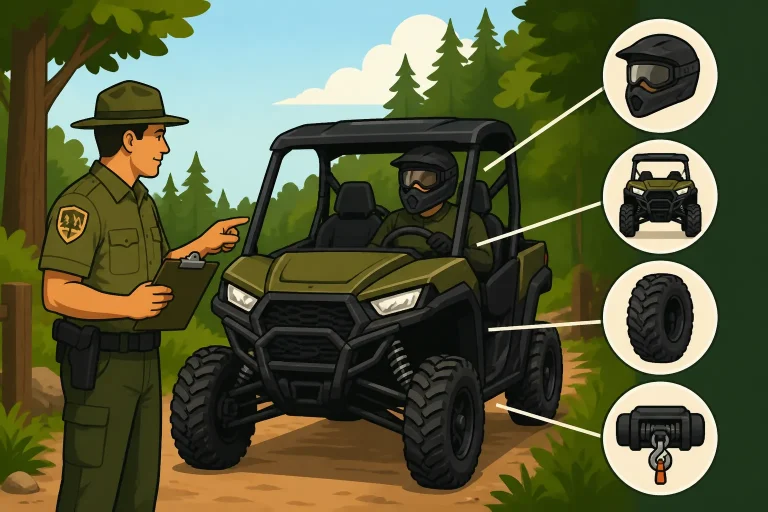
Keep proof of registration and permits accessible, but understand what each document covers. If a ranger or officer asks about the machine, a clear explanation of its type and where you are traveling can help resolve basic questions. Carrying a map is also useful when boundaries or route names are easy to confuse.
If you cannot confirm that the vehicle is allowed in a particular area, choose a route whose rules clearly cover it. That may mean leaving the water capability unused or selecting a different riding area. It is better to make that decision before unloading than to discover that a trail, crossing, or waterbody is closed after you have arrived.
Disclaimer
This article is for general informational purposes only and does not constitute professional advice. Laws, prices and regulations vary by location and change over time. Consult a qualified professional for guidance on your specific situation.