Arkansas Visitors From Mississippi
A Mississippi rider planning an Arkansas trip may have home-state paperwork in order and still need another permit at the trailhead. That is because vehicle registration, Arkansas forest OHV permits, and access rules are separate questions. Here’s how to sort them out before crossing the state line, what documents to carry, and what to confirm for the specific place you plan to ride.
Mississippi paperwork and Arkansas registration
Do not assume that paperwork from Mississippi automatically covers every Arkansas requirement. First distinguish the machine’s state registration or other ownership paperwork from permits required to ride a particular Arkansas trail system.
Arkansas has requirements for registering many off-highway vehicles, and a nonresident’s situation can depend on whether the machine is registered under the rules of the rider’s home state. The key question is not simply whether you live in Mississippi. It is whether your machine has qualifying current registration or documentation, and whether Arkansas recognizes it for the purpose at hand.
Because procedures and eligibility can be specific, check the current rule with an Arkansas Revenue Office or the Arkansas Department of Finance and Administration before traveling. The overview in Do Out-of-State Riders Need an Arkansas Registration Decal? can help you identify the issue to ask about. If the machine is not registered in Mississippi, do not presume that being a visitor exempts it from Arkansas registration. Ask what Arkansas requires for your machine and what evidence will establish your status.
What to carry
Take documents that make it easy to identify both the machine and its owner. Depending on your circumstances, useful items may include:
- Current Mississippi registration or other official vehicle paperwork, if applicable
- A bill of sale, dealer paperwork, or another record showing ownership
- A document showing the machine’s make, model, and serial or vehicle identification number
- Any Arkansas registration or decal paperwork already issued for the machine
- Identification for the person responsible for the machine
Requirements can differ when the machine was bought privately, inherited, brought from another state, or has no standard ownership paperwork. If you have a bill of sale but no registration document, ask in advance whether that paperwork is enough for your situation. The checklist in [Arkansas Proof of Ownership on the Trail] is useful for thinking through what records to bring.
Keep a copy of important documents somewhere separate from the originals, and make sure the machine’s identifying number is legible. A clear photo of the serial number and paperwork can help if documents are misplaced, but do not treat photos as a substitute for documents an official requires you to carry.
Registration is not trail access
Even if your paperwork satisfies the state registration question, it does not automatically give you permission to ride every public or private area. Registration concerns the vehicle and its legal status. A trail permit concerns access to a particular riding area.
That distinction matters for Mississippi visitors because it is easy to think in terms of one out-of-state registration or reciprocity rule covering the whole trip. In practice, you need to check both the vehicle paperwork and each intended riding location. Arkansas Registration and Nonresident Riders covers the registration side, while the sections below explain the separate trail-access question.
Arkansas forest permits are separate from Mississippi registration
Arkansas visitors should plan around the riding area, not just the state line. Some Arkansas off-highway trails on national forest land require a forest OHV permit. A Mississippi registration document, Arkansas vehicle decal, or permit from another riding area should not be assumed to replace a required forest pass.
Arkansas has separate permit systems for its two national forests. A pass that is valid for one forest does not automatically cover trails in the other. The exact places where a permit is required, how it must be displayed or carried, and how to buy it can depend on the forest and trail system. Check the current instructions from the land manager for the area you plan to visit.
| What you are checking | What it covers | What it does not automatically cover |
|---|---|---|
| Mississippi registration or ownership paperwork | The machine’s status and ownership records under applicable rules | Arkansas forest trail access |
| Arkansas ATV registration requirements | State-level requirements for the machine, depending on the rider’s circumstances | A permit for a specific forest trail system |
| National forest OHV permit | Access to the covered trail system under its permit rules | Trails in a different forest or access to every public land area |
| Private park admission or waiver | Entry under that business’s current rules | Public forest trails or other private properties |
Use Arkansas Riders Need Two Different Forest Passes and Why One Forest Pass Does Not Cover the Other to understand why a ride that crosses between forest systems can call for more than one permit. The broader overview in Arkansas OHV Permits: Two Forests, Two Prices can help you identify which system to check. Confirm current availability and instructions before setting out; do not rely on an old pass, an old receipt, or a friend’s understanding of the rules.
Match the permit to the trailhead
Before buying a pass, write down the trail system and trailhead you intend to use. A general destination such as “the Ouachitas” or “the Ozarks” may not be specific enough. Nearby riding areas can have different land managers, permit rules, or access conditions.
Then confirm:
- Whether the riding area is open to your type of machine
- Whether an OHV permit is required for that trail system
- Whether the permit is issued per vehicle or under another basis
- Whether you need a separate pass for another forest or trail network
- How to display or carry the permit
- Whether current closures, weather, or maintenance affect your route
The permit is often tied to a particular vehicle rather than serving as a general pass for everyone in a group. Read the current instructions carefully, especially if you are bringing several machines, using a rental, or switching machines during the trip. The details can affect what you need to purchase and how the permit must be used.
Buying ahead can reduce last-minute uncertainty, but only use the official permit channel for the area. Buying a Pass Before You Leave Home has related planning guidance. Keep the receipt and the permit instructions with your trip documents.
Check rules for WMAs and private parks separately
A forest OHV permit does not give blanket permission to ride on every public land parcel in Arkansas. Wildlife management areas, other public properties, and private parks may each have their own access rules. Some places allow vehicles only on designated roads or under limited conditions; others may prohibit ATV or UTV use in certain areas.
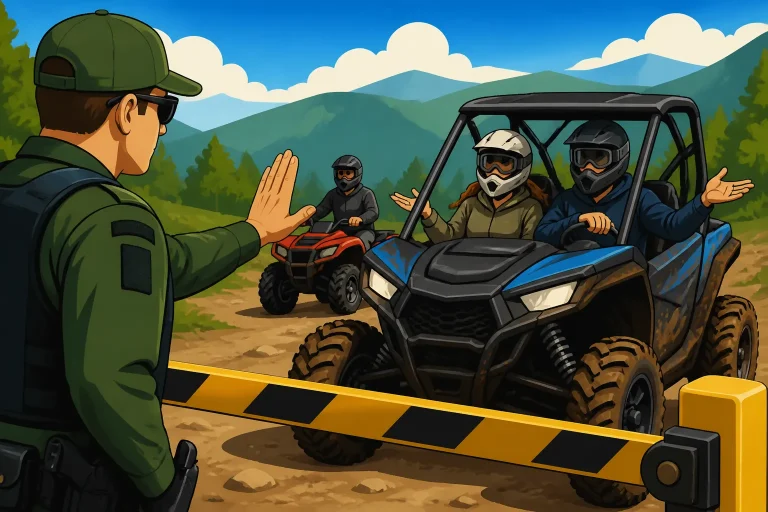
For Mississippi visitors, this is particularly important if the trip combines trail riding with hunting, camping, or travel across land that looks connected to a forest trail. A road, levee, food plot, gated track, or open-looking clearing is not necessarily open to recreational riding. Follow posted signs and barriers, and verify the rules for the exact property. Arkansas WMAs That Allow ATVs and Those That Do Not is a helpful starting point for understanding why WMA access needs its own check.
A permit for a national forest trail also does not grant access to private property. If a route, staging area, or connector crosses land outside the permitted system, use it only if the owner or manager allows it. Do not use an unmarked gap or an open gate as proof that riders are welcome.
Private off-road parks
Private parks set their own entry procedures and operating rules. They may require admission, a waiver, a safety briefing, or particular equipment. Some impose age, passenger, noise, or machine-size limits. Those rules are independent of forest permit requirements, so contact the park directly before making the drive.
Ask whether the park’s access arrangement includes the riding area you want, what paperwork it expects, and whether a forest permit is irrelevant there. A private park’s admission does not generally serve as a pass for nearby public trails. Likewise, a forest pass is not a substitute for a private park’s entry process. Arkansas Private Park Waivers and Rules explains what to look for in a park’s own requirements.
A practical checklist for a Mississippi-to-Arkansas ride
The easiest way to avoid a frustrating trip is to settle the paperwork and access questions before loading the trailer. Work through these steps for every machine and every planned riding area.
- Identify each machine. Record its make, model, serial or identification number, and owner. Check that the number on the machine is readable.
- Gather Mississippi paperwork. Bring current registration or other applicable documents, plus proof of ownership. If the machine has no formal registration, ask Arkansas officials what documentation they will accept.
- Confirm the Arkansas registration question. Contact an Arkansas Revenue Office or the Arkansas Department of Finance and Administration if you are unsure whether the machine’s Mississippi status satisfies Arkansas requirements. Do this before relying on an assumed nonresident exception.
- Choose the actual trail system. Do not stop at a broad regional destination. Identify the forest, trail network, and trailhead.
- Check the land manager’s permit rules. Verify whether a permit is required, which permit applies, and how to display or carry it.
- Check closures and access limits. Trails may be closed or restricted, and a route can have machine-width or other access limits. Confirm conditions close to departure.
- Check any additional property rules. Look separately at WMA requirements, private park policies, and any land crossed between the staging area and trail.
- Carry the documents and permits. Keep required paperwork accessible and follow the instructions for displaying a decal or showing a permit.
- Recheck if plans change. A second forest, a different trailhead, or a stop at a private park may mean different requirements.
If riding a UTV rather than a quad, confirm that the specific machine is allowed on the route. Width can matter at gates and on narrow trails, and a permit does not override a vehicle restriction. The related overview Arkansas Rules for an Out-of-State UTV can help you frame those questions.
Common planning mistakes
The most common mistake is treating a permit as universal. A Mississippi registration, an Arkansas registration decal, a national forest pass, and a private park admission each answer different questions. None should be assumed to cover all the others.
Another mistake is checking only whether a trail is in a national forest. The specific trail system and land manager matter, and neighboring properties may have different rules. Likewise, a permit that was valid on a previous trip may not prove that the same route is open now.
Finally, do not wait until arrival to sort out missing ownership documents or a permit question. If an office or permit channel needs time to process a request, a last-minute visit can derail the ride. Make the calls, confirm current requirements, and keep the answers with your trip paperwork.
Disclaimer
This article is for general informational purposes only and does not constitute professional advice. Laws, prices and regulations vary by location and change over time. Consult a qualified professional for guidance on your specific situation.