What a Safety Course Teaches
An ATV or side-by-side can feel straightforward to drive, but uneven ground, slopes, passengers and sudden obstacles demand more than basic steering. A safety course helps riders build habits for handling those situations before they happen. In Arkansas, a course is generally voluntary, but the skills can be useful on trails, private land and family rides. Here’s what a course typically covers and how to choose one that fits.
What an ATV and UTV Safety Course Covers
A useful course combines risk awareness with practical decisions. It is not simply a list of rules or a promise that a rider will never crash. The goal is to help riders recognize hazards, use the machine appropriately and avoid common mistakes.
Course content varies by provider, age group and format. An online course may focus on concepts and decision-making, while an in-person class may include demonstrations or supervised practice. Before signing up, check the course description to see what it actually includes.
| Topic | What riders may practice or learn | Why it matters |
|---|---|---|
| Pre-ride checks | Inspect controls, tires, brakes, lights and visible damage | Problems are easier to address before setting out |
| Protective equipment | Choose and fit a helmet, eye protection, gloves and suitable clothing | Proper gear can reduce exposure to common riding hazards |
| Basic controls | Start, stop, turn and use controls smoothly | Sudden inputs can upset balance or traction |
| Terrain assessment | Read slopes, loose surfaces, ruts, rocks and water crossings | A route that looks manageable can conceal a difficult line |
| Riding position | Adjust body position and balance for the machine and terrain | Rider movement affects stability and control |
| Group riding | Keep space, communicate and avoid following too closely | Dust, abrupt stops and limited sightlines can create chain reactions |
| Passenger and cargo safety | Consider seating, load limits and how weight affects handling | Extra weight changes braking and maneuvering |
| Emergency response | Stop safely, seek help and respond to an injury or breakdown | Preparation matters when a rider is far from a road or service |
Pre-ride inspection and equipment
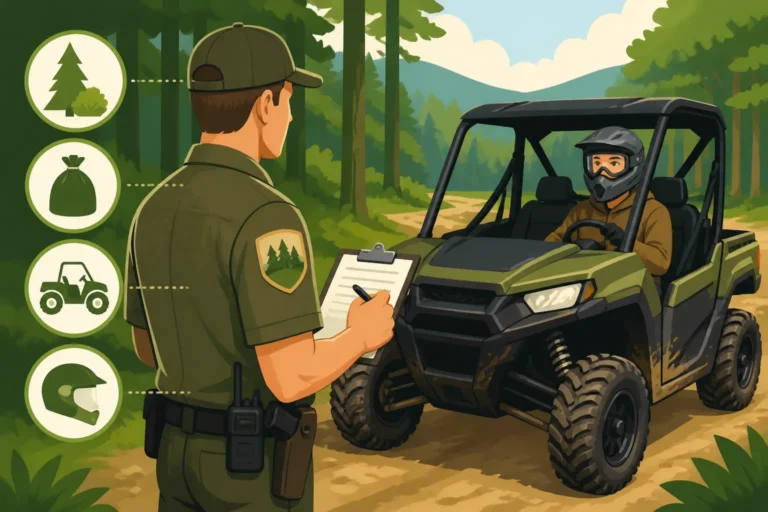
Many courses start with a walk-around inspection. Riders may be taught to look for low or damaged tires, loose parts, leaks, worn controls and other visible problems. They may also learn to check that the machine is appropriate for the planned ride and that important controls work as expected.
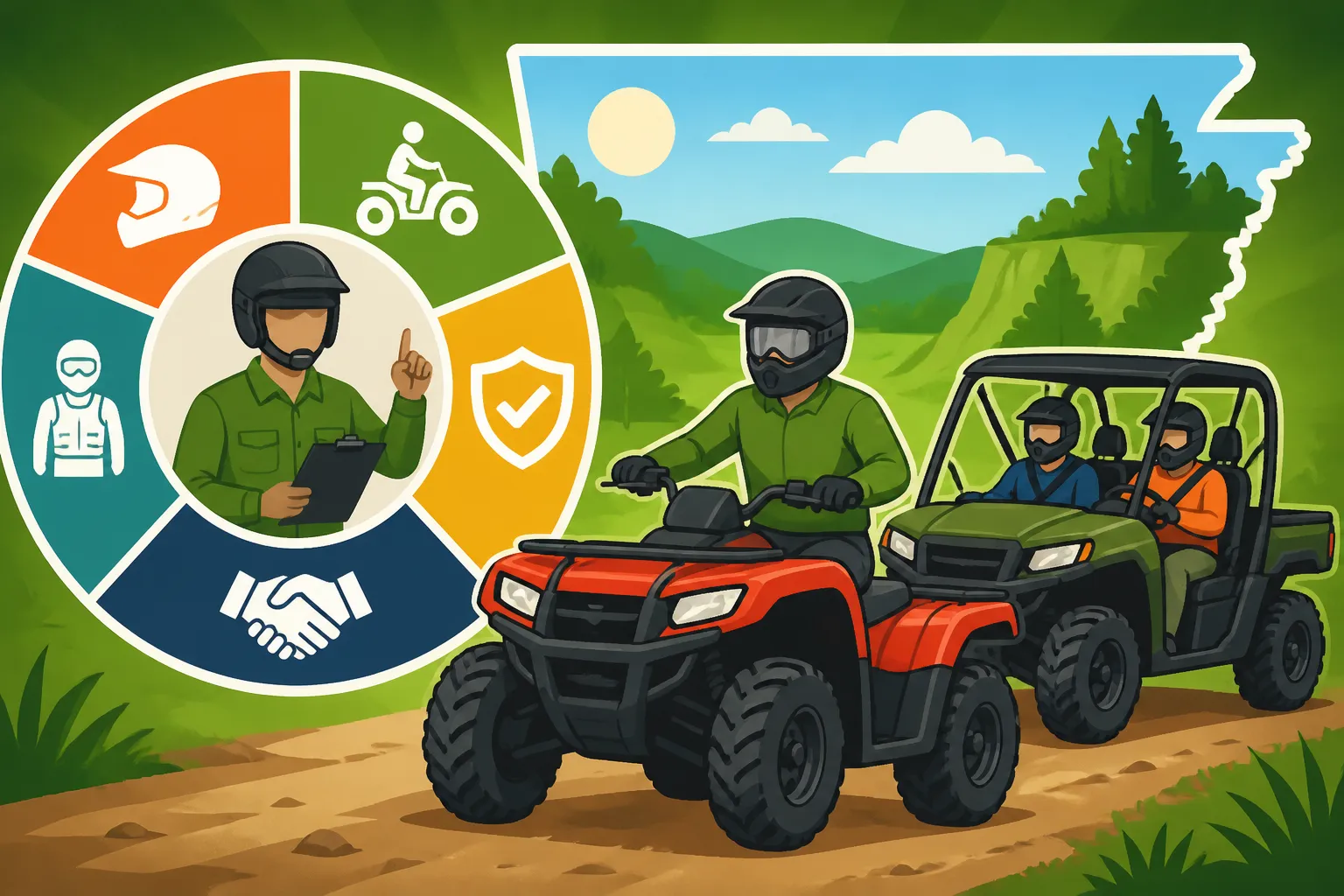
Protective equipment is another central subject. A course can explain the purpose of a properly fitted helmet, eye protection, gloves, long sleeves, long pants and sturdy footwear. The right gear depends on the machine, conditions and riding area, but leaving skin and eyes exposed to branches, grit or debris is an avoidable risk.
A safety class can also help riders distinguish between equipment intended for different activities. A helmet, goggles and clothing should fit the rider and work together; loose or poorly fitted gear may distract or fail to protect as intended. Riders should follow the course provider’s equipment guidance and any rules set by the riding area.
Controls, balance and terrain
Basic control practice is about smooth, deliberate inputs rather than speed. Riders may work on starting, stopping, turning, shifting their weight and maintaining a controlled pace. Instructors can explain how traction, slope and surface conditions affect the machine, and why a rider should slow down when visibility or grip is limited.
Terrain lessons often focus on making a decision before entering a difficult section. A rider may need to choose a safer route, stop to assess an obstacle or turn around rather than continuing. Courses may discuss hills, loose gravel, mud, rocks, ruts and water crossings, but a classroom lesson cannot guarantee that a rider can safely handle every real-world obstacle.
The machine itself matters. A small ATV, a larger quad and a side-by-side have different handling characteristics, seating arrangements and passenger considerations. Some techniques are not interchangeable. Riders should make sure the instruction applies to the type of machine they use, especially if they are moving from an ATV to a UTV or vice versa.
Judgment, communication and emergencies
A course should reinforce that safe riding includes deciding when not to ride. Fatigue, poor weather, low visibility, unfamiliar terrain, mechanical problems and pressure from a group can all make a ride riskier. Riders can learn to set a manageable pace, communicate a change of plan and stop when conditions are beyond their ability or the machine’s capability.
Group riding also brings practical safety lessons. Riders need enough space to react, a way to communicate stops or hazards, and a plan for what to do if someone falls behind. On dusty or winding trails, following too closely can reduce reaction time and visibility.
Emergency topics may include what to do after a breakdown, how to summon help and how to avoid making an injury worse. The exact instruction varies, so ask whether a course covers first aid or only general response steps. A safety course is not a substitute for carrying appropriate supplies or knowing how to contact emergency services in the area.
For riders who want more detail on equipment and field preparation, Arkansas Safety Courses That Are Voluntary and What a Safety Course Teaches are related topics to compare with the course provider’s own description.
What a Course Can and Cannot Do for Arkansas Riders
A safety course can give riders a foundation, but it does not automatically grant access to every trail or replace site-specific requirements. Arkansas riders may encounter different rules on public land, at private parks, on trails and on property they do not own. A course completion record should not be treated as a permit, registration document or substitute for permission to ride.
Arkansas does not generally require every ATV or UTV rider to complete a safety course just to ride. Still, a riding area, rental provider, event organizer or other organization may set its own conditions. Ask the place where you plan to ride what it requires, and confirm whether it recognizes the course you intend to take. The article Arkansas Has No Mandatory ATV Safety Course explains the voluntary-course point, while [Arkansas Private Park Age Minimums] and Arkansas Private Park Waiver Forms address separate park policies.
A course also cannot make an unlawful or closed route safe to use. Before a trip, check the current access rules for the specific trail or property. A forest permit, trail pass or local authorization is separate from safety training. Arkansas OHV Permits: Two Forests, Two Prices explains why riders may need to consider access requirements separately from a class.
Riders should also keep road rules distinct from trail skills. Knowing how to cross an obstacle does not authorize riding on a public road. Arkansas road access for ATVs and UTVs depends on the legal situation and, in some places, local rules. See Can You Drive an ATV on the Road in Arkansas? for the road-use question, and confirm any local ordinance that applies to the route.
Online, in-person and youth options
Online training can be convenient when the main goal is learning concepts, terminology and safety habits. It can be completed without taking a machine to a class, but it usually cannot provide the same supervised practice as an in-person session. Check whether the course includes a skills component, an assessment, or only lessons and a completion record.
An in-person course can provide a chance to ask questions and observe techniques. If there is hands-on practice, ask what machines are used, what protective gear participants need and whether the instructor expects students to bring their own machine. Do not assume every class offers riding practice simply because it meets in person.
Youth courses should match the child’s age, size and experience. A young rider needs instruction appropriate to the machine they will use, not just a condensed adult class. Parents and guardians should also understand the supervision expectations that apply where the child will ride. Arkansas Rules for Riders Under Twelve and Direct Supervision by an Adult cover related considerations; a course does not override applicable supervision rules.
For mixed-age groups, consider whether separate instruction would be more effective. Children and adults may need different pacing, examples and practice. A child who understands a lesson in a classroom may still need close supervision and a machine suited to their ability.
A course is not the same as a permit
Riders sometimes confuse a training certificate with access paperwork because both may be checked before a ride. They serve different purposes:
- Safety training teaches skills and judgment.
- A permit or pass may authorize access to a particular riding area.
- Registration or a decal may be required for the machine under applicable rules.
- Permission is needed to ride on private land that the rider does not own.
- A waiver or park rule may apply at a privately operated riding area.
A course certificate does not necessarily prove that a machine is registered or that the rider has permission to be on a property. Keep documents organized and check each requirement separately. For riding on someone else’s property, Arkansas Rules With a Landowner’s Permission offers more context.
How to Choose a Course and Put the Lessons to Use
Choose a course based on the rider, machine and type of riding—not just the shortest or most convenient option. Start by deciding whether the rider needs introductory instruction, a refresher or hands-on practice. Then compare the course outline with the situations the rider is likely to encounter.
Use this process before enrolling:
- Identify the machine. Confirm whether the course covers an ATV, a UTV or both. Ask if its examples and exercises match the machine the rider will use.
- Check the format. Find out whether the class is online, in person or a combination, and whether it includes practical skills.
- Review who the course is designed for. Look for age guidance and beginner or refresher descriptions. Ask about accommodations if the rider needs a different pace.
- Ask what completion means. Confirm whether the provider issues a record or certificate, and whether the riding area or organization you have in mind accepts it.
- Confirm equipment and participation rules. Ask what to bring, whether the provider supplies machines and protective gear, and whether a parent or guardian must attend with a minor.
- Check site requirements separately. Contact the riding area about permits, age limits, waivers, machine restrictions and current closures. Do not assume the course answers these questions.
- Practice gradually. After training, begin on terrain suited to the rider’s ability and the machine. Build skills before attempting steep, rocky or unfamiliar sections.
A course description should be specific enough to tell you what will be taught. If it only promises a certificate but says little about topics or practice, ask for the syllabus. Useful questions include: Does the course teach pre-ride inspection? Does it address passenger safety for UTVs? Will students practice on a machine? Is the instruction designed for children, adults or both? Does it cover riding in groups and responding to an emergency?
Once the rider completes a course, use the lessons before every ride. Do a walk-around inspection, choose gear, discuss the route and agree on a pace. For a group, set a simple plan for stops and regrouping. If the ride involves unfamiliar trails, check conditions and access information before leaving home. A course is most valuable when it becomes a routine, not a one-time box to check.
It is also sensible to repeat or refresh training when circumstances change. A rider who moves from a quad to a side-by-side may need instruction on passengers, seat belts and different handling. A returning rider may need a refresher after a long break. A new trail type can expose gaps in experience even when the rider is comfortable elsewhere.
No course can eliminate risk. Even trained riders can encounter changing weather, hidden hazards, mechanical failure or another person’s mistake. The practical value of training is that it helps riders recognize trouble earlier, make a conservative choice and respond more deliberately.
Frequently Asked Questions
Is an ATV safety course required in Arkansas?
A safety course is generally voluntary for ATV riders in Arkansas. A particular park, event, rental provider or organization may have its own conditions, so check directly before riding.
Does an online course include riding practice?
Not necessarily. Online courses commonly focus on lessons and knowledge, while hands-on practice depends on the provider. Review the course outline and ask before enrolling if practical instruction is important.
Is ATV training the same as UTV training?
Not always. Some courses cover both, but an ATV and a UTV have different controls, seating and passenger considerations. Confirm that the course addresses the machine the rider will operate.
Does a course certificate replace a trail permit?
No. Training, access permits, machine registration and landowner permission are separate matters. Check the requirements for the specific riding area.
Disclaimer
This article is for general informational purposes only and does not constitute professional advice. Laws, prices and regulations vary by location and change over time. Consult a qualified professional for guidance on your specific situation.