Why the Supervising Adult Must Be Eighteen or Older
When a young rider needs adult supervision, it is natural to assume the supervising adult must be eighteen or older. But the rule can depend on where you ride, and the age requirement for the rider is not the same as a stated minimum age for the supervisor. Here’s what Arkansas and federal rules establish—and what to confirm before heading out.
What Arkansas and federal rules say about supervision
Arkansas has a supervision rule for younger ATV operators, but that rule should not be confused with a separately stated minimum age for the supervising adult. According to the Arkansas General Assembly, a person must be at least twelve years old to operate an ATV without adult supervision. That establishes when a young rider may ride without supervision; it does not, by itself, establish that the adult supervising must be eighteen or older.
Federal forest rules add another location-specific distinction. According to the USDA Forest Service, operators must be at least sixteen years old to ride without constant adult supervision on federal public lands such as National Forests in Arkansas. That is a rule about the operator’s age and supervision, not confirmation of a universal minimum age for the supervising person.
This distinction matters because a statement like “children need an adult” can leave out the most important details: which land manager’s rules apply, what kind of supervision is required, and whether that agency specifies the supervisor’s age. The information available here does not establish an eighteen-or-older minimum for supervisors across Arkansas. Before relying on that threshold, check the rule for the particular riding area.
| Question | What the stated rule establishes | What it does not establish |
|---|---|---|
| When may a rider operate without adult supervision under Arkansas state law? | According to the Arkansas General Assembly, the operator must be at least twelve. | A separate minimum age for the supervising adult. |
| When may an operator ride without constant adult supervision on a National Forest? | According to the USDA Forest Service, the operator must be at least sixteen. | That every supervising adult must be eighteen or older. |
| Does one rule automatically apply everywhere? | No. State law and federal-land rules can differ by location. | That meeting one rule is enough for every trail, park, or managed area. |
If you are preparing for a ride with a young person, start with Arkansas Rules for Riders Under Twelve and Adult Supervision Rules for Arkansas Riders Under 12. Those topics help clarify the state-level supervision question. For a federal riding area, check the land manager’s rules separately rather than assuming the state rule answers every question.
Why the adult’s age can still matter
Even when a rule does not clearly state the supervisor’s minimum age, the adult’s ability to supervise is a real safety issue. A responsible adult needs to pay attention, communicate clearly, recognize when a rider is tired or overwhelmed, and respond if the machine stalls, tips, or develops a problem. A person who is technically present but distracted or unable to help may not provide meaningful supervision.
An age threshold, where an agency or riding area sets one, can also make enforcement easier. It gives families and staff a clear standard instead of asking them to judge maturity or responsibility on the spot. But that practical rationale is not a substitute for the written rule. Do not treat a common-sense expectation, a park policy, or a rule from another state as proof of Arkansas law.
It also helps to separate supervision from riding permission. An adult may be able to supervise a young rider while still needing the landowner’s permission, following a park’s own policies, and keeping the machine on routes open to motorized use. Supervision does not make a closed road or trail available, and it does not replace required permits.
Why the riding location changes the answer
A ride may involve state law, federal land rules, a private park’s policies, or a combination of them. The relevant rule depends on who manages the land and where the machine will operate. A family riding on private property should not assume the same procedures apply at a National Forest trailhead, and a forest rule should not automatically be applied to a private park.
On National Forest land, follow the USDA Forest Service rules for that forest and trail system. The agency’s operator-age rule for riding without constant adult supervision is not the only requirement to check. Routes, vehicle restrictions, seasonal access, and trail permits can vary. For example, the USDA Forest Service requires a day-use fee or permit on specific Ozark-St. Francis National Forest trail systems, including Mill Creek and Moccasin Gap. A permit requirement and a supervision rule address different issues, so satisfying one does not satisfy the other.
Visitors from out of state should be especially careful not to assume that a home-state age rule controls in Arkansas. According to the USDA Forest Service, a separate state OHV registration or trail permit is generally not required for nonresidents using designated routes on federal public lands in Arkansas, but rules and entry permits can differ on land managed by another agency. The same principle applies to supervision: identify the manager for the exact place you plan to ride and check its requirements.
The land manager can also change within a broader region. The National Park Service oversees regulations within the boundaries of Buffalo National River. A nearby forest or trail may have a different manager and different rules. If a route crosses between managed areas, confirm the rules for each part of the planned ride rather than relying on a single answer.
For help distinguishing a required permit from a riding rule, see Arkansas Riders Need Two Different Forest Passes and Arkansas Permits for Riders Under Twelve. If your trip includes state-managed wildlife land, review Arkansas AGFC WMA Rules for Riders as well. These are separate checks from the adult-supervision question, but each can affect whether and where you may ride.
Ask the right question
A vague question such as “Does my child need an adult?” may not get you a complete answer. Contact the office or operator responsible for the riding area and ask:
- What is the minimum operator age for this route or property?
- Does the rider need an adult with them, or must the adult maintain constant supervision?
- Does the written rule set a minimum age for the supervising adult?
- Does the adult need to be on the same machine, or is another form of supervision allowed?
- Are there separate rules for private parks, state-managed areas, or federal land?
- Are permits, route restrictions, or vehicle requirements relevant to this ride?
Get the answer for the exact location, not just a general answer about Arkansas. If staff describe a policy, ask whether it is a state rule, a federal land-management rule, or the riding area’s own condition of entry. That distinction helps explain why one rule may apply at one trailhead but not another.
How to supervise a young rider responsibly
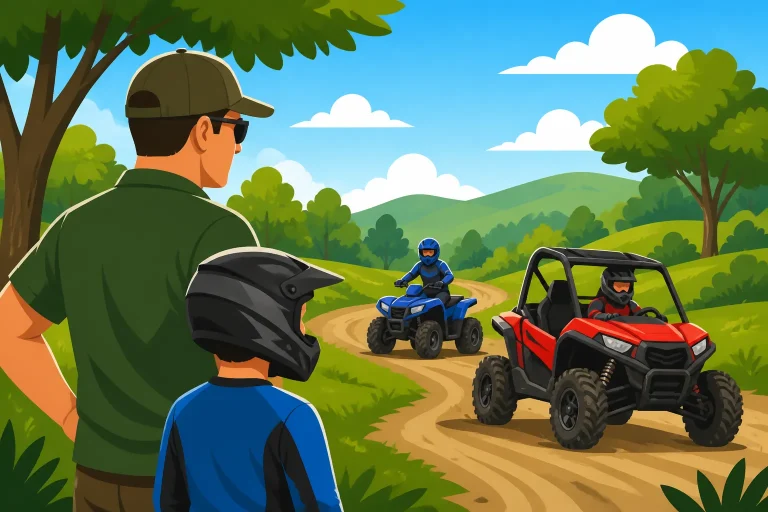
Whatever minimums apply, supervision should be active and matched to the rider’s skill. A young person who has never used a machine before may need closer attention than a confident rider who knows the route. The supervising adult should understand the machine’s controls, know how to stop it safely, and be ready to intervene without putting either person in a more dangerous position.
Before riding, agree on simple instructions: where the rider may go, when to stop, how to signal a problem, and what to do if the adult is out of sight. Keep the plan realistic for the terrain and the rider’s abilities. A difficult route, poor visibility, fatigue, or changing weather can make it harder to supervise effectively.
A practical preparation routine can help:
- Check the specific property’s age, supervision, equipment, and access rules.
- Explain the controls and safe stopping procedure before the machine moves.
- Choose a route that fits the rider’s experience and the machine.
- Keep communication clear and agree on how to handle a separation or breakdown.
- Stop the ride if the rider is tired, frightened, or unable to follow instructions.
A safety course can also help a new rider understand basic operating habits, even when a course is not the same thing as a permit or supervision requirement. See Arkansas Safety Courses That Are Voluntary for more on the difference between optional training and rules that govern a particular ride. For younger children, Arkansas Supervision Rules for Small Children may help you prepare questions about direct oversight.
Finally, do not let the word “adult” do too much work. It may describe the general role expected of a supervisor, but the exact legal age, required closeness, and responsibility can depend on the applicable rule. The available state and federal rules establish ages for when an operator may ride without supervision; they do not establish a single Arkansas-wide age threshold of eighteen or older for every supervising adult. Confirm that specific requirement with the agency or property manager before you ride.
Sources
- National Park Service — Buffalo National River (checked November 2, 2026)
- Arkansas General Assembly / United States Department of Agriculture Forest Service — Arkansas Code § 27-21-107 / Off-highway Vehicle Touring (checked November 2, 2026)
Disclaimer
This article is for general informational purposes only and does not constitute professional advice. Laws, prices and regulations vary by location and change over time. Consult a qualified professional for guidance on your specific situation.