Arkansas Rules for a Six-Year-Old Rider
A six-year-old may be eager to ride, but age is only one part of the decision. Arkansas rules, the machine’s design, the riding location and the level of adult supervision all matter. Here’s how to think through whether a six-year-old can operate an ATV, what changes on public land or at a private park, and how to reduce the risks before the engine starts.
Can a six-year-old operate an ATV in Arkansas?
Arkansas has a supervision rule for young ATV operators: a rider under twelve must be under the direct supervision of an adult. That does not mean every six-year-old is ready to operate a machine, or that supervision makes every location legal. The land, trail rules and machine’s intended age range still matter.
Direct supervision should mean the adult can see the child and respond immediately, not simply remain somewhere on the property or wait at the trailhead. The adult should be close enough to stop the ride if the child loses control, approaches a hazard or ignores instructions. Review Direct Supervision by an Adult and Why the Supervising Adult Must Be Eighteen or Older for more on what meaningful supervision involves.
The age rule is a legal minimum condition, not a recommendation that a six-year-old ride. A child’s coordination, judgment, strength, experience and ability to follow directions vary widely. A young rider may be unable to reach or use the controls reliably, recognize changing terrain, or react quickly when the machine tips or slides. If the child cannot demonstrate safe control in a calm, open practice area, do not move on to a trail.
It also helps to separate operating an ATV from riding as a passenger. A child should not ride as a passenger on a quad that is designed for one person. A passenger belongs only on a machine built and equipped for passengers, and only if the child can sit securely, reach the handholds and footrests, and follow the manufacturer’s instructions. A side-by-side may have a passenger seat, but that does not automatically mean every child fits safely.
| Situation | What to check before riding |
|---|---|
| Six-year-old operating an ATV | Direct adult supervision, manufacturer’s age guidance, the child’s ability to control the machine, and permission to ride on that land |
| Child riding as a passenger | Whether the machine is designed for passengers and whether the child fits securely in the seat and restraints |
| Riding on a public trail or forest road | Current land-manager rules, machine requirements, permits and any posted closures |
| Riding at a private park | The park’s minimum age, machine restrictions, waiver, equipment and supervision rules |
| Riding on a road | Do not assume registration or an off-road permit makes road riding legal; Arkansas generally restricts ATV road use, with limited exceptions |
For a closer look at the broader age rules, see Arkansas Rules for Riders Under Twelve. If the child is a passenger rather than the operator, check the separate guidance in Arkansas Rules for a Child Passenger. The right answer can differ between a private property ride, a managed trail and a commercial park.
Where a six-year-old may ride, and what changes by location
Permission to operate under adult supervision does not provide permission to ride anywhere. Landowners, public-land agencies, trail operators and local authorities can each set rules that affect a six-year-old. Before loading the machine, identify who manages the riding area and check the rules for that exact site.
Private property
On private land, confirm that the owner allows the child to ride and that the route is suitable for a beginner. A parent’s property is not automatically safe: slopes, ditches, fences, livestock, vehicles and hidden obstacles can create hazards even in a familiar yard. Start in a broad, level area away from roads, water, buildings and other riders.
If the family is riding on someone else’s land, get permission and ask where riding is allowed. Permission to be on the property does not necessarily mean permission to use every trail or cross every field. Arkansas Rules on a Parent’s Property and Arkansas Rules With a Landowner’s Permission explain why the land arrangement matters.
Public trails and national forest land
Public riding areas often have their own access rules, and some restrictions concern the machine rather than the rider’s age. Check whether the trail is open, whether the ATV or UTV fits any width or equipment requirements, and whether the area requires a permit. A permit generally does not cancel the need to obey age, supervision, safety or trail restrictions.
Arkansas has separate forest OHV permit systems for the Ouachita National Forest and the Ozark-St. Francis National Forest. Do not assume a pass for one forest covers the other. Permit requirements are tied to where and how the machine is used, not a substitute for checking whether a six-year-old may ride there. See Arkansas Riders Need Two Different Forest Passes and Arkansas WMA Vehicle Rules in Plain English before planning a public-land ride.
Wildlife management areas can have additional vehicle restrictions. Some roads or routes may be open under specific conditions, while gated roads, levees, food plots and other areas can be closed to riding. A child being supervised does not override a closure or a restriction on the vehicle. Check the current rules for the particular area rather than relying on what another rider says was allowed on a previous visit.
Private off-road parks
A private park can set a stricter minimum age than the general state rule, limit the kinds of machines young riders may use, or require a parent or guardian to complete paperwork. The park might also require specific helmets, protective gear, waivers or supervision arrangements. Rules can differ from one facility to another, so contact the park before making the drive.
Ask specifically whether a six-year-old can operate a machine, whether a parent must ride alongside, and whether the child may use a family-owned ATV or only a designated youth machine. If the child will be a passenger, ask about seat and restraint requirements. The park’s answer should apply to the exact machine and riding area you plan to use. Arkansas Private Park Age Minimums and [Arkansas Private Park Helmet Rules] are useful starting points, but confirm the facility’s current rules directly.
Choosing equipment and supervising the ride
A six-year-old should never be placed on a full-size ATV simply because an adult can supervise from nearby. Choose a machine the manufacturer identifies as appropriate for the child’s age and size, and make sure the child can operate its controls as intended. Follow the owner’s manual; do not modify the machine in a way that defeats its safety features or makes it harder to control.
Before riding, check that the child can sit in the correct position, keep both hands on the handlebars and place both feet securely on the footrests. The child should be able to operate the controls without stretching or shifting dangerously. If the child cannot reach a control, hold a stable riding position, or follow a stop instruction, the machine is not a suitable fit.
Start with a short, controlled practice
A first ride should happen on private, level ground with plenty of open space and no traffic or bystanders in the riding path. Explain one instruction at a time, including how to stop, where to look and what to do if the machine starts to feel unstable. Keep the practice short. Fatigue and excitement can reduce a child’s attention before an adult expects it.
A practical progression is:
- Review the controls and the stop command while the machine is off.
- Have the child practice sitting correctly and using the controls without moving.
- Begin at a very slow pace in a clear, level area.
- Practice stopping and turning gently before introducing uneven ground.
- End the session as soon as the child becomes tired, distracted or reluctant.
An adult should remain close enough to intervene and should not supervise while distracted by a phone, another vehicle or a separate task. Do not let children ride in a group where faster, larger machines can crowd or pressure them. Give the young rider a clear route and keep other riders well separated.
Helmet and protective gear
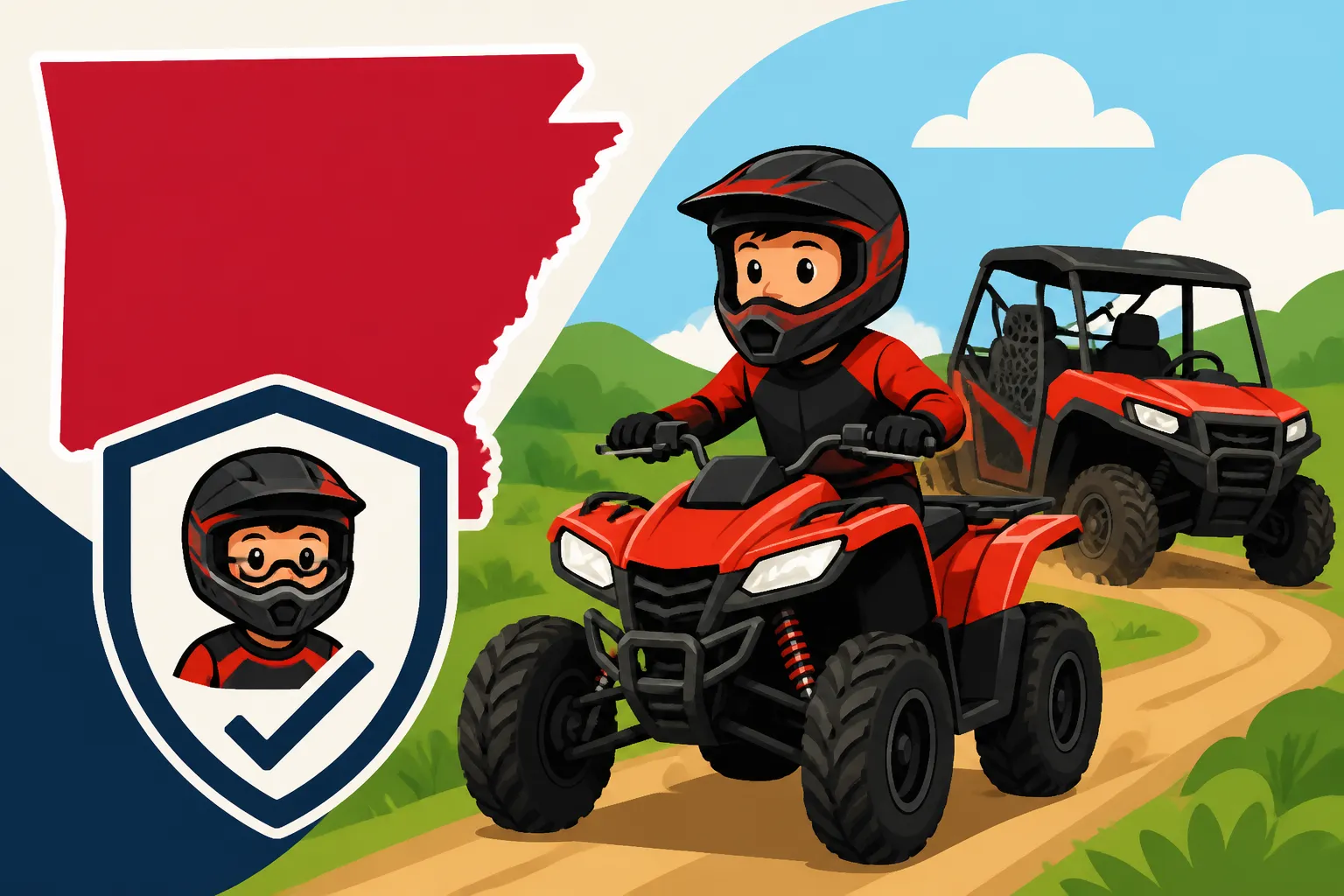
Use a properly fitted, motorcycle-style helmet that meets recognized safety standards, along with eye protection, gloves, long sleeves, long pants and sturdy over-the-ankle footwear. A helmet that shifts, blocks the child’s vision or does not fit securely is not protective equipment that should be relied on. Retailers such as Amazon may carry youth helmets, but the buyer still needs to verify the fit, safety labeling and suitability for the activity.
Arkansas does not have a general ATV helmet law, but a trail operator or private park may set its own helmet requirements. Even where a helmet is not legally required, wearing one is a sensible safety choice for a child. Read Arkansas Has No ATV Helmet Law alongside the land manager’s current rules, and do not treat the absence of a statewide helmet mandate as a reason to ride without one.
Protective gear is only one part of a safe setup. Avoid riding near roads, steep drops, water, trees or other hazards that leave little room to correct a mistake. Keep the machine’s speed low, use only terrain that matches the child’s ability, and stop the ride when conditions change. Mud, loose gravel, poor visibility and wet slopes can turn an easy route into a difficult one.
Arkansas does not require an ATV safety course for every rider, but training can help a young child learn basic habits in a controlled setting. A course may not be designed for a six-year-old, so check the instructor’s minimum age and suitability before enrolling. See Arkansas Safety Courses That Are Voluntary for background, and follow the machine manufacturer’s guidance as well.
A pre-ride checklist for parents and guardians
A short check before each ride helps catch problems that age and experience alone will not. Rules can vary by riding area, and conditions can change, so confirm access requirements before leaving home. If a rule is unclear, contact the land manager or park rather than assuming a child is allowed to ride.
Before the child operates or rides as a passenger, confirm:
- The role is clear: Is the child operating the machine or riding as a passenger? The machine must be designed for that role.
- The adult can supervise directly: The supervising adult can watch continuously and intervene promptly.
- The machine fits the child: The child can reach the controls, maintain a stable position and follow the manufacturer’s instructions.
- The location allows it: The landowner, trail manager or park permits the child’s age and the planned activity.
- The route is appropriate: The surface is manageable for a beginner, with room to stop and no nearby traffic or severe hazards.
- The equipment fits: Helmet, eye protection, gloves, clothing and footwear are suitable and secure.
- The machine is ready: Check the brakes, throttle, tires, controls and other basic items described in the owner’s manual.
- The child understands the rules: The child knows how to stop, where to ride and when to wait for the adult.
- Everyone knows the limits: Set a clear stopping point and end the ride if the child is tired, upset or no longer following instructions.
- Permits and access are settled: Confirm required passes and any trail restrictions for the particular riding area.
For forest or WMA riding, check the rules close to the trip date because closures, access conditions and permit details may change. A pass or decal may be required for a machine, but it does not make a closed route open or make an unsuitable machine appropriate for a six-year-old. For the basics of forest access, How to Buy an Arkansas Forest OHV Permit can help you understand what to check before traveling.
The safest decision may be to wait. If the child cannot operate an age-appropriate machine confidently at low speed, cannot follow directions consistently, or does not fit safely as a passenger, choose another activity for now. The legal supervision rule is a minimum safeguard; the adult still has to decide whether the specific child, machine and location make the ride reasonable.
Disclaimer
This article is for general informational purposes only and does not constitute professional advice. Laws, prices and regulations vary by location and change over time. Consult a qualified professional for guidance on your specific situation.